Branding is relational, not transactional. It's about retention, not acquisition. I work with companies and governments to identify and develop the strategies required to build the relationships that ensure ongoing branding success.
I call it data driven branding & it should not be confused with creative driven branding.
I'm also a rugby nut & devoted family man, probably in that order, but don't tell my wife!
“You’ll find many ‘marketers’ pushing their social and interactive expertise with little true marketing experience in their backgrounds. This results in tactically driven campaigns that do not support a company brand promise or any kind of overarching strategy. It’s talking for the sake of having a mouth – but ultimately saying nothing.”
CEOs and or CMOs, already under pressure time wise, are giving too much responsibility to creative advertising agencies to manage their brands. This is a sweeping generalisation but the fact is creative advertising agencies do creative advertising because that’s all they do. Good luck to them but creativity design alone cannot build a brand.
Brand strategy is being sacrificed for speed, creativity, originality and one off tactics that have no longevity. Shareholders and consumers are the losers.
Dr Jim Hamill, IBM, GARTNER, MOSTI & OTHER HIGH-PROFILE THOUGHT LEADERS TO HIGHLIGHT FIRST ASEAN SOCIAL BUSINESS SUMMIT
A premier 1-day event in Malaysia to provide business and government with insights, case studies & useful tips for high-ROI innovation and collaboration
High-profile international speakers at the premier event, whose theme is “where innovation and collaboration meet,” include IBM, Gartner, MOSTI (Ministry of Science, Technology and Innovation) and other Social Business leaders. Presentations include case studies, strategic insights and hands-on advice and tips about optimizing innovation and collaboration. ECS, an IBM Business Partner, is a Gold Sponsor of the event.
The keynote speaker, one of the foremost world experts on Social Business, is Dr Jim Hamill, Business Fellow at the University of Strathclyde Business School. Dr. Hamill will present a case study about a UK public company that leveraged both a Balanced Scorecard and Social Business to improve operations.
International business and government leaders such as GE, Australian Bureau of Statistics, CEMEX, China Telecom, Asian Paints, HP, DHL, Shell, NBCUniversal and many more have turned to Social Business to streamline organizational processes, enhance customer collaboration, speed information flow, fast-track innovation and improve access to expertise.
According to a study by McKinsey & Co., “We asked 4,200 global executives how organizations deploy [Social Business] and the benefits it confers. When adopted at scale & integrated into work processes, social technologies can boost a company’s financial performance and market share, respondents say.” As a result of these benefits, Forrester estimates that the Social Business market will increase 61% through 2016.
Major speakers and topics include:
• Dave Aron, Gartner: “Impact of Social on Business Models: Broad and Deep”
• Brian Cheng, IBM: “4 major trends shaping Social Business 2013 and beyond”
• Cuneyt Uysal, Newsgator: “Collaboration: It’s not only about future work, but also how the future works”
• Azim Pawanchik, Alpha Catalyst Consulting (ACC): “Case study: Using Open Innovation to expand the Social Business ecosystem”
A limited number of sponsorships for this high-profile, high-value event remain available. For more information, contact me marcus(at)fusionbrand.com.
The event fee is RM1,500. Early-bird and other discounts from 20-35% are available. For more details and registration, visit: www.socialbizsummit.com
Please note: Social Business refers to enterprise collaboration & innovation that use social technologies to boost corporate, customer and social value. Social Business does NOT refer to social marketing (PR) or social entrepreneurship (helping rural businesses).
If you are responsible for a country or destination brand, read on.
As cheap air travel and the package tour (as well as the devaluation of the Spanish Peseta and the abolition of currency controls in the UK) helped jump start international travel in the 1960s, 1970s and 1980s, the world was still a fairly predictable place and countries were, on the whole inhabited mainly by citizens of that country and not by the multicultural citizens living in most cities today.
Moreover, due to the social and economic structure of Western countries, consumers were only just beginning to have disposable income that allowed them to experience the concept of leisure time.
At the same time, mass media was becoming increasingly influential as consumers purchased more and more TVs and radios.
So, with more disposable income, more leisure time and the establishment of commercial television, it was now possible to reach large swathes of a population reasonably quickly and relatively inexpensively.
In this environment countries put their faith in creativity to build brands, hoping that an exotic image, tagline or promotion would resonate with prospects and increase visitor arrivals.
And generally, because of the cultural and social predictability of countries, the same message could be used to communicate with everyone.
Moreover, with few conduits to increasingly wealthy consumers who had more disposable income than ever before and with limited competition in the market place, this type of creative driven branding often raised the profile of countries enough to attract visitors.
Countries and destinations such as Spain, the UK, Kenya, Florida, Greece, The Algarve, Singapore and Italy as well as many other destinations used this approach. And in this mass market economy, mass media – TV, Print, Outdoor, with its huge reach, was the logical vehicle to enhance the impact of creative-driven branding with reach and repetition.
Early tourism ads worked because markets were similar, new, eager and easy to reach
But that mass-market economy no longer exists. Today’s consumers are increasingly overwhelmed with those creative images, taglines and promotions. And many of the messages have become so similar that it is virtually impossible to differentiate one from another. And of course, consumers have also become fed up with countries failing to deliver on promises made.
Despite this new world order, countries, agencies and consultants continue to try and build country brands by using ‘cool’ advertising, creative or symbolic logo’s with pretty colours, catchy taglines and so on.
But these activities are nothing more than advertising campaigns and do very little to build a nation brand. And even the one’s that have made us sit up, take notice and seek more information are more often than not soon forgotten or overtaken by a new campaign from a competitor destination or the recommendation of a friend.
But most worrying of all, these advertising campaigns lull countries into a false sense of security. ‘Visitor arrivals are up so everything is good in the world’. The problem is that an advertising campaign might draw the attention of visitors to a destination but it doesn’t build a destination brand.
An advertising campaign may be important but it is part of what should be a well researched and planned brand strategy that takes into account all brand related activities.
These include internal buy in and a thorough understanding of external stakeholder requirements for value and other elements such as content development, social media, PR and most important of all for a country, crisis management. Traditional communications pushed out across traditional and digital media, may still have a role to play, but they are not a total solution.
Sadly, too many countries and destinations have short cut the process to try and get their ads out quickly. This has resulted in the demise of the brand strategy. Yet failure to invest in such a brand strategy can be detrimental to the long term success of the brand.
A case in point. The Maldives has invested more than US$10 million in the last three years on advertising itself as a luxury destination. But in 2012, political turmoil saw arrivals from the lucrative European markets fall, with the UK registering a 12.2% drop. If it weren’t for a sharp rise in low yield arrivals from China, the Maldives would probably have registered a major drop in arrivals.
To the detriment of the country, participants or perhaps victims of the political turmoil in the Maldives called for a boycott of the tourism business and attempts by the new government to develop the tourism business are constantly thwarted by opponents.
One example was when the Twitter hashtag #sunnysideoflife (the official tagline) was hijacked and brochures entitled ‘The cloudy side of life’ threw scorn on tourism players and drew the readers attention to human rights abuses and police brutality against Maldivians.
This year has seen further negative press after a 15 year old girl raped by her stepfather and sexually abused by other men was sentenced to 100 lashes for having pre marital sex.
So far the Maldives government hasn’t responded, leading one to suspect they don’t have a brand strategy with a crisis plan to deal with such a situation. What is certainly true is that this complicated issue will not be solved with an advertising campaign.
In 2012 Jakarta initiated an advertising campaign across Asia in an attempt to attract visitors to the capital and largest city in Indonesia. The campaign was poorly planned, conceived and executed. You can read more about the Jakarta campaign here.
Based on the advertising campaign and the website, it is fairly safe to assume these two elements were not part of a brand strategy.
Does this ad make you want to get more information on Jakarta?Lack of integration and poor content suggests little or no planning
India is famous for its ‘Incredible India’ campaign launched in 2002. By 2009, India was spending US$200 million advertising the country. This iconic advertising campaign is still going strong and in November 2012 at the World Travel Market in London and to great fanfare, India announced a new advertising campaign headlined, “Find what you seek”.
Early ‘incredible India’ ads – excellent execution
Officially launched by the new Indian minister of tourism at a hotel in London in front of 400 guests, the new Incredible India campaign highlighted to consumers ‘that they will find whatever they are looking for from a holiday in India.’
It was also announced at the launch event that the goal of the campaign is to increase international arrivals by 12% annual till 2016.
Little more than a month later, in December 2012 in Delhi a woman was brutally gang raped and left for dead on a public bus. The story made headlines around the world.
And then in March 2013, a Swiss woman was gang raped whilst on a cycling tour of Madhya Pradesh and soon after, a British woman was attacked in Delhi and only avoided further suffering after jumping from a hotel window to escape.
Within a matter of weeks, tour operators were reporting a 35% cancellation rate from women and a 25% drop in all arrivals with multiple cancellations from the lucrative markets of Australia, the UK, Canada and the United States.
Much of the outrage toward these events is related to the treatment of woman in India and numerous stories that would not normally feature on international news are now making headlines globally including the stoning, arrests and murder of Indian women. None of these events will be addressed by advertising.
If you are responsible for developing a Nation, country or destination brand, don’t allow yourself to be lulled into a false sense of security over a ‘successful’ advertising and promotions campaign telling the world how great is your country or destination.
To build a strong brand amid increasing international competition and unforeseen circumstances that are carried across social media and possibly across mass media as well, destinations must have in place a well defined brand strategy that covers all potential scenarios and doesn’t just focus on communications.
A brand strategy has other benefits. Here are five more reasons for developing a brand strategy:
1) A brand strategy clearly defines the organisation values and promises and ensures stakeholders understand what is required of them to deliver on those promises and values. For a nation brand this internal branding is critical to the success of the brand.
2) Staying with the internal brand, lots of tourism boards and CVBs attend trade shows but if I had a pound for every time I’ve been to ITB or WTM and seen poorly trained personnel representing countries or states, I’d be a very wealthy man. Trade shows cost a lot of money. A brand strategy will ensure training occurs at the best possible time.
3) A brand strategy ensures the brand is ready for every eventuality, with a crisis plan to address issues such as those that have happened in India, the Maldives and most recently, Boston.
4) A brand strategy ensures all stakeholders are pulling in the same direction. If one state is targeting visitors at the same time as another state, resources are being wasted. A brand strategy will ensure integration and engagement, not individual tactics.
5) A brand strategy ensures time isn’t wasted on stand alone tactical initiatives implemented at the whim of a government servant or other person who should know better.
Far too many countries or destinations give the responsibility of building their brand to creative advertising agencies. These agencies are called advertising agencies for a reason. They do advertising.
A couple of years ago I wrote a blog post about negative brand association. You can read the story here.
I hate to say ‘I told you so’ but I’ve always said that in the social economy, the concept of using communications to try and position a product or service in the mind of a consumer is fraught with danger because it can backfire in many ways.
When I last discussed this issue, I mentioned a video on the BBC website that featured a drunk driver in China who was caught on film smashing into road dividers and barricades.
That video story was preceded by a commercial for Lexus! Here is a still image from the end of the commercial.
Negative brand association – Lexus and drunk drivers
Interestingly, the story is still online but now the video is preceded by a commercial for the Philippines with an amusing if a little tactless play on the concept of parking! Which would suggest the ad placement is left to the media owner.
India spent millions and millions of dollars positioning the country as an incredible destination only for all their hard work to be undone in a matter of months this year as report after report came out about the rape and murder of women, tourists and children.
More recently, Facebook has been criticised not only for featuring customer ads on controversial sites, but also for reacting slowly to complaints from customers.
Dove, owned by Unilever the global Multinational Corporation that spends over US$1.5 billion per year on advertising, with an increasingly large percentage spent online was said to be furious when its ads on Facebook were featured on controversial group pages such as ‘Drop kicking sluts in the teeth’ and ‘Raping’.
Vodafone, another advertiser with a global marketing budget in excess of US$1.3 billion was particularly miffed when its ads appeared on the offensive Facebook page ‘This is why Indian girls are raped’.
It’s the responsibility of brands to know where their ads are placed
Another advertiser affected in a similar way announced that it would review it’s advertising if Facebook could not ensure this didn’t happen again.
Facebook’s revenue from advertising in the last quarter was an impressive US$1.33 billion, up 41% on the previous quarter.
If Facebook wants to continue to see such massive increases in advertising revenue, it needs to sort out its processes and systems.
But it’s also the responsibility of CEOs, brand owners and managers who need to understand that in the social economy, using traditional methods to try and position brands is a lazy approach and unless they start to take control of their brands, the platforms they use and the way they communicate, they may find that their brands will suffer in the long term.
They will probably blame their advertising or media agency and they have a point but the real responsibility lies with them, the brand owner.
John Cullen runs an Internet marketing company out of Ohio in the US. He dropped by my blog and out of courtesy I had a look at his. He also liked the ‘about me’ page on my blog. I’m not sure if I should be happy with that because I hope he liked some of branding related stuff too!
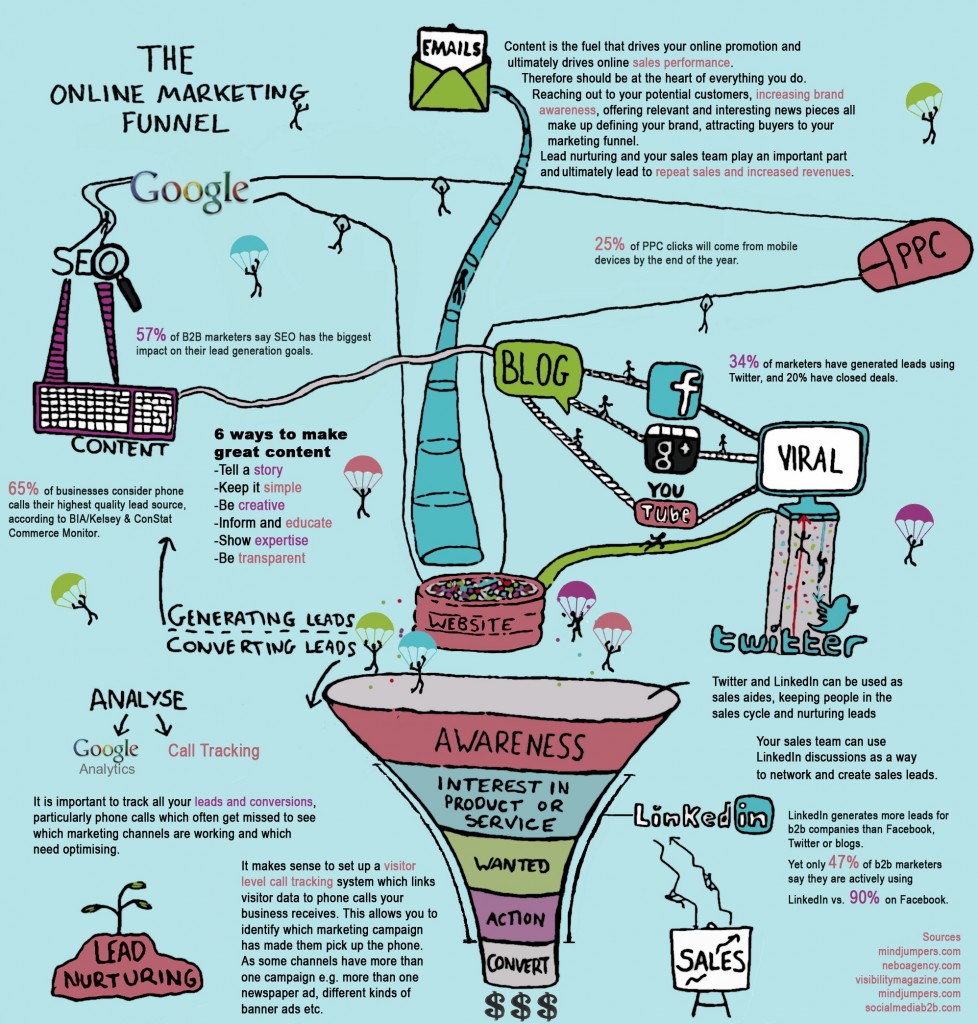
Anyway on his blog I came across this excellent infographic that explains the online marketing funnel.
Online marketing funnel
This fascinating infographic is useful because it shows the importance of digital marketing when building a brand, not through advertising but through the use of content and yet it also shows how important traditional tools such as the telephone are in the brand building process.
It also shows how important it is to use the right tools for the right sector. For instance, Linkedin generates more leads for B2B companies than Facebook, twitter or blogs yet only 47% of B2B marketers say they are active on Linkedin compared with 90% who are active on Facebook.
All you need to know to start building your brand online. Check out response tap for more on this topic.
The concept of the April Fools Day joke has had something of a renaissance with the advent of the Internet. Many brands take it very seriously as they try to out do each other with varying levels of success. Google is always up there and this year Twitter also scored well in the original stakes. But the traditional media companies also performed well this year.
Here is my top 5 of this year’s gags.
5) Youtube is shutting down
4) Google now has a search by smell feature (still in beta stage) Google adds the new ‘scentsation’ in search
3) The Guardian newspaper in the UK launched a product a pair of Web-connected ‘augmented reality’ spectacles that will beam content directly into the wearer’s visual field, enabling users to see the world through the Guardian’s eyes at all times. Now we can all groan
2) Apple to release a unisex scent that smells like Steve Jobs. This report came from Macworld in the UK (I’m not sure if it refers to when he was alive or now) Now you can smell like him
1) Richard Branson announces Virgin has developed new technology that will see the production of glass bottomed planes The ‘drawings’ for the glass bottomed plane
1) Research is more important than ever.
Research has always been important but it was cumbersome and time consuming. Not any more. Today, the right research can be developed and implemented and results analysed quickly and efficiently.
Brand building – don’t run before you can walk
It’s easy to find those people who are likely to like your product. It’s even easier to talk to them. But too many companies don’t bother, preferring to chase the holy grail of more new customers through corporate driven messages.
And don’t forget your existing customers because they are your best source of information. Talk to them, find out what they are looking for, what they value and match attributes to their requirements for value.
2) Mass market branding with a focus on the 4 Ps is no longer effective.
Brands today are built on delivering economic, experiential and emotional value. Not on creating some cool position and communicating it across as many channels as possible for as long as possible.
Deliver that value with stories that resonate with target markets and existing customers. Build relationships with customers by allowing access to the brand, personalizing all elements of all interactions, through relevance, experiences and emotions.
Ignore the social element of the social economy by trying to speak to everyone with one corporate driven message and you will fail.
3) Focus on developing more profitable relationships, not a more profitable product. Brands evolve when companies start buying for customers instead of selling to them. This is especially true in times of economic hardship.
4) Branding is an organisational issue not a departmental responsibility.
And the organisation is the responsibility of the CEO. The CEO needs to be involved in the development of the corporate brand.
Your brand is too important to be left to a marketing department that still believes in the corporate driven message over the engagement of the consumer.
And once you’ve built a brand, don’t rest on your laurels, continue to innovate or you will be left behind.
5) Retention is key to brand building.
Companies no longer sell products, customers buy them. And once customers have bought a product, companies must do everything possible to hang onto those customers. After all, you’ve investment a lot of money to gain a customer, why let them go?
Especially as the more time a customer spends with you, the more money they will spend with you.
I’m a brand consultant (that’s brand consultant not advertising agency marketing itself as a brand consultant – you can learn the difference here).
We’ve worked with many elements of the Malaysia Nation Brand and were once appointed to develop the Malaysia Nation Brand. Unfortunately, due to one of those cruel twists of fate and through no fault of our own, the project was cancelled.
However we still track developments in this space and are confident once those who are currently responsible for developing the Brand realise it can’t be built using communications and traditional tools such as PR and advertising, we will be called in again.
At the heart of our approach is the need to carry out brand audits to identify perception gaps, seek data on where the country is going wrong (and right), identify organisational issues that impact the brand delivery, recommendations for improvement and more. These brand audits require both qualitative and quantitative research including talking to relevant stakeholders including citizens.
These brand audits are critical to the success of a Nation Branding exercise. There are other principles involved and for more information on those, please read this post.
In addition to the brand audits and because no private sector organisation is going to develop a Nation brand strategy, the process also requires a heavy investment by the government in something that is strategic even though most governments have a tactical outlook. Finally, a Nation Brand strategy also requires investment in new activities, tools and departments and inculcating new cultures into those departments.
One of those new departments set up by the Malaysian Government is TalentCorp. Talentcorp is tasked with attracting top talent working abroad to return to Malaysia. It was a sensible idea to set up TalentCorp and although it is finding the going tough, it is having some success.
Recently though, I came across a rather scathing letter in the combative online news portal Malaysia today from a Malaysian citizen living abroad who had been invited to an event hosted by TalentCorp in Qatar.
Although the letter is not very complimentary, I hope that TalentCorp will be happy to receive this feedback and will use it to improve what is, like any organisation, big or small, new or established a work in progress.
But I do find it puzzling that the writer felt the need to write to news portal rather than the company itself. Surely if one’s intentions are honourable, then any such feedback should be sent directly to the organisation? If one has issues with the way something is done, why not write, at least initially anyway, directly to the organisation and not use a popular soapbox to air one’s grievances.
TalentCorp cannot be expected to achieve miracles but it is attempting to reverse the brain drain, which by the way is not unique to Malaysia – 500,000 wealthy Brits have left or are leaving the UK. Last year a survey there said 48% of Brits would leave if they could. The first thing Aussies do when they get the chance is leave the country. Almost 4 million Canadians live abroad.
The writer comments on the Malaysian education system and other related issues. But TalentCorp is not responsible for overhauling the education system or for addressing the “systematic discrimination amongst employers” – That’s a sweeping generalisation by the way. TalentCorp is responsible for encouraging Malaysians to come home.
Another comment in the letter states, “there is bias in the Malaysian oil and gas sector that allows certain foreign nationals to dominate various technical sectors.” I’d like to know more about this point because oil companies answer to shareholders. They need the best people at the best price. 30 years ago the majority of oil industry engineers were British with some Lebanese but mostly British.
Far sighted governments in India and the Philippines may have spotted an opportunity to encourage universities to develop courses to create engineers who now dominate many industries. If Malaysia missed the boat, it’s a shame but that isn’t TalentCorp’s fault.
Nor is it TalentCorp’s fault that many Malaysian graduates ‘are not up to the high standards required by the energy sector’. If it is true, it’s also not TalentCorp’s fault that ‘there is bias in the Malaysian oil and gas sector that allows certain foreign nationals to dominate various technical sectors’.
I also don’t think it is TalentCorp’s responsibility to improve the Malaysian job market. I also don’t think it is the responsibility of the Malaysian government to challenge the private sector. The issue with employers in Malaysia is a complex one that has at its heart the belief that employees are a cost not an investment.
Part of the blame for that lies at the feet of employers but the other part lies at the feet of the employee. And for both of them to change will take time. But that too is not the responsibility of TalentCorp.
I think the writer has been harsh in his criticism which often comes across as a rant against the government rather than TalentCorp. And no matter who one votes for, we have to accept that in a democracy, as many as 49.9% of the population can be unhappy with an election result but they have to live with it.
Besides the Nation Brand is much longer term than the government of the day and any efforts by the government to improve that Nation Brand – and the creation of TalentCorp is one key element to that process – should be applauded and given the support of citizens.
Responsible citizens with honest intentions should voice their grievances to the organisation but not to a controversial and confrontational news portal. And as part of the required corporate cultural changes, the organisation – in this case TalentCorp – must be open to such feedback and see it as that and not criticism.
I think the letter has actionable data that can help improve TalentCorp and I find it positive that this citizen was concerned enough to write a letter. I hope more citizens will provide more feedback in order for these companies to improve and build the Malaysia brand, one step at a time.
In case you are wondering, I don’t work for TalentCorp and don’t have any connection with them. However as an individual I’ve had dealings with them and I must say there is room for improvement. But I’ll take that up with them directly!
Every now and then a television commercial appears that brings a smile to the viewers face. And Unilever brand Dove tends to make us laugh more than many other brands. Their new commercial, created for the Brazil market is creating a bit of a stir .
It features a conversation between two men in an office, one of whom (Diego) appears to have beautiful shiny (really shiny!), curly, lively hair that bounces around like the hair in those cringeworthy women’s shampoo ads.
Diego happens to have his shampoo with him in the office and realises he has been using a woman’s shampoo. When he realises that’s why his hair is bouncing all over the place, hair guy rushes to the store and buys a man’s shampoo, goes straight home and jumps in the shower and washes his hair after which it becomes a ‘normal’ male cut.
The commercial closes with the tagline, “Women’s shampoo is not meant for you.”
It’s a fun ad but not without risk. It tells men that the brand (I’ve forgotten the name) is the right choice for masculine men who want masculine hair but it could alienate men with long hair who might feel it says they are not cool.
And it only works if it encourages men to switch from a competing brand. If it is just moving men from Unilevers range of women’s shampoo to men’s shampoo then it doesn’t really make a difference. And for those men like me who are married with kids, all they care about when they get in the shower is whether or not there is some shampoo left in the bottle!
It is accepted now that consumers are paying less attention to traditional media.
Although the TV or the radio may be on, it doesn’t mean they are viewed or heard. And with the proliferation of ads and trailers, more consumers are reaching for other screens during a break in programming.
But marketers still insist on using traditional media to reach as many consumers as possible in the hope that their message will stick. Even those companies that are spending on digital are using the same methods as they used in the old mass economy.
This despite the fact that last year Harvard Business Review said, “Traditional marketing is dead… in today’s increasingly social media-infused environment, traditional marketing and sales not only doesn’t work so well, it doesn’t make sense.”
However, all is not doom and gloom for traditional media channels. Or at least the TV.
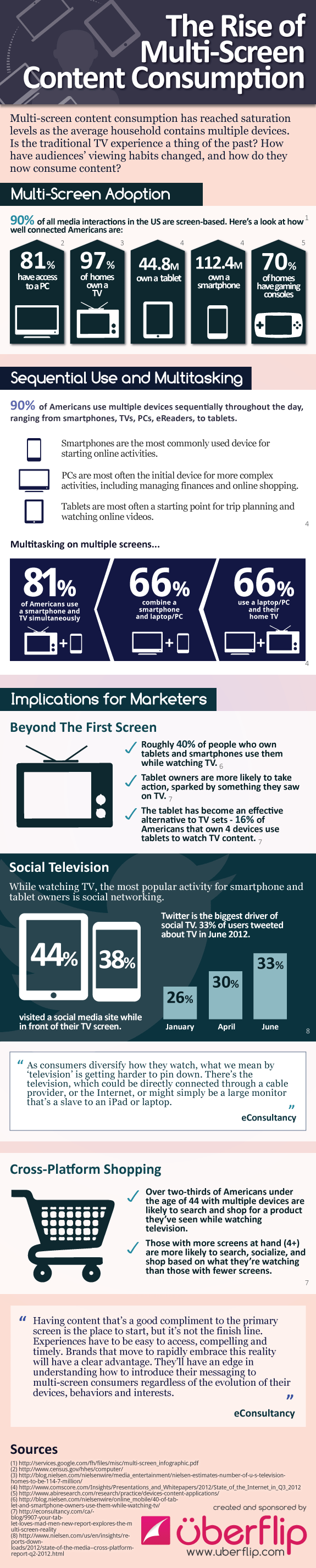
This infographic from Uberflip shows that although consumers are reaching for other devices whilst watching TV, many of them (66%) are using those devices to source information on a product and often purchase after seeing that product on TV.
Cross platform marketing requires a new mindset
So there may be a future for the TV as a communications tool after all.
However, what marketers must do is rely less on corporate driven messages and instead, identify how to introduce their products on one screen and then integrate that product and messaging across other screens taking into account changed behaviours, attitudes and cultures.













 brandconsultantasia.com