There was an interesting interview with Tony Fadell in the Daily Telegraph last week. Tony Fadell is the inventor of the iPod and although the interview is meant to focus on his patest invention – smart thermostats – the conversation keeps coming back to his time at Apple.
What I found most interesting was Apple’s approach to doing business. Tony Fadell talks about branding in a refreshing, relevant way. He says, ““If you’re a company focused on competitors,” he says, “you’ll be a follower. And you’ll talk to the media about all sorts of stuff. But if you’re a company focused on the consumer you’ll talk about the products that you’ve got and how to get the most out of them.”
This is so, so true. In the customer economy, if you spend all your time looking at what your competitors are doing and then try to replicate it, you are always going to be playing catchup.
But more importantly, this is the wrong place to look because companies don’t define brands anymore, customers do. And also, loyalty is a lot harder to earn and certainly isn’t earned by a traditional, corporate driven positioning strategy.
Apple talks about it’s products but more importantly, it lets consumers talk about its products and you need to build an environment where consumers can talk about your brand. Don’t be afraid to be talked about because it is already happening anyway.
In the social economies of Asia, giving consumers platforms or building communities for them to discuss your brand allows you to track the conversations and get involved when need be.
Critically it allows you to identify and engage with influential consumers, those people other consumers listen to. Because brands need to understand that in the customer economy, success will be determined by relationships not transactions. An automotive dealer doesn’t sell cars, they build relationships with people looking to make their lives more interesting, exciting or easier.
As that relationship evolves and solutions provided, they seek introductions to others who may also join the family by buying the product. This requires an investment in the product and also in the relationships. But the investment in the product can be determined by the needs of the customers.
Take a leaf out of the Apple book and look to your customers not your competitors to build your brand.
A business needs a plan or as I prefer to call it, an organisational framework.
But the content of that plan and the way the plan is executed is changing.
That is because the world is so fluid.
Today, personnel have to be recruited not for their ability to sit an exam based on a course that is perhaps 2 or more years old (ancient history in today’s business environment) but on whether they have the skills and confidence to see events as they are and to have the confidence to make decisions and take risks based on what’s in front of them at a specific time.
Freedom to act, for the benefit of the business, within a framework.
Trust, collaboration, personalisation, flexibility, communication, value, pragmatism will build brands not ads, logos, creativity and deep pockets.
Most advertising industry professionals will tell you that consumers are finding it hard to pay attention to traditional advertising.
As a simple example from the automotive industry, in 2009, General Motors spent US$2.2 billion on advertising just in the United States. Despite this colossal investment, total 2009 sales were down 30 per cent on the previous year.
Admittedly this was a tough year as the US tried to adjust to the economic downturn and the company went through a painful restructuring under bankruptcy protection.
A recent article in the Economist stated it takes over US$1 billion to build a brand in Europe and the USA, using traditional marketing methods.
I was reading through the papers recently and came across this image of a Land Rover in UK during the recent bad weather. I don’t know about you but this image made a huge impression on me.
If I were Land Rover, I would ditch all my beautifully produced corporate collateral and just send this image out to all my prospects with an offer of a test drive at their convenience!
As they enter the season of contract negotiations, many Asian and Malaysian firms are finding their margins squeezed by the Western brands for which they manufacture products.
As they go through this painful process, the question of whether they should explore the possibility of developing their own brands will come to the fore once again.
It is well known of course that the cost of building a brand can be substantial but failure rates are high too – as high as 90% according to Ernst & Young.
But the rewards of developing a brand successfully are difficult to ignore and Apple is considered by many to be the poster boy of successful branding.
Almost bankrupt 15 years ago Apple’s stock reached US$369.89 in August 2011 when its market capitalisation hit US$342.8 billion. This put the tech superpower ahead of the previous richest company Exxon, whose stock fell to US$68.78 with a market cap of US$334.41 billion.
Although Apple only held the position of richest company in the world for a short time, it was some achievement.
The demand for Apple products continues and the company sold four million of the iPhone 4S in the first four days after the launch in November 2011.
Such demand allows the company to charge a premium for its products. But how much profit does Apple make on iPhones and is it really beneficial to build a brand?
A recent report from technology research firm iSuppli would suggest the answer is a definate yes.
iSuppli has carried out extensive research and recently announced that a 16GB iPhone 4S costs US$196 (RM616) to make whilst the 64GB costs US$245 RM770).
In the UK the iPhone 4S costs UK pounds 499 or RM2,520 out of contract. The iPhone 4S is not on sale in Malaysia yet but in Singapore an out of contract 16GB iPhone 4S will cost S$948 (RM2,526) and the 64GB will cost S$1,088 (RM2,669).
Back in June 2011, Google launched Google+ to counter the increasingly powerful and influential Facebook. According to Google, 40 million people have signed up for Google+ which equates to about 8 million new users a month. Not a bad effort but a long way to go to reach the 800 million Facebook users.
The launch of Google+ saw a number of complaints from consumers, especially related to applications whose functionality was changed or users being forced to give up pseudonyms to continue sharing.
Corporations also complained because they were unable to connect and build relationships with consumers, something they have been able to do and do successfully on Facebook.
Some companies did try to create business pages on Google+ but they were rejected, with a request to wait.
Well the wait is over with the launch today of Google+ Brand Pages. Now firms can connect and engage with consumers through corporate pages. Although Google+ Brand Pages doesn’t operate that differently from Facebook, it will have to form a part of any corporation’s social media strategy.
One neat feature not available on Facebook is Google+ Direct Connect. Simply by putting “+” in front of a brand’s name before making a Google search, will ensure searchers are directed to the firms Google+ page.
Google’s open approach also means that a brand can now have a business page that is integrated with Google search, Ad words, Google places and YouTube.
Critically, I also expect Google+ profiles to have a significant impact on Search Engine Optimisation (SEO) and search results. And once Google starts to provide metrics for pages via Google analytics, we may see Facebook’s crown slip.
Recently I’ve met a couple of companies who couldn’t explain why they implemented a customer satisfaction survey and how they used the results! I hope this is the exception, not the rule.
If you’ve carried out a customer satisfaction survey, you probably did it because you want to deliver great customer service and believe the satisfaction survey will give you something to benchmark future results against. If this is the case, you are not alone.
Many companies regularly measure customer satisfaction. They send out surveys or call asking questions about satisfaction with service, product usage and more. Most people will have encountered the satisfaction survey at the bank counter that encourages immediate responses, the results of which can impact the manager’s bonus.
Others may have received a call from a car workshop after a service or an email from an online service provider.
But, unfortunately, the results of such measurement are unactionable. That means customer satisfaction surveys do a poor job of linking cause and effect.
As an example, a traditional survey might ask, “How satisfied were you with the product/service?” And then give 5 options from “Very satisfied” to “Very dissatisfied” but where’s the cause and effect?
If customers are dissatisfied with the product, what caused it? Was it a poor sales or other service experience? Or was it because the teller gave the wrong information? An unfair ‘returns policy’? Complexity? A lack of add-ons?
Part of a typical satisfaction survey, how measureable are the results?
Many customer satisfaction surveys measure the wrong activity at the wrong time, often with the wrong customers. If a walk in customer to a branch of a bank is a frequent visitor who takes up a lot of time making withdrawals or engaging expensive, trained personnel with minor transactions, should the bank care if they are satisfied or not?
Another failing of customer satisfaction surveys is that they are divorced from the costs of satisfaction. Yes, customers can be satisfied, but do you really want to satisfy every customer no matter what it costs?
Many organizations apparently do and some think good satisfaction scores are considered more important than profits. At least one Malaysian firm boasts of “exceeding expectations.” Not unexpectedly, setting the satisfaction bar so high inevitably leads to excessive expenses, hurting profitability.
And it is also misleading. According to Frederick Reichheld, writing in the influential Harvard Business School publication, 90% of industry customers report that they are satisfied or very satisfied. Impressive figures but why is it then that repeat purchases remain in the 30% – 40% range? Surely if so many customers are satisfied, shouldn’t they be making repeat purchases?
But most telling of all, in numerous surveys, 60% – 80% of customers have reported they are happy with service, before moving to a competitor!
Harvard Business Review - even completely satisfied customers can leave
Another issue with satisfaction is that as consumers become more empowered, the less likely they are to be satisfied. According to a survey by Accenture and the Marketing Society, the percentage of people whose ‘expectations of service quality are frequently or always met’ declined from 53% in 2007 to 40% in 2009. If this trend continues, it is unlikely that expectations will ever be met and therefore, what is the relevance of a satisfaction survey?
Companies can also influence or manipulate satisfaction scores with the timing of the questions. For instance, if an airline upgrades a traveler from economy to business class on a long haul flight and then calls the next day to ask if the passenger was satisfied will produce a predictable answer.
What you really want to do is to value satisfaction, not measure it. Valuing satisfaction means putting an actual cost figure on the satisfaction that is required to keep a customer as a customer.
After all, you spend large amounts of money on advertising, sales and other branding tactics to acquire a customer and then when you do acquire him, you ask if he is satisfied with the service. Wouldn’t it make sense to know why he became a customer and what it will take to keep him as a customer?
The importance of keeping a customer as a customer is ignored in almost all satisfaction surveys. Yet why would you want to satisfy a customer if 60% – 80% are likely to defect to a competitor with the next purchase?
Companies committed to growing profitability instead of expenses are already making the move to valuing satisfaction.
One of the first companies was Starbucks. Starbucks prides itself in providing a unique customer experience. In many ways, its brand is based on this customer experience. But Starbucks success meant longer queues that created unhappy customers. So, to ensure continued growth, Starbucks sought to measure satisfaction with the customer experience.
Starbucks strives to deliver value
Starbucks decided to talk to customers. Its customer research discovered that the average “unsatisfied” customer stuck with the company for a little more than one year, made 47 visits to its stores during that period and spent a total of approximately US$200. Not bad, really, for an “unsatisfied” customer.
But look at the value of a “satisfied” customer. The average “highly satisfied” Starbucks customer patronized the chain for more than eight years, made almost double the amount of visits (86) per year and spent over US$3,000 over that average eight-year time frame.
What was the primary difference between “unsatisfied” and “highly satisfied” customers? The amount of time the customer had to wait in line. Now that Starbucks knew the value of satisfaction, it could make the appropriate financial decisions.
Indeed, once the connection was made between marketing metric and financial outcome, calculating the investment and its potential payoff became easier. Based on Starbucks’ estimate, marketing would have to invest US$40 million annually worldwide to sufficiently reduce wait times and help convert those unsatisfied customers into highly satisfied ones. That’s no small amount, even for Starbucks.
If you were the CEO of Starbucks, what would you have done?
Actually, the data made the decision quite easy. Since the research had shown that each highly satisfied customer was worth US$3,000 over eight years and each unsatisfied customer was worth US$200 for one year, all Starbucks had to do was calculate the discounted cash flow and determine how many customers must be converted from unsatisfied to satisfied customers to generate the US$40 million in incremental revenue needed to cover the investment. The calculation revealed that Starbucks would rapidly recover its investment in satisfaction.
So take a close look at your own customer satisfaction surveys. Are they just telling you how “happy” customers are at a particular time and place and based on a specific transaction? Or do they provide actionable data about customer value?
Do they let you know their standards for product and service performance? Do they let you know how customers hold you accountable? Do they provide data that lets you make financial investments in customers that will bring the greatest financial return?
What’s needed today – and unfortunately is missing among companies that depend on creativity to build their brand – is a correlation between marketing metrics and financial outcomes.
Don’t limit your bottom line with feel-good customer satisfaction surveys that just look at customer good will. Instead, measure the value of their satisfaction. The result will not only tell you the causes of their satisfaction or dissatisfaction, but, much more importantly, provide the hard financial data to determine what to do about it.
This article first appeared in the 28th October 2011 issue of the Malaysian Reserve.
The recent budget and the implications of the budget are still being debated but what is clear is that the government is trying to help SMEs.
As part of the budget, the prime minister announced a RM100 million SME Revitalisation Fund for entrepreneurs who have tried and failed. The goal of the fund is to give those entrepreneurs the chance to get up and have another go.
SMEs are the engine room of countless economies and crucial to the development of many countries. In Malaysia the percentage contribution of SMEs to the nation’s Gross Domestic Product is 47.3%. This compares favourably to the larger economies of China (60%), Japan (55.3%) and Korea (50%).
One of the reasons Malaysian SMEs have stayed relevant is because most of them have been nimble and adaptable, making the change from primary industries such as agriculture and mining up until 1990 to an industrialized economy that saw manufacturing becoming the leading growth sector over the last 20 years.
However, many of those SMEs that made the move from commodities to manufacturing succeeded because they were able to compete on price. And with low labour and other costs, Malaysian made products were attractive and demand was constant. This also encouraged FDI.
But talk to any Malaysian manufacturing SME and you will most likely find that over the last 20 years, with few exceptions, every new contract negotiation with the companies they have supplied clothing or equipment to has resulted in their being forced to lower their price. Margins, with a few exceptions are down to less than 4%.
Despite relationships that may span as many as 20 years, loyalty is non existent and, despite vague promises of long term relationships, business is now being lost to Cambodia, China, Indonesia and Vietnam.
Hardly surprising when average factory wages in Malaysia are 250% higher than in Cambodia, 200% higher than in Vietnam, 160% higher than in Indonesia and even 40% higher than in China. Worse of all, as a contract manufacturer for a third party, Malaysian manufacturers have no knowledge of their consumers and little chance of finding new business.
As FDI and even local investment in manufacturing has dried up as brand owners seek less expensive locations, Malaysian SMEs are now fighting for their survival and whilst the SME revitalization fund is an important step to help those who have failed, Malaysian SMEs will need to develop more strategic ways to differentiate themselves.
One obvious way for SMEs to do this is to build brands. Yet the majority of Malaysian SMEs ignore the importance of branding. But competition, accentuated by AFTA and China’s entry into the WTO means that if they do not begin to brand, they will not be able to compete. The long term reliance on cost to differentiate, driven by historical experience in commodities and the fact that Malaysia was a cheap manufacturing base, will no longer suffice.
The irony is that Many Malaysian SMEs have done the hard part. Malaysian SMEs are already capable but are yet to sell their capabilities to the world. A major investment in branding will allow Malaysian SMEs to leverage substantial advances in quality manufacturing, workforce productivity, logistics and efficiency.
Malaysian SMEs already produce garments for international brands, components for the international aerospace industry, electronics for the global computer industry and numerous personal consumer goods.
In the services sector Malaysian SMEs provide support to banks, airlines, hospitality providers, medical services, insurance companies, and so on.
But these SMEs may lose out to international competition if they do not develop brands. Now is the time for SMEs to learn the importance of branding and the strategies and skills needed to create and maintain market strength through building relationships, providing personalisation and delivering value to customers.
Compounding the problem is that Malaysia is becoming a victim of its own success. As it becomes a more mature economy, global MNCs will start to take notice, as they are already doing and flood the market with international brands using international budgets to buy market share. Unless Malaysian SMEs begin to brand they will not survive this onslaught.
It’s especially important that Malaysian SME’s allocate their (and the Governments) limited resources effectively. The brand promotion grant, launched by the government about six years ago helped some companies advertise but using advertising to build a brand requires deep pockets and leaves too much to chance because it is so hard to stand out from the clutter and be heard over the noise of other advertisers and make an impact with consumers who are permanently distracted.
The good news is that branding today does not necessarily require huge investments in logos, slogans and expensive creative driven advertising campaigns pushed out across traditional mass media, which too often result in at best, a short-term sales spike but have no real long term gains for the company.
By utilizing emerging technologies and trends that are having a major impact on brands and branding and by leveraging these technologies and trends, and by integrating such trends and technologies with the social nature of Malaysian culture, Malaysian SMEs can potentially build global powerhouse brands. And not in the twenty years it has taken traditionally taken to build a brand, but possibly in as few as five to ten years.
But to do this Malaysian SMEs must focus not on price and trying to undercut rivals, both domestic, regional and international, but by identifying prospects, building relationships and understanding customer requirements for value. This will take a significant change on organizational culture but it is one that Malaysian SMEs must make.
It is great news that the government is trying to help SMEs with the SME revitalization fund but it is also important that SMEs help themselves and understand that if they are to survive and thrive, they can no longer compete on price alone.
Apple’s shares took a hit of as much as 3% yesterday after a JP Morgan Chase analyst announced that Apple was reducing orders of parts for its iPad by as much as 25%.
This is an interesting move, especially as we’re about to begin the traditionally busy lead up to Christmas.
I don’t want to say “I told you so”, but I did write here, here and here that the iPad will fail.
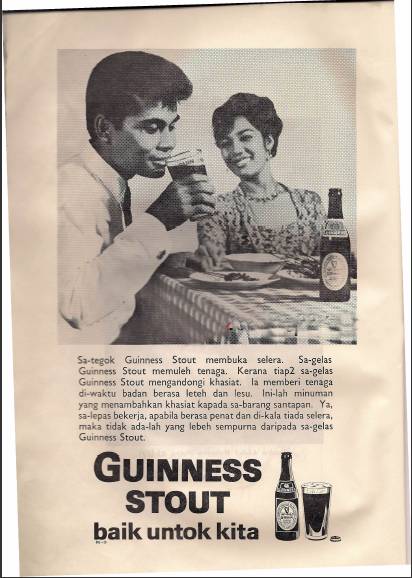
Here’s a lovely old print advertisement from 1968.
The ad features a young Malay professional enjoying a pint of Guinness and some satay whilst his admiring and approving wife looks on.
The copy tells the reader that Guinness gives you energy when you are tired after work and that there are nutritional benefits to drinking Guinness. And the tagline reminds you that Guinness is good for you.
It’s a fairly innocent ad, typical of the period but what is most surprising is that it features Malays! How times have changed!
One of the greatest branding success stories has to be British Airways, the blue riband aviation brand.
Recently the airline hired agency BBH to create a new campaign to explain the history of the company. The final work can be seen below
As part of their work, the agency chose a row of 747s at a terminal. Unfortunately not all the aircraft were BA 747s!
Never mind, the agency got the digital guys to put BA livery on the planes.
Unfortunately, they forgot to delete the serial code of the nearest aircraft which was actually a Virgin aircraft! Not clever, especially as Virgin is BA’s sworn enemy!
Fortunately, during an internal showing to staff, a hawk eyed engineer spotted the offending information and alerted the marketing department!
Ironically, the director, Frederic Planchon is renown for his attention to detail!
You can see the edited shot about 56 seconds into what is in my opinion, a beautifully crafted video.


 brandconsultantasia.com