Brands, it is no longer about you


Whilst researching a chapter for my new book (you can get an idea of how the book will go by reading this article here) I came across a fascinating company called Undercurrent.

One of the key players in the firm is a guy called Aaron Dignan. You can follow him on Twitter here.

I was impressed by much of what I read on their website but whilst continuing my research, I also found this quote from Aaron:

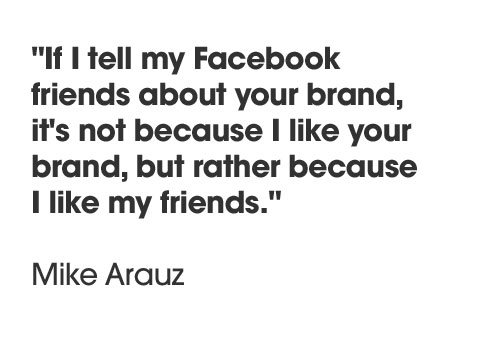
Do you really understand Facebook?

This simple quote sums up the new world order of branding. It is not about you. Consumers really don’t care about you and your brand. There are so many brands out there that consumers are no longer buying into brands in the same way as they did before.

There are exceptions but on the whole, the world is changing and brands can no longer expect to have the loyalty they used to take for granted. Do you agree?

This infographic shows the right way to build a brand online


John Cullen runs an Internet marketing company out of Ohio in the US. He dropped by my blog and out of courtesy I had a look at his. He also liked the ‘about me’ page on my blog. I’m not sure if I should be happy with that because I hope he liked some of branding related stuff too!

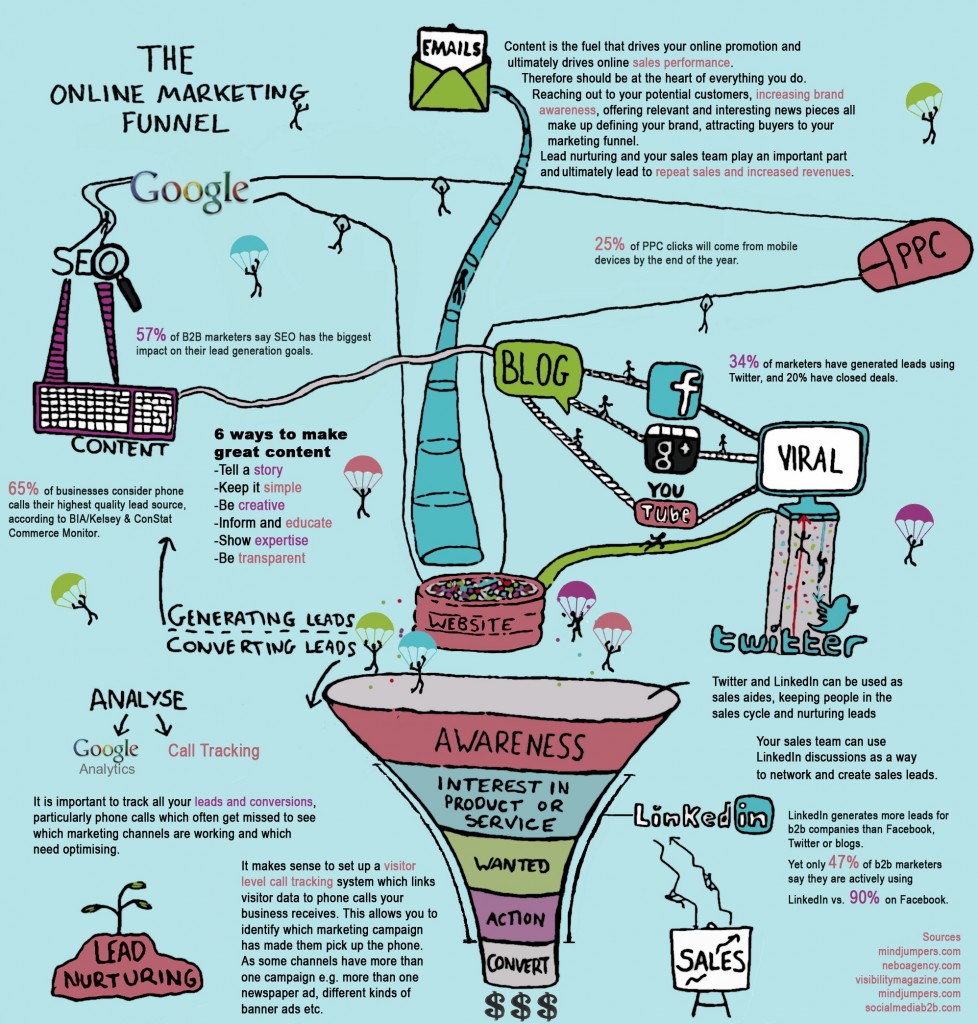
Anyway on his blog I came across this excellent infographic that explains the online marketing funnel.

Online marketing funnel

This fascinating infographic is useful because it shows the importance of digital marketing when building a brand, not through advertising but through the use of content and yet it also shows how important traditional tools such as the telephone are in the brand building process.

It also shows how important it is to use the right tools for the right sector. For instance, Linkedin generates more leads for B2B companies than Facebook, twitter or blogs yet only 47% of B2B marketers say they are active on Linkedin compared with 90% who are active on Facebook.

All you need to know to start building your brand online. Check out response tap for more on this topic.

Cross platform marketing to build a brand


It is accepted now that consumers are paying less attention to traditional media.

Although the TV or the radio may be on, it doesn’t mean they are viewed or heard. And with the proliferation of ads and trailers, more consumers are reaching for other screens during a break in programming.

But marketers still insist on using traditional media to reach as many consumers as possible in the hope that their message will stick. Even those companies that are spending on digital are using the same methods as they used in the old mass economy.

This despite the fact that last year Harvard Business Review said, “Traditional marketing is dead… in today’s increasingly social media-infused environment, traditional marketing and sales not only doesn’t work so well, it doesn’t make sense.”

However, all is not doom and gloom for traditional media channels. Or at least the TV.

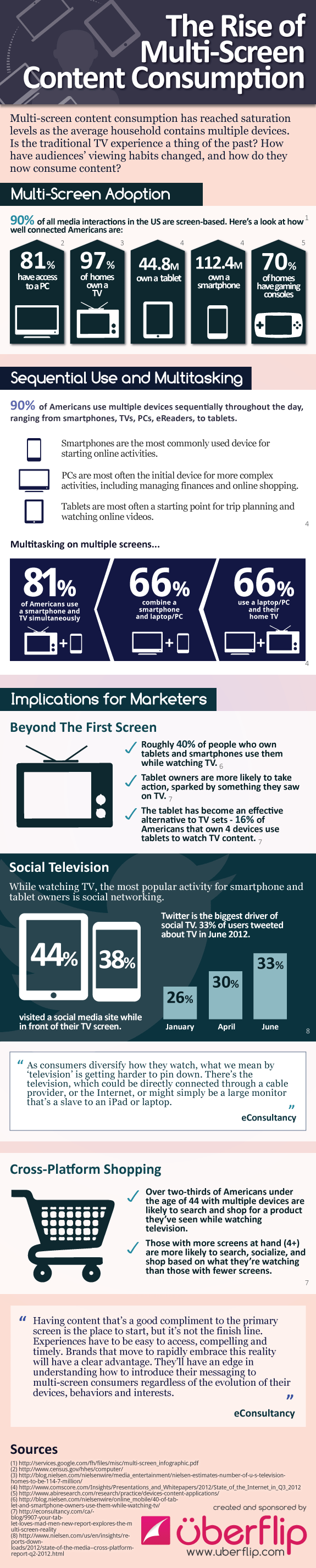
This infographic from Uberflip shows that although consumers are reaching for other devices whilst watching TV, many of them (66%) are using those devices to source information on a product and often purchase after seeing that product on TV.

Cross platform marketing requires a new mindset

So there may be a future for the TV as a communications tool after all.

However, what marketers must do is rely less on corporate driven messages and instead, identify how to introduce their products on one screen and then integrate that product and messaging across other screens taking into account changed behaviours, attitudes and cultures.

Can poor customer engagement across social media destroy a brand?


I came across a remarkable story about how a brand failed to deliver on its promise and the result of that failure. You can read the full story here

In a nutshell, it’s the story of a gamers attempt to buy an add-on for video game console controllers. The tool, known as the Avenger and invented by N-Control was announced in November 2011, word soon spread across social media and demand went through the roof.

After ordering 2 of the controllers, the gamer was told it would ship in early December 2011 however by the middle of the month he had heard nothing so emailed the president of marketing to enquire as to the shipping date and was told it would ship a day later than announced.

Unfortunately it didn’t. Then it was announced that anyone ordering the controller after December 26th would get a US$10 discount however, those who had ordered before December 26th and had still not received their controllers were not entitled to the discount.

By this stage the gamer was getting a bit annoyed and emailed the firm asking if he cancelled his original order, could he then qualify for the US$10 discount (don’t forget he’s ordered 2 of them).

The firm came back with this statement, “Feel free to cancel we need the units we’re back ordered 11,000 units so your 2 will be gone fast. Maybe I’ll put them on eBay for 150.00 myself. Have a good day Dan.”

By this stage the gamer was seething so he wrote again to the President of marketing but this time copied the email to organisers of major gaming conventions in the US. Amazingly the President of marketing responded by calling the gamer childish, laughing at his complaints, and dropping the names of numerous gaming conventions that they intended to attend, one of which was organised by the very company the email was CCd to.

The organiser took the side of the gamer and banned the company from taking a booth at their gaming convention. Then the story was posted online and went viral and this is when it really hit the fan. Because of the power of Facebook, Twitter, Reddit and others the story even crashed the site it originated from! You can see more information on how it went viral here

Soon after N-Control fired the President of marketing and made a US$10,000 donation to charity.

What lessons can be learned from such an event?

Promises made must be kept. If you don’t prepare to feel the wrath of the consumer.

Make sure the people who represent your brand live the brand.

N-Control is on the defensive and maybe for some time. It didn’t need to be in this situation. Know how to use the Internet.

Be careful when you offer discounts. Consumers who have paid pre discount rates expect value. If you don’t deliver, offer the discount to those who kick started your sales.

I believe that an event such as this may not bring down a brand but it could be extremely expensive and the fall out for N-Control will last for years. If they come up with a sub standard product they will really struggle.

And such an event can certainly cost people their jobs and quite possibly, as more and more employers trawl the Internet for information on potential hires, their careers.

Consumers have changed, has your marketing strategy?


Doe this sound familiar?

You need to spend time creating a position that is driven by the corporation.

Once created, the position must be communicate across traditional media (with a nod toward social media, but a nod only) to as many people as possible and hope that some of it sticks.

If it doesn’t, create a new position and repeat ad nauseum. Hopefully you will get it right. If you don’t, well you can always discount. This model was developed by Jack Trout in the 1970s. I wrote a blog post about it here

Sadly, despite US$1.5 trillion spent annually on marketing, 70% of today’s manufactured goods will be obsolete in six years (Industry Week magazine). There are estimated to be more than 30,000 new product introductions in the US alone every year, and that’s just in the packaged goods market. According to AC Nielsen, up to 90% of products fail to become brands. This means that as many as 27,000 of those new products will fail.

Today’s consumer has changed the way he lives his life and moreover, markets are so fluid, spending time developing a position and watching your competitors is the fastest route to business oblivion.

The key to success is the sales force and their ability to build your business through collaborations and by matching products/services to individual customer requirements for value and then maintaining those relationships and your brand communities team who develop brand evangelists and influence influencers.

And with social media and modern technology, that is not difficult. A lot less difficult than creating a position and pinning all your hopes on, well hope.

Advertising doesn’t work, just ask Microsoft


This is a great ad for Windows 8 from Microsoft Portugal (stick around for the ending) but it’s a corporate driven message and in the social economy, consumers no longer believe or trust corporate driven messages.

On seeing this ad, the first thing most consumers will do is search the net for more information. I did and I came across an interview in the Verge with Gabe Newell, Chief Executive of gaming company Valve who called Windows 8 ‘A great sadness’. He said Windows 8 is ‘inoperable’ and ‘it just hurts everybody in the PC business’.

He went on to add, ‘Rather than everybody being all excited to go buy a new PC and buying new software to run on it, we’ve had a 20% plus decline in PC sales.’

Consumers have been equally disappointed. One commented on extreme tech, “I’ve had win 8 on a desktop since last February and everything you do takes as many as 3 extra steps compared to win7, everything from shutting down to closing a program or web page is unduly complicated. This is by far the worst windows ever and I have been using windows since 1981.”

In December, MIT professor Philip Greenspun said the new operating system was a “Christmas gift for someone you hate.” Although Greenspun liked some of the apps, he hammered just about every aspect of Microsoft’s new software, noting that ‘Microsoft had since October 2008 to study Android and since June 2007 to study the iPhone and its OS, but still couldn’t build a usable tablet experience.’

Late last year Microsoft announced that it had sold 40 million Windows 8 licenses in the first month of sales which began at the end of October 2012. It’s unclear whether those licenses were sold to customers or retailers or how many were upgrades and new purchases.

Microsoft spent $1.6 billion in fiscal 2012 (its year ends in June) on advertising, $1.9 billion in 2011, and $1.6 billion in 2010. Prior to that the firm spent $1.2 billion in fiscal year 2006, $1.3 billion in fiscal 2007 and $1.2 billion in fiscal year 2008.

Despite spending these phenomenal amounts on advertising, according to IDC, Goldman Sachs Research Microsoft’s share of the consumer market has nosedived from 95% to 20% in the last 8 years.

microsoft-google-apple-other-consumer-compute-market-share-640x353

My bet is that Microsoft will find it hard to sustain those early Windows 8 sales if trade and consumer reviews continue to lambast Windows 8.

And no matter how much the firm spends on advertising and no matter how creative or well executed is the advertising, if the product doesn’t work properly, Microsoft’s share of the PC operating market will continue to plummet.

General Motors cancels Facebook advertising campaigns


A fellow branding professional who I respect a lot sent me this link to an article on Forbes.

It’s a fascinating story on a number of levels. General Motors (GM) has been very supportive of Facebook, spending in the region of US$40 million per year on marketing with the site, US$10 million of which was on paid advertising. However, the article says that GM will no longer spend the US$10 million on marketing but it remains heavily committed to using the site to engage consumers.

Advertisers such as GM have been key to driving up FB user revenue which is about US$9.51 per user in the U.S, compared to US$4.86 in Europe US$1.79 in Asia. Total revenue from advertising in 1Q2012 was about US$870 million so the US$10 million annual spend from GM will hardly register.

For the record, GM is one of the top three U.S. advertisers and according to adage, the firm spent US$2.8billion domestically and US$3.9billion globally on advertising in 2010.

The first time I read the story, I thought it reflected badly on FB but then I read it again and believe reflects well on Facebook but reflects badly on advertising.

The channel (FB) is alright and the content is working but the medium (advertising) is ignored by Facebook users and this is something we’ve actually known for a long time – consumers are rejecting traditional forms of advertising. What we didn’t know was that they are also doing this online.

But as Facebook goes to IPO, it does make one wonder how it can monotise those 900 million users. Having said that, I also read that Ford is ramping up it’s Facebook advertising.

On another note, I noticed this digital ad for a GM brand on a Malaysian news site! Note that it is for making purchases in the USA. Not much good to us in Malaysia! Perhaps the issue isn’t FB, it’s the targetting!

Effective use of Twitter to build your brand


This article first appeared in the 29th November print edition of The Malaysian Reserve

Earlier this week at the launch of the 1Malaysia Social Media Convention, the Prime Minister of Malaysia Datuk Seri Najib Abdul Razak announced that the Barisan Nasional (BN) was developing an army of BN friendly cyber practitioners to engage consumers online.

The PM said at the launch, “As a party that wants to be relevant, we have to change according to the change in time”. The Malaysian Prime Minister should be applauded for his grasp of the importance of Social Media because there are over 12 million Internet users in Malaysia and Social Media is responsible for one third of the web traffic in the country.

The Prime Minister understands that social media has transformed people’s behaviour, their expectations and how they like to express themselves. Unfortunately, although the Prime Minister is aware of the importance of Social Media, most corporations appear oblivious to the impact of Social Media on consumers and the way they learn about and share information on products.

This may be because up until recently companies have been able to manage their communications but this is changing and today, consumers no longer respect or trust slow, opaque, bureaucratic, dictatorial corporations and the structured PR and advertising they like to push out across traditional broadcast media. In fact a recent study noted that a staggering 86% of Malaysians don’t believe what advertisers tell them in traditional ads!

Consumers are fed up with the automated voicemail that greets them when they call with a product or service issue. Especially as many corporations use the inevitable waiting time to try and sell something else to a customer who is often seething at the company and is not in the right frame of mind to be sold to.

Today, consumers expect, no demand to be able to talk to the right person at the right time.

Today, successful organizations are the result of being human, responsive and transparent. And consumers will communicate with these companies across open and transparent social media communities such as Twitter, Facebook and others.

So over the next few months we’ll talk about some of the most likely social media tools you can use to communicate information about your brand and how those tools can be used for businesses such as yours.

This month we look at Twitter, what it is and how you can use it to build your brand.

Worldwide, there are now 100 million active Twitter users and daily Tweets are over 250 million. Most top actors, athletes, politicians, businessmen and artists are active on Twitter.

Every news, current affairs and sports programme proudly displays its Twitter account name. Global events anywhere in the world break first and spread faster on Twitter. While CNN is showing 2 day old sports’ scores on its ticker tape, Twitter is providing those who are interested with ball by ball updates live from the next days play.

Barack Obama has 11.2 million followers, Datuk Seri Najib Razak has 295,000, AirAsia has 245,000, Amazon has 149,000, Firefly has 47,000 and the numbers are growing fast. In Asia, Indonesia has the most subscribers to Twitter whilst there are about 1 million in Malaysia.

It is important to understand that Twitter is not another Facebook. Facebook is best described as a few to a few social network created with a goal of sharing personal information and life related stuff with friends. Only once two people ‘friend’ each other can information begin to flow. Twitter on the other hand, is a one to many social network that allows me to say follow Firefly to keep abreast of their offerings yet they don’t have to follow me back to make the relationship work.

Twitter allows prospects and customers to instantly connect with you. Brands are no longer defined by the campaigns created by marketing and PR departments within companies. In the social economy of today, brands are defined by consumers or more specifically the experiences those consumers have with brands.

Get it right and you’ll build a brand. Get it wrong, and consumers will ensure your brand fails.

One of the reasons for Twitter’s success is because consumers got fed up with the automated responses they were faced with every time they contact a company.

Twitter is a popular platform to disseminate news about your company. If you have set up your Twitter account properly, Twitter is a dynamic and inexpensive platform for you to post information relating to your brand. A well planned Twitter strategy can help keep prospects and existing customers abreast of new developments and engaged. Beware however that it is not a broadcast medium and you must know when to stop. Constantly sending out the same message will have a negative impact on the brand. It’s also important to respond to comments from consumers related to your announcements.

Twitter is an excellent platform for sourcing actionable data. Twitter lets you find out priceless information about your customers – their opinions of your brand, what they like and/or dislike about your brand, what they think of your competitors, recommendations for improvement and much more. Twitter gives you an opportunity to improving your business, often without the need for costly investments.

Twitter helps you to humanize your brand. Twitter allows you to reach, communicate and engage with consumers and match your product attributes to their requirements for value whilst other companies are publishing generic ads in newspapers or attempting to convince consumers with PR.

Twitter lets you send the right message to the right people immediately. By using groups, lists, communities and other Twitter features effectively, Twitter lets you distribute news, make announcements, inform or create awareness of special offers to the right people in real time. No more waiting a month for the magazine to come out or 24 hours for the newspaper (assuming they have the space).

Being active and effective on Twitter communicates a company at ease with technology. Being a part of the Twitter community shows that you are moving with the times, that you embrace technology and are an open and transparent organization.

Twitter case study
A frequent business traveler between Malaysia and the UK was a loyal user of Budget Rent a car. But after a 13 hour flight, the business traveller was forced to wait two hours for a pre booked car. He stayed with Budget until on another occassion he received a bill for £86 because he forgot to pay the £10 congestion charge. So he decided to look for another car hire company for his next trip to the UK.

Using a price comparison site he came across Sixt, a company he had never heard of. The company offered an attractive pick up and drop off within a 5 mile radius of the nearest showroom. But when the businessman was booking the car hire on line he couldn’t find out any information on the pick up service.

So he turned to Twitter and asked for help. Within 5 hours the MD and CEO of Sixt had both contacted him with a request for his email address so that the @Sixt customer service team could get in touch.

Arrangements were made with customer service for the pick up and as a nice touch the car hire company upgraded him to a premium car. The experience was seamless, quick and pleasant. The businessman then shared, across multiple social media platforms details of his experiences and I am now sharing his experience with readers of this Blog and across Twitter, Facebook, Stumbleupon and more.

What was the cost of the positive buzz and acquiring this new, influential customer from a competitor? In terms of time perhaps an hour at most. Financially, next to nothing.
A tactical fail for a major brand on twitter


Qantas has had a bad run of luck recently and has also made some questionable corporate decisions. Especially in relation to the ongoing wage negotiations with the Transport Workers Union that is threatening further disruption to the Aussie carrier.

The most recent Public Relations disaster is related to an attempt by the newly formed social media unit to implement a social media campaign.

The Twitter campaign asked users to describe what would be their “dream luxury inflight experience” and use the hashtag #QantasLuxury to generate traction.

The airline probably thought it would generate comments related to Spas, champagne and top quality service.

However, Aussies known for their acerbic wit, jumped at the chance to lay into the beleaguered national carrier. One of the first was, luxury is “giving yourself a pay rise whilst grounding your whole airline and taking local jobs offshore”.

Another example “#QantasLuxury is feeding a family of 5 on pittance they pay their ground staff while Alan Joyce is on $94k a week”

Cherry Pizza came up with “#QantasLuxury is sitting in your first-class lounge chair, watching a failed social media campaign get out of control.” How right she was!

The misjudged campaign was an unmitigated disaster and in an effort to end the suffering, two hours after launching the project, Qantas thanked users for their tweets. Unfortunately for Qantas, social media doesn’t work that way and 36 hours later the topic is rumoured to have generated 14,000 tweets, the best of which are featured in a presentation on slideshare and the topic is still trending high on Twitter.

It didn’t help that the prizes offered were a set of Qantas pyjamas and an amenity kit!

Why it pays to build a brand


As they enter the season of contract negotiations, many Asian and Malaysian firms are finding their margins squeezed by the Western brands for which they manufacture products.

As they go through this painful process, the question of whether they should explore the possibility of developing their own brands will come to the fore once again.

It is well known of course that the cost of building a brand can be substantial but failure rates are high too – as high as 90% according to Ernst & Young.

But the rewards of developing a brand successfully are difficult to ignore and Apple is considered by many to be the poster boy of successful branding.

Almost bankrupt 15 years ago Apple’s stock reached US$369.89 in August 2011 when its market capitalisation hit US$342.8 billion. This put the tech superpower ahead of the previous richest company Exxon, whose stock fell to US$68.78 with a market cap of US$334.41 billion.

Although Apple only held the position of richest company in the world for a short time, it was some achievement.

The demand for Apple products continues and the company sold four million of the iPhone 4S in the first four days after the launch in November 2011.

Such demand allows the company to charge a premium for its products. But how much profit does Apple make on iPhones and is it really beneficial to build a brand?

A recent report from technology research firm iSuppli would suggest the answer is a definate yes.

iSuppli has carried out extensive research and recently announced that a 16GB iPhone 4S costs US$196 (RM616) to make whilst the 64GB costs US$245 RM770).

In the UK the iPhone 4S costs UK pounds 499 or RM2,520 out of contract. The iPhone 4S is not on sale in Malaysia yet but in Singapore an out of contract 16GB iPhone 4S will cost S$948 (RM2,526) and the 64GB will cost S$1,088 (RM2,669).

Nice margins indeed!

Individual component costs of an iPhone