To engage consumers, Jakarta needs to improve its communications


As the world attempts to shake loose the shackles of the economic meltdown, competition for tourists from both established and new markets is gathering pace.

But the new environment is an even more competitive one. There are almost 200 countries worldwide and over 100,000 places in Asia alone, actively seeking to attract and retain tourists.

As a result, it is increasingly important that destinations seeking domestic and international visitors have a well researched, structured, long-term strategy for increasing visibility & engaging the right segments to generate arrivals.

One relative newcomer to this tourism marketing battleground is the city of Jakarta, the capital of Indonesia, located on the island of Java and the capital of Indonesia. If you haven’t been to Jakarta I recommend you go as soon as possible because it is a fascinatiing destination.

I spotted this ad in a Malaysian daily recently.

Does this ad make you want to get more information on Jakarta?

It would appear that the people at the Jakarta tourism and culture department are looking to attract visitors to Jakarta with the promise of great shopping. However, as a consumer, without knowing anything about the rest of this campaign I can tell you that this ad needs work.

Firstly, what is the headline trying to tell us? Is it telling us that time is irrelevant? This is an existential argument and possibly true but in this situation not relevant. Perhaps it is saying, “don’t worry about time when you go shopping in Jakarta”? Or to be more specific, when you go shopping for shoes because after looking at this ad, am I wrong to assume Jakarta is a great place to buy shoes?

There is no call to action, the image of the shoe boxes looks photo shopped onto the main image and there isn’t a website address to gather more information.

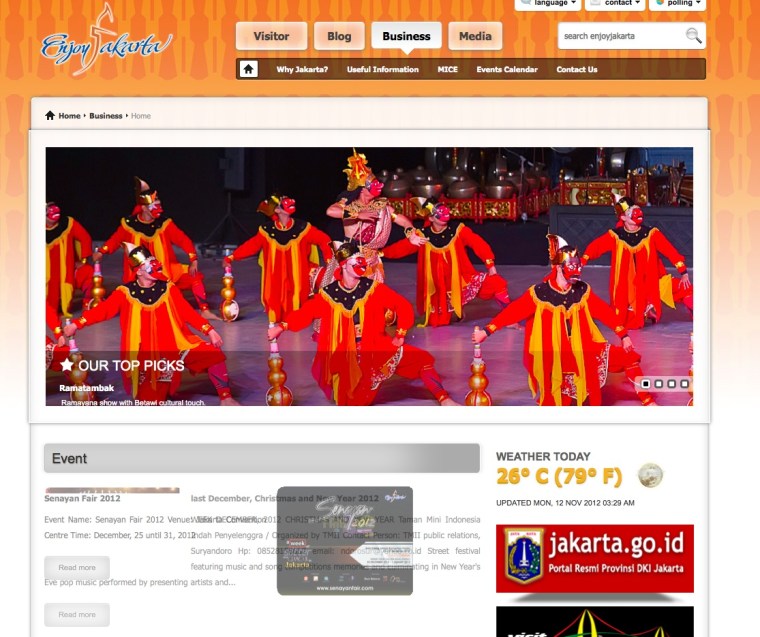
So I took it on myself to google (other search engines are available) “Enjoy Jakarta” and arrived at the official Jakarta travel website where I couldn’t find any information on enjoying Jakarta, shopping or even shoe shopping.

Not the best introduction to what Jakarta has to offer

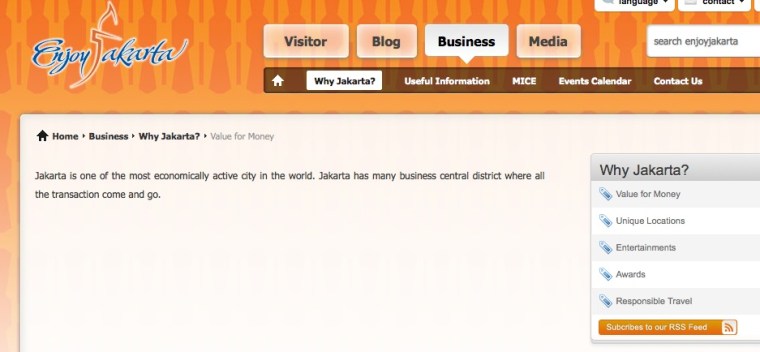
I spent some time on the site and for what it’s worth, I found the site very slow, difficult to navigate with limited information and English that needs proof reading before pubication. When I clicked on the “Why Jakarta” tab on the drop down menu, the information provided was hardly compelling and unlikely to attract investors. And talking of investors, is this a tourism site or a business site?

Not the most compelling of arguments

Moreover, I found the information above the fold didn’t match the information below the fold and when I clicked on Wine and Dine in the footer, all I got was a list of restaurants which to a first time visitor would mean nothing.

This won't mean much to anyone
This won’t mean much to anyone

Today, audiences rely less on traditional media to source information, making them increasingly hard to reach. Furthermore, consumers are less inclined to see or be interested in a corporate driven message delivered across traditional media.

But as the reliance on traditional media diminishes, opportunities arise in new and social media. Where before, companies were dependent on content from the media owners, today they can create their own content that resonates with specific consumers and their interests.

Consumers too are developing their own content and it’s important that destination brands such as Jakarta understand this and provide channels for consumers to create and share content.

It is good to see Jakarta looking to encourage visitors to this exciting city but it will take more than the print campaign and website reviewed in this article to be successful.

Look to customers not competitors to build your brand


There was an interesting interview with Tony Fadell in the Daily Telegraph last week. Tony Fadell is the inventor of the iPod and although the interview is meant to focus on his patest invention – smart thermostats – the conversation keeps coming back to his time at Apple.

You can read the full interview here

What I found most interesting was Apple’s approach to doing business. Tony Fadell talks about branding in a refreshing, relevant way. He says, ““If you’re a company focused on competitors,” he says, “you’ll be a follower. And you’ll talk to the media about all sorts of stuff. But if you’re a company focused on the consumer you’ll talk about the products that you’ve got and how to get the most out of them.”

This is so, so true. In the customer economy, if you spend all your time looking at what your competitors are doing and then try to replicate it, you are always going to be playing catchup.

But more importantly, this is the wrong place to look because companies don’t define brands anymore, customers do. And also, loyalty is a lot harder to earn and certainly isn’t earned by a traditional, corporate driven positioning strategy.

Apple talks about it’s products but more importantly, it lets consumers talk about its products and you need to build an environment where consumers can talk about your brand. Don’t be afraid to be talked about because it is already happening anyway.

In the social economies of Asia, giving consumers platforms or building communities for them to discuss your brand allows you to track the conversations and get involved when need be.

Critically it allows you to identify and engage with influential consumers, those people other consumers listen to. Because brands need to understand that in the customer economy, success will be determined by relationships not transactions. An automotive dealer doesn’t sell cars, they build relationships with people looking to make their lives more interesting, exciting or easier.

As that relationship evolves and solutions provided, they seek introductions to others who may also join the family by buying the product. This requires an investment in the product and also in the relationships. But the investment in the product can be determined by the needs of the customers.

Take a leaf out of the Apple book and look to your customers not your competitors to build your brand.

Direct marketing and your brand


More and more companies are moving toward a direct to consumer sales model. There are a number of reasons for this and it can be a tricky process to implement without upsetting the existing distribution ecosystem but let’s not go there for now.

But this move will see an increase in Direct Marketing. Direct Marketing should be included in any Malaysian business’s brand strategy, whether business to business or business to consumer. And it is a tactic that has plenty of room for growth as it is currently under appreciated and under utilized.

Because the quality of Direct Marketing in Malaysia and the mining and management of data must improve before consumers will pay attention.

What is direct marketing?
In a nutshell, direct marketing is the way in which a supplier of goods or services contacts an end user, normally a consumer or business. Direct marketing includes any mail sent via traditional post or email, brochures, magazine inserts, leaflets and catalogs.

With the direct to consumer sales model, it is also common to include telemarketing and face to face sales as elements of direct marketing

The existing model
If you want to at best create a bad first impression of your brand and at worst ensure an instant negative impact on the reputation of your brand, prepare a badly written product or services document on your desktop, use fonts that are hard to read or have a thick bold type face and whatever you do, don’t spell check the document.

Next, print 10,000 copies and shove them in letterboxes at office and/or apartment complexes in the Klang Valley. Don’t bother to record how many are delivered to each destination and ignore whether or not your product or service has any relevance to the occupants.

Then go back to your office and wait for the phone to ring (assuming you included your number on the document – and believe me, some don’t).

With this approach, the best you can hope for is that the leaflet will be used as a place mat for lunch or simply allowed to fall on the floor by the letterboxes. Hardly an inspiring ‘moment of truth’ first time experience for your brand and potential customers.

If there isn’t a response to the exercise, does this mean the ‘Direct Marketing campaign’ is unsuccessful? Absolutely not, what it means is that a very good tool has been used wrongly.

Another way to damage your brand is to send the wrong material to the wrong people. Credit card companies are renowned for sending credit card application forms to children.

Why am I receiving this sort of mail? – Note to self, do not use this company for training.

Little wonder consumers lose faith in financial institutions when they make such glaring mistakes. Think of the money wasted on buying the list of names, designing and writing content for brochures, envelopes, postage, administration and so on.

Email is still one of the most effective forms of communication with open rates of 22%, click through rates of 8% and conversion rates of 1.5%. But it must be done properly. The common approach is to buy a list of names (normally the cheapest) and carpet bomb that list with every offering you have.

Conference and training providers do this. They don’t bother who the recipient is and what he does, they simply fire off an email offering agile this, scrum that to their mailing list each time they have a new event or training seminar. Research suggests most executives have a spam filter that directs this mail straight to the trash.

The UK has some of the toughest privacy laws in the world yet Direct Marketing is still one of the most effective forms of brand development.

In 2011, UK firms spent RM14.5 billion on direct marketing which was responsible for 23% of all sales and generated RM196 billion of business. Direct marketing is effective in the UK because it is used properly.

How to do it properly
The key for all direct marketing is get the customer information right in the first place and keep it updated accurately thereafter. Well targeted communications can improve response rates by 300%.

If you don’t have the resources to compile data, outsource. There are many firms offering data collection, cleansing and data suppression services and it is money well spent.

Next, take some time to think about what you are doing and why. Are you looking to make a sale or build a customer base? Free tip, it should be the latter. Once you know what you are doing and why, think about the channel.

Determine which is the right channel. Should you use email, magazine or newspaper inserts or other. If you have a lot to say or want to show off images, an email is probably not the right channel to use unless you have a very niche product and a very well researched database. Many firms simply programme their servers to reject any email with an attachment.

Measurement
Measurement is critical in any campaign but especially so in Direct Marketing. Understand what the exercise is going to cost so that you know what your break even point is. Also measure response rates from specific segments and determine why prospects don’t buy.

Personalise each communication
If you want to stand out from the competition and have a chance of connecting, every communication should be personalised to ensure a chance of engagement. Personalisation is dificult and time consuming because it requires attention to detail but worth the investment because it instantly makes the recipient feel recognised and important.

Content is king
Content is critical, especially if you are selling a luxury product. Yes I am aware that Malaysia is a price driven and discount defined market but I disagree that that is all it is. It has got to that stage because consumers have been let down by advertisers so often and for so long that they now focus on price and price alone.

But as many luxury retailers, developers and service providers will tell you, provide a high quality service and product and consumers suddenly seem less focused on price and more focused on the experience and the prestige.

So make your content interesting. The example below is from a property developer trying to get wealthy buyers to part with millions of dollars. I doubt they will be successful with this copy.

Make content interesting, it’s not rocket science!

There is an edict within Direct Marketing industry that says, “Right offer, right person, right time.” It isn’t complicated, it just means that to be successful, start up, SMEs and GLCs need to up their game.

Put an end to poorly thought out, badly designed, written and untargeted material and use quality direct marketing to build quality brands.

What is the difference between an advertising agency and a brand consultancy?


As the consumer landscape changes and consumer habits and the purchase decision making process evolves, it is imperative that brand owners understand where, when and how to spend their valuable and increasingly limited resources.

Historically advertising agencies defined and controlled a brand’s message and through which channels it was broadcast. They would then blitz consumers with intrusive advertising and messages. The goal was to reach as large and as broad a target audience as possible on those platforms with the most extensive penetration.

But in the social economy, consumers have little faith in such corporate driven messages broadcast across mass media channels to which they are paying less and less attention.

Today consumers spend their time in a variety of social networks or in niche online communities with likeminded people. And it is to these people they look to when seeking information on products and services.

So does this mean the end of advertising agencies and advertising? Definitely not, there is still a need for good advertising agencies that create good work but the process has changed and the advertising agency can no longer be given responsibility for building brands.

In the past, branding and advertising used to be elements of marketing. Today, marketing and advertising are now part of branding and it is the brand consultant you should look to if you want to build a brand.

So here is an outline of the difference between an advertising agency and a brand consultancy. Hopefully this will give you enough knowledge to make an informed decision on who should build your brand.

1) Branding is strategic and advertising is tactical. The most strategic actions you will get from an advertising agency will be a brief. The brief will define the proposition that the advertising must communicate and to which segments. But then what? And what about internally? How will you get personnel on brand? Does the delivery driver or sales assistant know what their role is in the delivery of the promise/s made?

A brand consultant will develop a brand plan or brand blueprint that will drive the brand strategy, both internally and externally. This holistic approach will address all key elements of the brand from the copy used in recruitment advertising to customer facing departments and their ability to represent the brand to point of sale and retention strategies and more.

The brand consultant will then work with you to determine the best resources to use to get the whole organisation on brand.

It is not possible to define a brand through an advertising brief but it is possible to define a brand through a brand plan or blueprint.

2) Advertising agencies do advertising. That’s what they are good at. In fact some of them are very good at it. Advertising uses creativity and a slick message (normally defined by the organisation) to get your attention.

And this is done via campaigns pushed out across TV, radio, billboards, websites and so on. The idea is that enough people will see the campaign and the message will hopefully resonate with as many people as possible. And of course the agency gets a commission for placing these ads with the channels.

If it doesn’t work you either get the agency to come up with another creative idea and go through the whole process again, get rid of the agency, hire another one and hope they can come up with a creative campaign that does resonate or you can go out of business.

And as consumers have lost faith in traditional marketing and now distrust the messages contained in such campaigns or simply miss them because of the clutter, it is increasingly difficult to build a brand using such a model.

So unless you have very, very deep pockets and can advertise consistently for long periods of time, this approach is simply going to waste valuable resources.

A brand consultant will carry out an audit of your business, industry, processes, systems, stakeholders and more and then determine the best way forward for you.

Solutions may require advertising but will also look to improve R&D, sales, production, supply chains, operations, customer relationships and retention strategies.

3) If you are looking to go with an advertising agency, your strategy is likely to be in the hands of a creative director and his team. If the agency is going through a difficult period and doesn’t have many staff when they win your business, the agency will attempt to employ talent with experience in your industry.

Unfortunately, if the talent isn’t available, perhaps because they are working for competitor agencies, you will end up with sub standard people working on your brand and your chances of success are reduced further.

Because branding is a strategic institutional initiative, not a marketing initiative and therefore must have the buy in of executive management, a brand consultant will insist on having C level involvement in the development of the brand which places your brand strategy where it should be, in the hands of executive management.

4) Advertising agencies are often deemed successful if they have won lots of awards for creativity not whether a campaign increases sales or profitability.

There aren’t many awards for brand consultants which is a good thing because this allows them to focus on increasing profitability, often through developing and strengthening relationships with stakeholders and customers.

5) Most advertising focuses on a series of tactical initiatives to acquire customers. A brand consultant will develop a strategy to acquire and retain customers.

6) Traditional marketing activities are enormously wasteful as much of the advertising targets irrelevant demographics or customers that cannot afford or are not interested in the product. A recent report in the Harvard Business Review quoted a UK study that reported 72% of CEOs are tired of being asked for money from marketing departments without an explanation of how it will increase business.

Furthermore, in the same survey, 77% of CEOs have had enough of talk about ‘brand equity’ that can’t be linked to any real equity. A brand consultant will ensure budgets are spent on the right strategies for the right segments with metrics for measurement.

7) An advertising agency uses a one size fits all series of tactical advertising campaigns that use mass marketing across mass media with only a nod to digital and below the line activities.

A brand consultant will look to collect and leverage specific data to develop targetted communications across digital channels to engage prospects, whilst carrying on conversations with existing customers.

8) An advertising agency will often look at what the competition is doing and try to position an offering based on competitor actions. This approach is flawed because successful organisations are nimble and by the time you have developed your position the competition’s strategy will have evolved.

A brand consultant will be aware of competitor activities and will use that knowledge to strengthen the firm’s competitive advantage but will not allow competitors to define strategy going forward.

9) The impact of an advertising agency’s work is difficult to measure. A brand consultant will develop metrics to measure promotions, advertising and other activities.

Customer retention is not the same as customer loyalty


I read an interesting post on The Free Malaysia Today website about customer loyalty and you can read the full article here

It’s a useful article that any Malaysian business owner should pay attention to. But as often happens, it blurs the lines between customer loyalty and customer retention. They are not the same thing.

A retention program is not the same as a loyalty program because a retention program is normally price driven and those customers acquired as a result of a retention program can often be lost to competitors.

A loyalty program on the other hand will help increase share of wallet by encouraging more purchases, often of more premium products and, more pertinently in the social economy encourage customers to become brand advocates and communicate positively about the brand and experiences with the brand.

A case in point for me personally is MAS. I am a member of the MAS frequent flyer program but it does not buy my loyalty. MAS retains me as a customer but I am always looking for a better deal with other carriers.

If another carrier were to invest in building a relationship with me I would switch in a heart beat. I also tend to talk negatively about MAS and even when it delivers a positive experience I tend to take it for granted.

Whilst I’m on the topic of MAS I should mention that one way MAS could improve its business is by investing in its loyalty program and in particular software that can mine the database more effectively. As it is, all the loyalty program does is try to blanket sell all offerings to all members.

Loyalty is no longer about personal relationships and how often you take someone to karaoke or for teh tarik. Customers also expect you to know their industry, the challenges they face, who are their competitors and crucially, who are their customers, potential customers and who are the influencers of those customers.

If you understand and integrate a loyalty program into your brand strategy you will be on the way to building a strong brand. But if you mistake a loyalty program for a retention program, you may do more harm than good.

Successful brand building is determined more by customer experiences than by slick advertising campaigns


Far too many companies, whether Multi National Corporation (MNC) or Small, Medium sized Enterprise (SME) think or are led to believe that the fast track way to branding acceptance is to spend large amounts of money on high quality TV commercials, billboards or print advertising campaigns that showcase their products or services and communicate corporate driven messages to consumers.

But just because telecommunications companies, banks, oil companies, soft drinks firms and others spend considerable amounts of money on advertising doesn’t mean that the advertising is the reason for their success or that it is right for you.

In fact quite often, there seems to be no rhyme or reason to the advertising campaigns initiated by these companies. A case in point is the current Celcom campaign “Ini Wilayah Celcom” prominent on billboards across Kuala Lumpur. With current mobile penetration in Malaysia around 125% of the population, it doesn’t make sense for Celcom to be creating awareness with expensive outdoor campaigns.

Unsurprisingly, at end of many such campaigns, there is often very little change in the fortunes of the brand. Which is why many of these advertising campaigns, do little to build brands and should not be emulated by other companies.

Because a key element of whether or not your brand building is successful will depend not on what you tell consumers through paid media but on the experiences consumers have with your personnel, your business and your products.

Put simply, if you manufacture furniture and spend a lot of money advertising a new furniture range but the furniture breaks all the time, you may make some sales but your brand will suffer as consumers avoid making a return visit and worse, discuss their issues with other consumers on and off line.

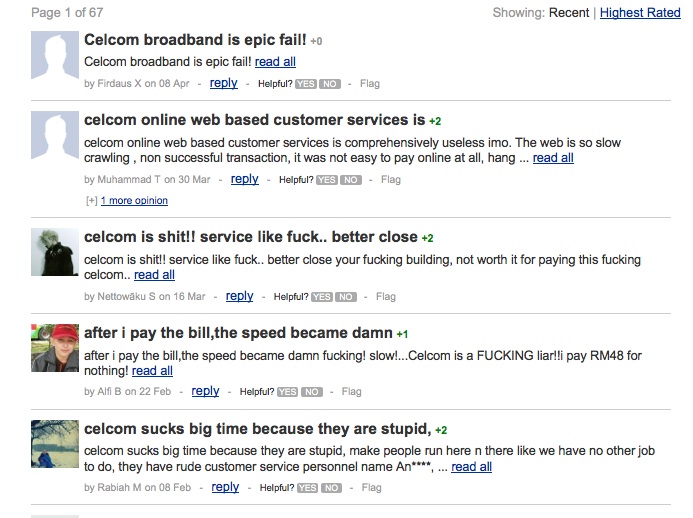
Likewise if your staff are slow, rude, inattentive, badly groomed, lack product knowledge, unhelpful and poorly trained, you may make a sale but the customer is unlikely to return and you can be sure they will share their negative experiences with others.

Furthermore, these negative experiences will be spread across the Internet using social media tools and in coffee shops, bars and so on will have a negative impact on your brand. Even sales of previously successful products may be affected negatively.
However, treat customers well and they will remain loyal. In a recent survey by Spherion, 97% of those questioned said a great experience makes them more likely to buy more of a product or repeat a service. However, once they have a bad experience or their trust is lost, it’s very hard to win back. To have a chance of winning back their business, 22% want a simple apology, 10% want a complete refund, and 8% would want incentives or coupons and even then there is no guarantee.

But 46% said that it would take an apology, a complete refund AND coupons or further incentives to have a chance of winning back their business. The implications therefore on your brand, of delivering a bad experience is costly and time consuming.

For the record, 15% said absolutely nothing would atone for their bad experience.

So you can try to shape the perceptions of your products or services with advertising, PR, advertorials, nice brochures and with content across social media and elsewhere but the reality is that the success or failure of your brand will be determined by experiences and how customers discuss your brand after the experiences.

Apple for example charges a premium for its products. It sells the sort of stuff – computers, smart phones, MP3 players – that lots of other people sell yet sells them at a premium. Margins for Apple iPhones are in the region of 50% compared to a meagre 6.2% for Nokia smartphones.

Furthermore, Apple ‘only’ spends US$250 million (2009) on advertising compared with Microsoft US$1.4 billion and Dell US811 million. In terms of a percentage of sales, this equates to 2.4% for Microsoft, 1.3% for Dell and 0.5% for Apple. RIM, manufacturer of the Blackberry spends 3.6% of revenue on advertising.

New technology companies that have sophisticated digital strategies and use email to market themselves spend even less on traditional advertising. Google spends only US$11 million on advertising or 0.05% of revenue. Amazon is a little higher at US$43 million or 0.17% of revenue.

As a general rule of thumb, spending less than 2% of revenue on advertising is considered low. For the automotive industry average advertising spend is nearer 3.5% of revenue. For alcohol it is more like 7% and for packaged goods and most other industries, as high as 10%.

Firms such as Apple, Google, Amazon and others are not successful because they spend huge amounts on short term advertising campaigns to create awareness but on innovative design, quality products and excellent service that is uniformly outstanding across all customer touch points such as in stores, whether bricks and mortar or online.

Consumers will pay more for Apple products because they are guaranteed a quality product (as well as inclusion into a not so unique club of Apple users) that will not fail them. And if it does, customers know they can go back to the store and seek a replacement or have repairs carried out under warranty.

Unfortunately most MNCs and SMEs don’t appreciate just how important the customer experience is. And the increasing popularity of social media means that consumers are voicing their dissent, not just to a few friends over teh tarik at a local Kopi Tiam but now to thousands and thousands of friends and followers and to their friends and followers across communities on Twitter, Facebook and more.
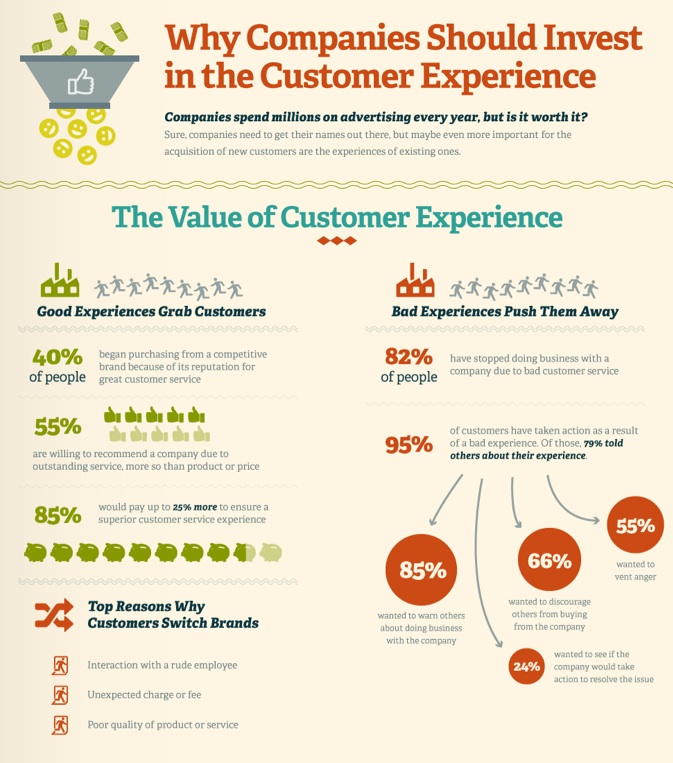
So as you try to build a successful brand, a core component of your strategy must be to build relationships with prospects and customers. You must learn how to manage relationships with customers, not just offline and during office hours but also online and at weekends.

Because unless you have a unique product or service (and few companies have unique products or offer unique services today), customers may buy from you if they have a bad experience but they are unlikely to come back again. And because of increased competition, it is impossible to build a brand on a business model that relies on new customers all the time.

Make sure that at every touch point where consumers interact with your brand, the experience for those customers is a positive one. This becomes a greater challenge as a company grows and if you get it wrong, what was once a nice little niche business with a manageable group of customers who all spoke positively about the company can become, almost overnight a loss making enterprise with fewer customers and a bad reputation for over promising and under delivering.

Ensure that every sales contact, service delivery and customer service interaction that the customer comes into contact with is positive as this will have a positive impact on your brand. Even suppliers need to be treated with respect.

But even if you invest heavily in customer relationships, and even if you keep 99% of your customers happy, there will always be some who are not happy and are dissatisfied with your service. What do you do with them?

The first thing is not to ignore these important customers. Try to get them to explain to you what is the problem. Be prepared to listen and hear stuff that may sound unreasonable. Some customers will be rude, personal and even physical. But you have to make sure your people are trained to listen and empathise. Think KFC!

And where possible solve their problem in a way that is satisfactory for them, not you. I know this might be a problem for you and will certainly cost you money on that particular transaction but in the long run it will offer far greater returns.

If you try to take care of every single customer, both those that are not a problem and those that are you’ll create a positive reputation. Even if customers are frustrated with their experiences with your brand, if you show empathy and provide a solution that makes them happy, there is a good chance they will tell others that they were impressed with you and how hard you worked to solve the problem for them. And with a little incentive, you can probably convince them to come back.

Despite what you may have been told, mass advertising across mass media is not the holy grail to building a brand. Which is fortunate because it means SMEs won’t waste hard earned money on campaigns to compete with large conglomerates. But if you look after the customer and try to make every experience a positive one, you will speed up the process of building a brand.

Thanks to zendesk for the graphic above.

Is Pinterest right for my brand?


So you run a small business and you’ve invested loads of valuable man hours developing social media profiles on Twitter, Facebook, Linkedin, Flickr, Tumblr and Youtube.

You were about to relax and then Google+ launched so you created another profile.

That was the easy part. You then started engaging with consumers, prospects, customers both satisfied and unsatisfied, suppliers, potential partners and so on. You posted images, retweeted articles, learned a lot and realised it is possible, all be it for only a few weeks, to run a business on three hours sleep a night.

And now, just as you’ve got into a rhythm, Pinterest has arrived with a label of ‘the next big thing in social media.’

Pinterest is an online pinboard that lets you post images, organise them and share them. It’s a digital scrapbook of images listed under themes such as wedding gifts, favourite foods, redecorating and so on.

The site looks and feels good, with clean lines, an easy to use model that reflects the short attention spans of today and frankly, it’s not very sophisticated, which is probably why it is so popular.

Pinterest, clean, neat look and feel

And popular it is. Launched in 2010, it has experienced phenomenal growth. The site had 1.6 million unique visitors in September 2011, 7 million in December and 11.7 million in January 2012. In six months, from July 2011 the time visitors spend on the site has risen from 38 minutes to 98 minutes. Crucially, Pinterest is reported to be driving more traffic to more company websites and blogs than Google+. Linkedin and Youtube combined.

Some companies such as jewelers, wedding planners, furniture stores, clothing retailers and food companies are reporting sensational sales spikes after joining Pinterest.

Currently most of the content is posted by women and it is very USA centric. But what is it about Pinterest that is seeing such rapid growth, is it sustainable and most important of all, should you invest more valuable resources in Pinterest?

Firstly I think the growth is like that of many social sites these days. Early adopters initiate the stampede and then, because of the global nature of the Internet, others follow quickly.

What is also key is that the decision making process for consumers is changing from one inspired by slick corporate messages aired accross mass media to information posted online by friends or associates with similar interests.

If for instance I’m a hiker and I’m looking for accessories for a hiking trip, Pinterest may offer a simple way of gathering information during the research stage of the buying process.

I could find a rucksack or tent etc on a friend’s Pinterest board and review the comments of other hikers to determine if the rucksack or tent is suitable for my needs. If I am going somewhere unusual or perhaps with some hostile terrain, I could look for comments from others who have used the rucksack/tent in the same location or somewhere similar.

I could use the same process if I wanted to go to a new destination and want to see images of the destination, not the hotel produced images but those of people like me.

Like all new social initiatives, no one knows if the growth is sustainable so I’ll avoid that one!

Creative people, and those looking for a job or a freelancer seeking employment are using Pinterest to share samples of my work.

So the final question is, should you invest your valuable time in Pinterest? Basically that depends on your product. If you have something that is visually intersting, unique even then it may be right for you.

It certainly doesn’t take much effort to set up an account and it is easy to create your own pinboard. It also has neat little apps like the ‘Pin it’ button that you can add to your website. Then, if a user likes something they see online, they can add it to their own website with one click.

Of course there may be some copyright issues and this link is to a very good article on the potential legal ramifications of using Pinterest.

Pinterest can also offer you inspiration by looking at images posted by others in your industry.

So my advice is yes, take the plunge, set up a Pinboard and say goodbye to that remaining hour of sleep.

If anyone in Malaysia, Thailand, Singapore or Indonesia has set up a Pinterest page, let us know how you are getting on.

ASTRO makes a small but significant branding blunder


Rugby is an increasingly popular sport just about everywhere. According to a recent Mastercard report, the overall global growth in the sport is estimated at 15% per year.

The main rugby event is the rugby world cup which is held every four years. The first rugby world cup was held in 1987 and attracted a global TV audience of 300 million. Twenty years later, the 2007 Rugby world cup attracted a global audience of 4.2 BILLION TV viewers, and the Rugby world cup is now the most watched sport after the Football world cup and the Olympics.

The six nations rugby tournament is the second most important international rugby tournament after the rugby world cup. It is held annually between England, Ireland, Scotland, Italy, France and Wales and was watched by over 69 million TV viewers in Europe in 2011.

The six nations, only a few games live on TV in Malaysia

According to Wikipedia, in Malaysia there are sixteen rugby unions, associations and councils affiliated to the Malaysian Rugby Union and more than 300 clubs and 600 schools and universities nationwide that teach the game.

There are 41,050 registered rugby players in Malaysia (I don’t know who they are registered with), and the country is currently ranked 57th in the world.

There are also countless other rugby players and fans who are not registered but have an interest in the game, such as expatriates from rugby playing countries.

When the commonwealth games were held in Malaysia in 1998, it was estimated that over 50,000 people watched the Rugby Sevens part of the tournament live and 20,000 were at the ground to watch the final, won by New Zealand.

It wouldn’t be too far fetched to say there are probably 250,000 to 500,000 people connected to or involved in some way with rugby in Malaysia.

So it has caused somewhat of a storm within the rugby fraternity in Malaysia to discover that ASTRO, the only satellite TV provider in the country has decided to show only a small percentage of this top class global event live on TV.

One corporate subscriber that spends almost RM100,000 per annum subscribing to Astro was stunned to learn of Astro’s poorly thought out decision not to show the games live and said, “I am shock (sic) to learn of this decision. I don’t get it, why would you not show this popular competition live? We know Astro can do it so why don’t they?”

Another domestic subscriber summed the situation up thus, “I’m sick and tired of the crap they show on Astro and then when something I really want to watch isn’t on live, it really makes me angry and I wish I could change provider.”

An audience of 500,000 is relatively small (although it does equate to about 25% of total Astro subscribers) but this is a lucrative segment with influence and with related content, advertisers would have a captive audience. Such an event should be on the radar of destinations, financial institutions, hotels, automotive companies, schools and universities, real estate agents and more.

One potential local advertiser would be Mastercard which supports rugby on a global scale. Credit cards are sold in many ways in Malaysia, including a sort of hijacking of prospects at petrol stations.

Personally, I would be more likely to be influenced by a Mastercard advertisement linked to rugby than I am by the current tactics.

Astro spends a lot of money acquiring customers but spends little on retaining customers. It may be that because Astro is a monopoly, it doesn’t think it has to listen to its subscribers and it may have a point.

But with a new provider due to launch in 2Q2012, the growing penetration of IPTV providers such as Telekom Malaysia and the growing trend for downloading programmes from the Internet, now may not be the best time to alienate a small but wealthy segment.

What do you guys think?

AirAsia brand hits turbulence


A week ago, AirAsia X CEO Azran Osman-Rani announced to much fanfare, a new service between Sydney and Kuala Lumpur.

Soon after, the Australian Competition and Consumer Commission, (ACCC) an Australian consumer watchdog announced that it has launched a court action against AirAsia, alleging the company is misleading consumers in its advertisements for flights out of Australia.

This follows negative press after AirAsia X recently announced it was ceasing flights to London, Paris, Mumbai and New Delhi and criticism by Neil Warnock, the former manager of Queens Park Rangers football club, owned by AirAsia chairman Tony Fernandes after he was sacked.

Although the company acted quickly and decisively with offers of refunds or alternative travel at no extra cost for passengers who hold tickets for future flights to Europe and India, in terms of customer loyalty, these latest developments won’t do the brand any favours.

Especially as the airline is also copping plenty of flak for it’s opaque charging and poor engagement skills on social media, as seen by this image taken from a disgruntled customer on Facebook.

The former AirAsia fan says the image was taken down after 10 minutes when he posted it on the company Facebook page and he has since been barred from posting anything on the AirAsia Facebook page!

Hidden or extra fees add almost 100% to cost of Kuala Lumpur to London ticket on AirAsia

According to the ACCC, AirAsia’s website did not include all taxes, duties, fees and other mandatory charges when advertising fares on certain routes from the Gold Coast, Melbourne and Perth. In Australia if a company wishes to advertise part of a price, it must also advertise one total price for the product or service.

Brands are defined by the economic, experiential and emotional value they deliver to customers. Fail on any of these counts and your brand will struggle. The disgruntled Facebook customer and customers like those in this article have undone a lot of the work AirAsia has done to build a people friendly brand.

As Low cost carrier brands grow, charging extra for food and entertainment may be acceptable on short or medium haul routes but many consumers see it as unfair on long haul routes so strategic changes need to be made if they really do want to build brands.

Building a brand in the consumer economy is more than the CEO and Chairman tweeting all day. It requires a strategic plan with processes to deal with reputation issues and a willingness to engage with consumers who raise positive AND negative issues on and off line.

The reality is that AirAsia probably had little choice in cutting unprofitable routes to India and Europe.

But what it should have done was have a strategy in place to announce the changes and a plan to communicate with existing ticket holders to inform them and work with them to solve their personal issues in as seamless manner as possible.

A Facebook page with direct access to a community director and suggestions for alternative routes or airlines and how to go about booking flights would have been a tactical initiative to show the airline cared.

Such an effort may be a relatively time consuming and expensive initiative but in the social economy, one that is imperative and one that will pay retention dividends.

Effective use of Twitter to build your brand


This article first appeared in the 29th November print edition of The Malaysian Reserve

Earlier this week at the launch of the 1Malaysia Social Media Convention, the Prime Minister of Malaysia Datuk Seri Najib Abdul Razak announced that the Barisan Nasional (BN) was developing an army of BN friendly cyber practitioners to engage consumers online.

The PM said at the launch, “As a party that wants to be relevant, we have to change according to the change in time”. The Malaysian Prime Minister should be applauded for his grasp of the importance of Social Media because there are over 12 million Internet users in Malaysia and Social Media is responsible for one third of the web traffic in the country.

The Prime Minister understands that social media has transformed people’s behaviour, their expectations and how they like to express themselves. Unfortunately, although the Prime Minister is aware of the importance of Social Media, most corporations appear oblivious to the impact of Social Media on consumers and the way they learn about and share information on products.

This may be because up until recently companies have been able to manage their communications but this is changing and today, consumers no longer respect or trust slow, opaque, bureaucratic, dictatorial corporations and the structured PR and advertising they like to push out across traditional broadcast media. In fact a recent study noted that a staggering 86% of Malaysians don’t believe what advertisers tell them in traditional ads!

Consumers are fed up with the automated voicemail that greets them when they call with a product or service issue. Especially as many corporations use the inevitable waiting time to try and sell something else to a customer who is often seething at the company and is not in the right frame of mind to be sold to.

Today, consumers expect, no demand to be able to talk to the right person at the right time.

Today, successful organizations are the result of being human, responsive and transparent. And consumers will communicate with these companies across open and transparent social media communities such as Twitter, Facebook and others.

So over the next few months we’ll talk about some of the most likely social media tools you can use to communicate information about your brand and how those tools can be used for businesses such as yours.

This month we look at Twitter, what it is and how you can use it to build your brand.

Worldwide, there are now 100 million active Twitter users and daily Tweets are over 250 million. Most top actors, athletes, politicians, businessmen and artists are active on Twitter.

Every news, current affairs and sports programme proudly displays its Twitter account name. Global events anywhere in the world break first and spread faster on Twitter. While CNN is showing 2 day old sports’ scores on its ticker tape, Twitter is providing those who are interested with ball by ball updates live from the next days play.

Barack Obama has 11.2 million followers, Datuk Seri Najib Razak has 295,000, AirAsia has 245,000, Amazon has 149,000, Firefly has 47,000 and the numbers are growing fast. In Asia, Indonesia has the most subscribers to Twitter whilst there are about 1 million in Malaysia.

It is important to understand that Twitter is not another Facebook. Facebook is best described as a few to a few social network created with a goal of sharing personal information and life related stuff with friends. Only once two people ‘friend’ each other can information begin to flow. Twitter on the other hand, is a one to many social network that allows me to say follow Firefly to keep abreast of their offerings yet they don’t have to follow me back to make the relationship work.

Twitter allows prospects and customers to instantly connect with you. Brands are no longer defined by the campaigns created by marketing and PR departments within companies. In the social economy of today, brands are defined by consumers or more specifically the experiences those consumers have with brands.

Get it right and you’ll build a brand. Get it wrong, and consumers will ensure your brand fails.

One of the reasons for Twitter’s success is because consumers got fed up with the automated responses they were faced with every time they contact a company.

Twitter is a popular platform to disseminate news about your company. If you have set up your Twitter account properly, Twitter is a dynamic and inexpensive platform for you to post information relating to your brand. A well planned Twitter strategy can help keep prospects and existing customers abreast of new developments and engaged. Beware however that it is not a broadcast medium and you must know when to stop. Constantly sending out the same message will have a negative impact on the brand. It’s also important to respond to comments from consumers related to your announcements.

Twitter is an excellent platform for sourcing actionable data. Twitter lets you find out priceless information about your customers – their opinions of your brand, what they like and/or dislike about your brand, what they think of your competitors, recommendations for improvement and much more. Twitter gives you an opportunity to improving your business, often without the need for costly investments.

Twitter helps you to humanize your brand. Twitter allows you to reach, communicate and engage with consumers and match your product attributes to their requirements for value whilst other companies are publishing generic ads in newspapers or attempting to convince consumers with PR.

Twitter lets you send the right message to the right people immediately. By using groups, lists, communities and other Twitter features effectively, Twitter lets you distribute news, make announcements, inform or create awareness of special offers to the right people in real time. No more waiting a month for the magazine to come out or 24 hours for the newspaper (assuming they have the space).

Being active and effective on Twitter communicates a company at ease with technology. Being a part of the Twitter community shows that you are moving with the times, that you embrace technology and are an open and transparent organization.

Twitter case study
A frequent business traveler between Malaysia and the UK was a loyal user of Budget Rent a car. But after a 13 hour flight, the business traveller was forced to wait two hours for a pre booked car. He stayed with Budget until on another occassion he received a bill for £86 because he forgot to pay the £10 congestion charge. So he decided to look for another car hire company for his next trip to the UK.

Using a price comparison site he came across Sixt, a company he had never heard of. The company offered an attractive pick up and drop off within a 5 mile radius of the nearest showroom. But when the businessman was booking the car hire on line he couldn’t find out any information on the pick up service.

So he turned to Twitter and asked for help. Within 5 hours the MD and CEO of Sixt had both contacted him with a request for his email address so that the @Sixt customer service team could get in touch.

Arrangements were made with customer service for the pick up and as a nice touch the car hire company upgraded him to a premium car. The experience was seamless, quick and pleasant. The businessman then shared, across multiple social media platforms details of his experiences and I am now sharing his experience with readers of this Blog and across Twitter, Facebook, Stumbleupon and more.

What was the cost of the positive buzz and acquiring this new, influential customer from a competitor? In terms of time perhaps an hour at most. Financially, next to nothing.