General Motors cancels Facebook advertising campaigns


A fellow branding professional who I respect a lot sent me this link to an article on Forbes.

It’s a fascinating story on a number of levels. General Motors (GM) has been very supportive of Facebook, spending in the region of US$40 million per year on marketing with the site, US$10 million of which was on paid advertising. However, the article says that GM will no longer spend the US$10 million on marketing but it remains heavily committed to using the site to engage consumers.

Advertisers such as GM have been key to driving up FB user revenue which is about US$9.51 per user in the U.S, compared to US$4.86 in Europe US$1.79 in Asia. Total revenue from advertising in 1Q2012 was about US$870 million so the US$10 million annual spend from GM will hardly register.

For the record, GM is one of the top three U.S. advertisers and according to adage, the firm spent US$2.8billion domestically and US$3.9billion globally on advertising in 2010.

The first time I read the story, I thought it reflected badly on FB but then I read it again and believe reflects well on Facebook but reflects badly on advertising.

The channel (FB) is alright and the content is working but the medium (advertising) is ignored by Facebook users and this is something we’ve actually known for a long time – consumers are rejecting traditional forms of advertising. What we didn’t know was that they are also doing this online.

But as Facebook goes to IPO, it does make one wonder how it can monotise those 900 million users. Having said that, I also read that Ford is ramping up it’s Facebook advertising.

On another note, I noticed this digital ad for a GM brand on a Malaysian news site! Note that it is for making purchases in the USA. Not much good to us in Malaysia! Perhaps the issue isn’t FB, it’s the targetting!

10 Principles to build the Malaysia Nation Brand


Minister in the Prime Minister’s department, Datuk Seri Idris Jala announced yesterday that the Prime Minister, Datuk Sri Najib Razak has a team in place and they are working full time to create a national brand for Malaysia.

Datuk Seri Idris said that the brand would involve Malaysian perspectives on national policy as well as the pattern of behaviour of Malaysians. He was quoted as saying, “If we can align these, then we can have a national brand”.

It is good to note that Datuk Seri Idris isn’t suggesting PR and advertising will drive the process. However, I don’t quite know what he means by “the brand would involve Malaysian perspectives on national policy…”, but I am sure he knows what he is doing.

One concern I have is that his statement might give some people the impression that building a Nation Brand is a relatively simple process and that it can be managed and controlled by internal forces.

Whilst the behaviour of Malaysians will have a distinct bearing on the success of a Malaysian Nation Brand, the process will also require significant investment in many other areas, many of which cannot be controlled by internal forces.

And as mentioned above and repeated later, Nation Branding is not a communications process. We cannot convince potential investors or tourists that Malaysia is the place to invest in, move to or visit.

We can influence the reputation of the country by building relationships and delivering on promises – multiple promises to multiple sectors – but we will never convince anyone of anything.

To help the PM and his team develop the Nation Brand, I’ve come up with ten key principles for a strategic Nation branding initiative. Although there isn’t a standard formula for building a Nation Brand because of course they all start from a different place, these principles will help form the foundations of any Nation brand strategy.

The same model should also be applied to government ministries, departments and agencies. And of course, these stakeholders should also form part of the internal element of any Nation Brand initiative.

• Nation Branding is a collaborative process
The best news to come out of Malaysia is that the Prime Minister is driving this initiative because without the CEOs buy in, any branding initiative is doomed. His involvement makes a statement to all those who will be involved that this is very important.

But the PM will need assistance from government representatives in each of the states and from other stakeholders. Most successful destination branding initiatives come from situations where key constituents move beyond turf protection/building, put aside their political affiliations and step out of their comfort zone and show some originality and courage.

Nation branding is difficult, requiring planning, support and coordination from a wide array of public and private entities. But even the best plan in the world will not succeed without buy-in from Nation brand stakeholders.

The most important step to ensuring buy-in is involvement in the research and planning process. As much as possible, brand stakeholders that are involved in implementation must have the opportunity to add their input to the plan.

Such buy-in has two advantages. First, it allows valuable perspectives and experiences to be incorporated into the plan, making the brand plan stronger and more effective.

Next, it facilitates better, more effective execution. If all the parties involved have a complete understanding of the entire plan and their role in it and what its success means to them, then redundant efforts can be avoided and resources maximized.

(I didn’t say this was going to be easy!)

• Research and data are fundamental
Sadly too many Nations (and companies) see Branding as a creative driven process of repetitively pushing government defined tourism and other messages out across traditional media, ad infinitum. The hope is that the message will resonate with someone or enough ‘someones’ to make it worthwhile.

Historically, this process has been the responsibility of the tourism board with support from other departments/agencies such as the agency responsible for inward investment and the Foreign Affairs Ministry.

Often the tourist board drives the Nation Brand

The tourism board delivers its message with a combination of slick, well-produced communications across mainly traditional media, PR and familiarization trips, trade shows and other trade related initiatives.

But just because the concept of carpet-bombing consumers with slickly produced commercials and PR messages worked (although this is contentious) for athletic shoes, automobiles, breakfast cereals and toothpaste in the mass economy (which incidentally no longer exists) of the post war years, doesn’t mean it is the way forward for the Malaysia Nation Brand.

Now, more than ever, step two in the Nation Branding process must include extensive qualitative and quantitative research with multiple stakeholders, both internal and external and from previously identified sectors.

Without research and data, branding decisions are no more than guesswork and the Malaysia Nation Brand is too important to base strategic decisions (or, any decisions) on guesswork.

The right research is vital for uncovering perceptions, attitudes and requirements for emotional, experiential and economic value, the three key elements of a successful Nation brand. Research also provides benchmarks for measurement and accountability.

Most perceptions about countries have been formed long ago but they can be changed, despite what Simon Anholt says! But the way they are changed in America will require a very different approach to the way they are changed in France, UK or Germany.

And of course the requirements for value of an automotive manufacturer from Detroit looking for an Asian country to set up a manufacturing base, will be very different to the value requirements of a financial institution from the city of London.

You’ll also need to know what target industries/segments think of you and also what they want from you, who/where they get their information from and what are their hot buttons.

It will be tempting to develop a common approach for these and other targetted yet diverse industries, but the reality is that each one will require information that is different and therefore more emphasis will have to be placed on relationship building than any communications.

The research will also allow you to identify what firms or institutions you should be going after and which ones you should not. And this is where the balance between the Nation Brand and the immediate success factors critical to political survival become entwined.

Because some industries are more attractive than others but if a firm from a controversial industry waves a couple of billion dollars in your face, the short term political benefits maybe significant but the long term branding benefits may be few, if any.

Of course it will require a very brave CEO to eschew those short-term political benefits for the long term benefit of the Nation. But such decisions will have to be made and to make them more palatable, they must be leveraged effectively for the benefit of the official and the government of the day.

• It is impossible for a Nation Brand to reach its greatest potential using creativity alone
Too much is at stake – both in terms of a country’s brand and resources invested – to depend on a creative-driven branding campaign (and that’s all it is because it is impossible to sustain) to form the foundations of your brand.

Furthermore, a creative campaign is best suited for mass markets and mass media – we’re back to running shoes, shampoo and so on.

Consumers are being inundated with so many messages they've stopped listening

Think of a TV commercial for a country or enterprise zone (you probably won’t be able to remember any, even if you are looking for one). They all say pretty much the same thing – how good the accessibility is, how great the country is, how special/unique their incentives are, how well educated their talent pool is, how extensive is their public transport system and so on.

But the reality is that if you are looking for somewhere to relocate to, the first thing you will do is get on the Internet and use a search engine to explore options.

Increasingly, the information you review will come from consumer generated media across social media platforms. It doesn’t matter how much a country spends on a cool logo or pushing a creative driven message out across traditional media, prospects will still go to the Internet and look for real world experiences.

Another issue I have with the creative driven approach is that it is essentially an acquisition driven model and doesn’t take into account existing prospects and investors.

But most damning of all, this approach leaves the strategy for the Nation in the hands of the advertising agency not in the hands of the CEO and executive management.

• Plan your work and work your plan
Once you have carried out your research and aligned your stakeholders, you can start to map out a Nation Brand plan that will not only form the foundations of attempts to drive the brand forward but also be the glue that keeps stakeholders together.

The world is loose, more fluid and more collaborative than ever before. And you have less control over the Nation Brand than ever before but that doesn’t mean you should forgo a well-researched brand plan and let consumers define your brand. In fact the plan is more important than ever as it serves as a blueprint for all stakeholders to adhere to.

Specifically, the Malaysia Nation Brand plan must communicate a positive and dynamic personality with economic, experiential and emotional values that reflect target audience requirements.

The brand plan must be holistic and comprehensive to enhance export promotion, economic development, tourism, foreign direct investment and other key national initiatives.

It must also communicate the intended message to the target constituents and stakeholders in multiple countries and at the same time, it must lay guidelines to strengthen the strategic, communications and visual impact of the Nation Brand.

The blueprint must also systemically connect the Nation Brand to the country’s core industries, corporate brands and Small and Medium Enterprise (SME) sector brands (more on SMEs later).

This must be established via a systematic, holistic process that accommodates the requirements of both national and international stakeholders. This process must not only be effective to optimize the Malaysia Nation Brand, but also maximize limited national resources.

But be flexible and open to the implementation of the plan. Let events influence the plan and be ready to adapt to events and opportunities.

• The essence of the Malaysia Nation Brand is more important than the brand guidelines so beloved of advertising agencies
It is common practice for companies to spend a great deal of money and time producing, communicating and training personnel about brand guidelines and how to police those brand guidelines.

What they really should be doing is spending those resources on building and nurturing a national appreciation and understanding of the brand and what it stands for, and developing a culture that will deliver a consistent brand across all touch points.

A great example is the South West of England that spent more offering free customer engagement and relationship training to key visitor facing companies than it did on advertising.

• Segmentation enables differentiation
Despite, or because of the power and sweep of globalization, which has Malaysians wearing the same fashions as Italians and Aston Martins in hot demand from Brazil to India and China, each country has its own requirements and world-views.

Once research has revealed the differing characteristics of various audiences, branding must be devoted to tailoring messages, media, channels and activities to the specific values and requirements of target markets.

Such segmentation not only ensures more receptive targets but also easily ensures differentiation from competitive countries trying to be all things to all people.

Social media and the voice of the consumer will drive online discussion and it is imperative that a social media strategy is initiated and integrated with the brand plan.

But communications are not enough. Relationships will be the key to successful development of a Malaysia Nation Brand. The successful implementation of these relationships will require unique and diverse talents that will be able to go out and sell the country. And it is important to match the right level of personnel with the prospects.

• Nation branding is a marathon, not a sprint
There is no quick win or quick fixes in any branding and this applies especially to Nation branding. Even in these technology driven times, establishing a Nation brand may take as long as a generation to develop.

For example, the current view of Japan as a nation famed for its precision and electronics is not based on its weak economic performance over the last decade. Rather, the seeds of Japan’s current nation brand were planted more than thirty years ago, when it began exporting transistor radios and two-cycle engines overseas.

But because it invested heavily in the development of the Japan Nation Brand, it has withstood the effects of the ‘lost decade’ and in fact, many argue that the Japan brand has improved, despite the economic impact of that lost decade and the terrible Tsunami of 2011.

Just as Malaysia launched its Vision 2020 program in 1991 to become a developed nation by 2020, the country must adopt a similar long-term view for Nation branding. Malaysia must look at establishing a Nation brand not for us – but for our children.

The good news is that signs of improvement and the benefits of investing in the Nation Brand development process can be enjoyed more quickly as witnessed by countries such as Croatia, Slovenia and to a lesser extent, Bosnia. These countries have invested heavily in research, product development, training and communications and as a result are building promising Nation Brands.

• The private sector, and in particular SMEs must carry its weight
The Government of Malaysia has tried to develop policies and funding and other resource allocation for SMEs to build brands. The Brand Promotion Grant was one such initiative.

However what would work better for the SMEs would be Brand development grants because Malaysian SMEs, supposedly responsible for as much as 97% of the economy, need to build brands before they can promote them.

The Malaysian government has tried to do a lot for the Nation brand – but it cannot do it alone. The private sector and SMEs need to start pulling their weight.

One way of doing this that would also generate a lot of positive publicity for the government would be to commission a reality TV programme that looks to find 25, 50 or 100 companies with the potential to make it globally.

Every season viewers vote for the SME they think has the most potential and the winner is given the opportunity and significant resources to become a global brand.

This would give SMEs a clear roadmap to success and fast track ‘country of origin’ development for Malaysian products.

Global sporting events will also help to build the Malaysia Nation Brand. It is probably not the right time to suggest Malaysia host the Olympics (although personally, I think Malaysia should be exploring the possibility of co-hosting the event with Indonesia. This would also do wonders for relationships with its neighbour).

Other private sector initiatives can range from promoting country of origin on foods and industrial goods, as Australia has done, to helping to fund trade missions to even good business ethics.

Tourism shouldn’t be neglected but if there is a strategy, it needs to be reviewed because current communications are very tactical and fall into the ‘me too’ category with little differentiation from competitors.

1Malaysia is a good concept but it needs more structure and strategy, not least to protect it otherwise it’s strength and potential will be diluted. It also needs to be better sold to Malaysians.

• Measurement and evaluation
Why should money or resources ever be spent without knowing the return? Wherever possible, perceptions, activities and processes must be measured, ideally with quantitative benchmarks.

Such measurement and evaluation must be used to establish accountability and to ensure continuous improvement.

But don’t rely on polls such as the Nation Brand Index. Such a tool, whilst perhaps relevant to Western countries offers little value to developing countries. People are too worried about their own situations to worry about Malaysia.

The western world is looking to Asia to drag it out of the economic quagmire. We may never get such an opportunity again. The timing of this initiative by the Prime Minister is perfect but we need to move fast.

Destination Branding – Take advantage of opportunities when they come your way


A luxury cruise ship, the Azamara Quest caught fire a couple of days ago whilst sailing in the South China Seas. The ship was travelling from Manila on its way to Sulawesi, Bali and Komodo before heading off to its final destination of Singapore.

By all accounts, the Azamara Quest is a beautifully designed and well built ship and the crew extinguished the fire quickly and professionally and with little if any danger to the passengers.

But the ship is now running on limited power from its generator and the passengers are probably suffering, especially if there isn’t any air conditioning.

It is not clear if the ship was scheduled to stop at Sandakan on the eastern side of north Borneo because it is not listed as a destination on the company website. But anyway that doesn’t matter because it will be stopping there now!

Sandakan has a chance to leverage this opportunity to great effect. I don’t want to take anything away from the misfortune of the company and the passengers but up to 1,000 wealthy and influential, mainly European and American visitors are about to make an unscheduled stop at what is one of the best kept secrets in South East Asia.

Furthermore, because cruise ships have had a rotten press lately, the industry is reeling and as a result, this story is getting more coverage than is typical so many journalists from around the world are covering the story and may make their way there to talk to passengers when they dock.

It is a wonderful opportunity for Sandakan and Sabah, the Malaysian state in which Sandakan is the second largest city, to gain valuable exposure.

So what should Sabah tourism do?

Find a way of communicating with the passengers before they arrive and identify what they want when they get to port and make sure you give it to them. Depending on how long it will take to repair the ship, will determine how long the passengers are staying in Sandakan. Offer the cruise ship owner accommodation to all the passengers at hotels and make sure the rate is very attractive.

Being wealthy and influential passengers, many of them will be on tight schedules and this may mean the end of their holiday. If they leave Sandakan feeling unhappy, Sandakan may be guilty by association. Make sure those passengers that need to leave quickly are assisted in anyway possible and work with partners in Kuala Lumpur and other transit points to ensure their departure is a positive experience.

Assign well trained representatives to welcome the passengers and make sure they are easily contactable, given decision making responsibilities and budgets to help passengers in any way.

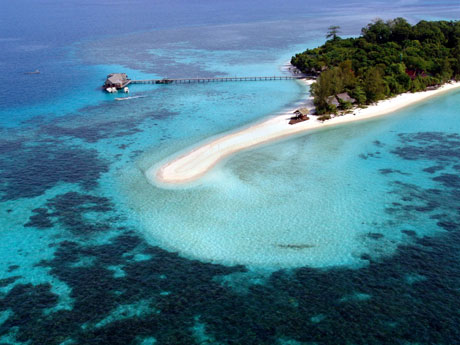
Use this opportunity to show off places like Lankayan island by providing free transfers to the island and subsidised rates for those passengers that would like to go diving.

Offer free trips to visit other attractions such as Gomantong caves, the Turtle island park, the Proboscis monkey sanctuary and of course, for anyone who has their clubs, a round of golf at the golf and country club.

All these efforts should be underwritten by the Sabah Tourism Board. There will be a temptation to see this an an opportunity to make some extra money and even charge more to the cruise ship passengers. This would be a mistake.

Wherever possible, get contact information, email addresses, twitter profiles, tumblr information and track them once they’ve left and stay in touch with those with influence.

Such gestures will also form the foundations for future negotiations with this and other cruise lines who will certainly learn of the generous and proactive approach of Sabah Tourism.

This is a marketing/PR/reputation opportunity and should be seen in such a way. These efforts won’t cost much, will leave an indelible impression on the visitors who will discuss the welcome they received in Sabah for years to come.

Why it pays to build brands not commodities


Mary Portas may not be a familiar name to many in South East Asia but the British born former actress has carved a niche for herself as a no nonsense retail guru.

Portas was responsible for turning the drab and dreary retail graveyard formerly known as Harvey Nichols into the cool, must go to destination now known as Harvey Nicks.

She went on to star in the TV series ‘Mary Queen of Shops’ and ‘Mary Queen of Frocks’ and most recently, she has been challenged to create a contemporary, hip UK ‘knickers’ brand.

The project is ongoing but she has already opened a closed down factory in an area of Manchester, England where the unemployment rate was 70%, created her first range and negotiated with retailers, or should I say bullied them into stocking the range.

You can read more about the project here.

What I like about this is that it may be an example of how it is possible to build a brand in an extraordinarily short period of time. We’ll have to wait to see the results but the brand could be well known and, more importantly, profitable within a year.

What I think is particularly relevant to Malaysian manufacturers obsessed with price but uninterested in the concept of building brands is the following data.

In the UK, cheap underpants retail for about £8 for a pack of three. That equates to £2.66 per pair. Materials, manufacturing, packaging, transportation and VAT accounts for £0.88. The balance of £1.78 goes to the retailer. The margins are minute and if mistakes are made in the manufacturing process or product is rejected, it can be the difference between profit and loss.

Mid range pants cost from £10 – £12 per pair
Materials, manufacturing, packaging, transportation and VAT accounts for £3 per pair. The higher price is because of the better quality materials which allows the higher cost. There is also more profit in this range.

Designer branded pants £35 – £85


Materials, manufacturing, packaging, transportation and VAT accounts for a higher price of between £5 – £15 per pair. The higher price is normally a reflection of the design complexity which means more time on the machines and the fact that more expensive materials such as silk are used. But the ability to charge a significant mark up is what should appeal to any company looking to move away from the commodity business and up the value chain.

Setting up your own brand will require investments in marketing. Something you don’t have to do if you are manufacturing cheap products or on a contract basis. But you won’t be the cheapest forever and once someone else produces cheaper than you, it will be only a matter of time before you are out of business.

5 branding tips for Malaysia Airlines to save its troubled brand


Earlier this month, troubled Malaysian carrier, Malaysia Airlines (MAS) reported a staggering RM2.52 Billion (US$850 million) loss for 2011. Despite the tough economic climate, a number of competitor airlines – British Airways, Singapore Airlines and Cathay Pacific all reported a profitable year.

Soon after, Group CEO of MAS Ahmad Jauhari announced that he will implement ‘strong and immediate measures to stem the flow of losses with staff redeployment, improved productivity and efficiency, further cost controls and more route reviews’ whilst at the same time, he also promised ‘an aggressive sales and marketing strategy’.

Marketing budget doubled
Then MAS announced that it has doubled its marketing budget for 2012. The marketing budget is reported to be as much as 2% of revenue which on 2011 revenue of RM13.90 billion (US$4.63 billion) equates to about RM278 million or nearly US$100 million.

So if the marketing budget is doubled, it means that MAS has more than RM550 million or US$190 million to rebuild it’s battered brand. That’s a tidy sum.

Details of what marketing initiatives the company has in mind are sketchy. Although the company has announced it will provide ‘better and more branded customer experience and embark on a major advertising and promotions campaign in 2H/2012’.

This morning I read that the airline has appointed Ogilvy and Mather Advertising as its master creative agency. I also read this comment on the appointment from Al Ishal Ishak the senior vice president for marketing and promotions, “2012 will be a breakthrough year for Malaysia Airlines on our path to recovery. We recognised, however, that we could not achieve financial success without clearly defining our brand positioning.”

He went on to say, “Ogilvy understood this and throughout the pitch process were best able to translate our message into a powerful campaign idea. An idea that is big enough to help us transform our business and truly engage our customers like never before.”

Before I go on, I have a confession to make, I am a loyal Malaysia Airlines passenger and fan of more than 20 years. During that time I have been on the receiving end of more positive than negative experiences with the airline. So I want the airline to succeed.

But if this is the last chance for this iconic brand, Al Ishak and his team have to get it right. Any advertising campaigns will need to reflect the culture of travel and consumers today and not try to use the traditional high gloss beautifully presented images and TVCs so favoured by the airline industry to ‘clearly define our brand positioning’.

How will MAS spend the marketing budget?
I appreciate it is early days but I have noticed a digital campaign selling the new A380. The style would suggest MAS is going the traditional route using glossy images and slick advertising with high production values to attempt to position the company in the minds of its consumers.

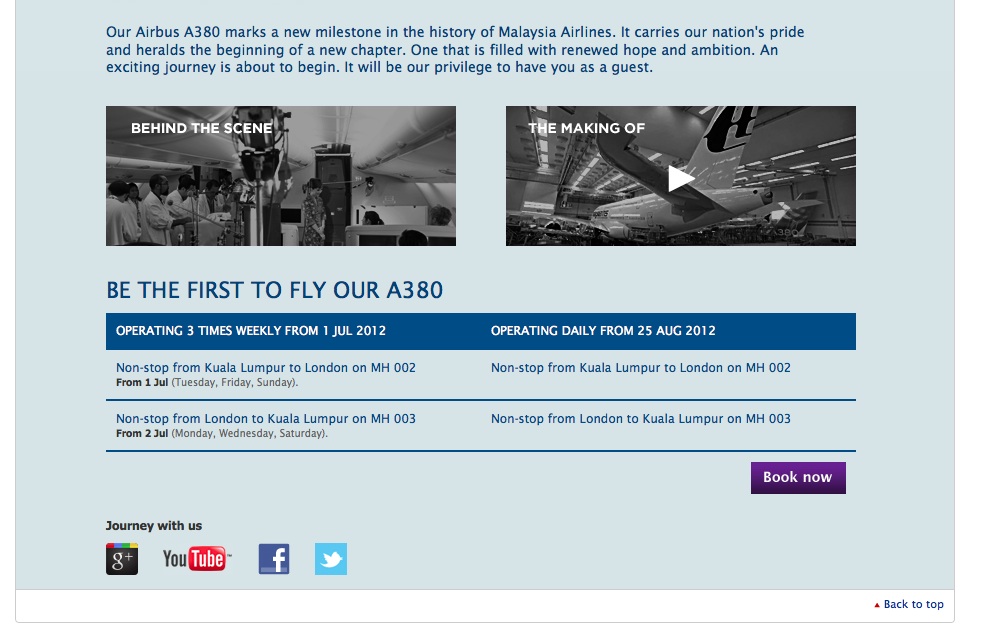
The ad features an image of the A380 in the very attractive new MAS livery and a tagline about the journey which I assume is related to the A380 and one about the aircraft being the pride of the nation. Let’s hope Ogilvy improves on that. Anyway, clicking on the ad, you go to the existing MAS site where you are greeted with the same, larger image of the A380 and the same taglines.

Below the fold there are two black and white images with click through options. The one on the left entitled, Behind the scene (sic) links to still images of the making of the new commercials which look very traditional and my first reaction was what a pity they haven’t changed the cabin crew uniforms. The image on the right links to a video entitled ‘The pride of our nation”, a predictable and uninspiring video of an MAS A380 being painted!

Throughout, the copy is uninspiring.

Below the images are social media options. I had a quick look at the twitter feed and it looks very collaborative with plenty of discussions although efforts to build the brand in the social context can be improved.

But I have a sneaking suspicion that the bulk of that US$190 million is going to be spent on advertising. And as Singapore Airlines learnt with it’s A380s, you can no longer rely on developing a position and using advertising to communicate that position in the hope that it will work and consumers will buy.

Positioning
The problem is that positioning is a throwback to the mass economy that no longer exists. What advertising agencies tried to do was create a position that reflected the strengths and weaknesses of the offering. Ideally, this position was based on being first in a particular category.

If someone was already first in a category, then companies attempted to redefine themselves in a new category to be first. In the airline business, this tended to be related to passenger comfort or service. The effectiveness of positioning depended on the ability of advertising to drive branding perceptions in the mind of consumers.

To do this, airlines often made promises they were unable to keep (admittedly, often due to third party issues out of their control), failed to meet traveller expectations, often because dynamic competitors moved quickly and so raised the bar, which in turn led to brand disillusionment.

Positioning was ideal for the mass economy. It was also ideal for advertising agencies and marketing departments because it gave them enormous power without the responsibility of accountability. Al Ries and Jack Trout invented the concept of positioning. The preface to one of their books states, “Positioning has nothing to do with the product,…. (it) is what you do in the mind of the prospect.” So, essentially this means that the consumer can be made to believe, through extensive advertising and PR and via the right conduits to consumers, and other vehicles, what an offering means to them.

Well I’m sorry, this might have been true in our parents day, when consumers were more predictable, more trusting and had less choice but in today’s mean spirited world, a world in which only 4% of Americans and 14% of Malaysians believe what they read in adverts it is going to be very, very difficult. And of course the problem with using positioning to build a brand is, if it doesn’t work, the money is wasted, time is lost and you have to repeat the process again, with a new position!

So how can MAS save its troubled brand?
1) Research. Your existing customers are your best source of information. But they are not all the same. I would be interested to know which, if any customers MAS talked to when they were configuring the aircraft. MAS is talking about flat beds and big TV screens in first and business. Well that is so last year and who doesn’t offer them so why should I change? What about Internet access? I hope the A380 offers it throughout the aircraft.

2) Mass market branding and the old model of developing a position and communicating that position across for mass media repetatively for as long as possible is no longer effective. Brands today are built on relationships, access, personalisation and relevance. Before MAS marketed to segments of 18 – 34 year olds, businessmen and so on. Today, MAS must deliver economic, experiential and emotional value to to everybody and on their terms.

3) MAS must focus on developing more profitable relationships, not a more profitable product. Brands evolve when companies start buying for customers instead of selling to them.

4) Branding is an organisational not a departmental responsibility. And the organisation is the responsibility of the CEO. MAS is charging about a 100% premium for an economy class ticket on its A380 in July over the price of an economy class ticket on a 747 for the same route. Throw in all the other airport fees etc and it’s going to have to be a pretty good product to charge such a premium.

5) Retention is key to brand building. Companies no longer sell a product, customers buy a product. And those customers have plenty of choice, especially in the airline business. Sadly too many companies spend lots of money on acquiring a customer but very little on retaining them. MAS is one such company. Once a consumer buys the product, companies should do everything possible to hang onto those customers, build relationships with them, learn about them and leverage them.

Bonus tip. This is the social era. As I said MAS is working hard on social media but there is room for improvement and integration. It would be interesting to know how they leverage their social media efforts to get more business.

Successful brand building is determined more by customer experiences than by slick advertising campaigns


Far too many companies, whether Multi National Corporation (MNC) or Small, Medium sized Enterprise (SME) think or are led to believe that the fast track way to branding acceptance is to spend large amounts of money on high quality TV commercials, billboards or print advertising campaigns that showcase their products or services and communicate corporate driven messages to consumers.

But just because telecommunications companies, banks, oil companies, soft drinks firms and others spend considerable amounts of money on advertising doesn’t mean that the advertising is the reason for their success or that it is right for you.

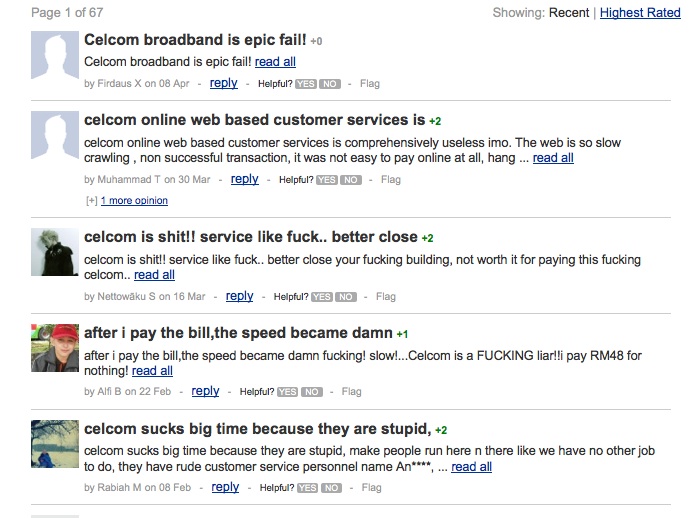
In fact quite often, there seems to be no rhyme or reason to the advertising campaigns initiated by these companies. A case in point is the current Celcom campaign “Ini Wilayah Celcom” prominent on billboards across Kuala Lumpur. With current mobile penetration in Malaysia around 125% of the population, it doesn’t make sense for Celcom to be creating awareness with expensive outdoor campaigns.

Unsurprisingly, at end of many such campaigns, there is often very little change in the fortunes of the brand. Which is why many of these advertising campaigns, do little to build brands and should not be emulated by other companies.

Because a key element of whether or not your brand building is successful will depend not on what you tell consumers through paid media but on the experiences consumers have with your personnel, your business and your products.

Put simply, if you manufacture furniture and spend a lot of money advertising a new furniture range but the furniture breaks all the time, you may make some sales but your brand will suffer as consumers avoid making a return visit and worse, discuss their issues with other consumers on and off line.

Likewise if your staff are slow, rude, inattentive, badly groomed, lack product knowledge, unhelpful and poorly trained, you may make a sale but the customer is unlikely to return and you can be sure they will share their negative experiences with others.

Furthermore, these negative experiences will be spread across the Internet using social media tools and in coffee shops, bars and so on will have a negative impact on your brand. Even sales of previously successful products may be affected negatively.

However, treat customers well and they will remain loyal. In a recent survey by Spherion, 97% of those questioned said a great experience makes them more likely to buy more of a product or repeat a service. However, once they have a bad experience or their trust is lost, it’s very hard to win back. To have a chance of winning back their business, 22% want a simple apology, 10% want a complete refund, and 8% would want incentives or coupons and even then there is no guarantee.

But 46% said that it would take an apology, a complete refund AND coupons or further incentives to have a chance of winning back their business. The implications therefore on your brand, of delivering a bad experience is costly and time consuming.

For the record, 15% said absolutely nothing would atone for their bad experience.

So you can try to shape the perceptions of your products or services with advertising, PR, advertorials, nice brochures and with content across social media and elsewhere but the reality is that the success or failure of your brand will be determined by experiences and how customers discuss your brand after the experiences.

Apple for example charges a premium for its products. It sells the sort of stuff – computers, smart phones, MP3 players – that lots of other people sell yet sells them at a premium. Margins for Apple iPhones are in the region of 50% compared to a meagre 6.2% for Nokia smartphones.

Furthermore, Apple ‘only’ spends US$250 million (2009) on advertising compared with Microsoft US$1.4 billion and Dell US811 million. In terms of a percentage of sales, this equates to 2.4% for Microsoft, 1.3% for Dell and 0.5% for Apple. RIM, manufacturer of the Blackberry spends 3.6% of revenue on advertising.

New technology companies that have sophisticated digital strategies and use email to market themselves spend even less on traditional advertising. Google spends only US$11 million on advertising or 0.05% of revenue. Amazon is a little higher at US$43 million or 0.17% of revenue.

As a general rule of thumb, spending less than 2% of revenue on advertising is considered low. For the automotive industry average advertising spend is nearer 3.5% of revenue. For alcohol it is more like 7% and for packaged goods and most other industries, as high as 10%.

Firms such as Apple, Google, Amazon and others are not successful because they spend huge amounts on short term advertising campaigns to create awareness but on innovative design, quality products and excellent service that is uniformly outstanding across all customer touch points such as in stores, whether bricks and mortar or online.

Consumers will pay more for Apple products because they are guaranteed a quality product (as well as inclusion into a not so unique club of Apple users) that will not fail them. And if it does, customers know they can go back to the store and seek a replacement or have repairs carried out under warranty.

Unfortunately most MNCs and SMEs don’t appreciate just how important the customer experience is. And the increasing popularity of social media means that consumers are voicing their dissent, not just to a few friends over teh tarik at a local Kopi Tiam but now to thousands and thousands of friends and followers and to their friends and followers across communities on Twitter, Facebook and more.

So as you try to build a successful brand, a core component of your strategy must be to build relationships with prospects and customers. You must learn how to manage relationships with customers, not just offline and during office hours but also online and at weekends.

Because unless you have a unique product or service (and few companies have unique products or offer unique services today), customers may buy from you if they have a bad experience but they are unlikely to come back again. And because of increased competition, it is impossible to build a brand on a business model that relies on new customers all the time.

Make sure that at every touch point where consumers interact with your brand, the experience for those customers is a positive one. This becomes a greater challenge as a company grows and if you get it wrong, what was once a nice little niche business with a manageable group of customers who all spoke positively about the company can become, almost overnight a loss making enterprise with fewer customers and a bad reputation for over promising and under delivering.

Ensure that every sales contact, service delivery and customer service interaction that the customer comes into contact with is positive as this will have a positive impact on your brand. Even suppliers need to be treated with respect.

But even if you invest heavily in customer relationships, and even if you keep 99% of your customers happy, there will always be some who are not happy and are dissatisfied with your service. What do you do with them?

The first thing is not to ignore these important customers. Try to get them to explain to you what is the problem. Be prepared to listen and hear stuff that may sound unreasonable. Some customers will be rude, personal and even physical. But you have to make sure your people are trained to listen and empathise. Think KFC!

And where possible solve their problem in a way that is satisfactory for them, not you. I know this might be a problem for you and will certainly cost you money on that particular transaction but in the long run it will offer far greater returns.

If you try to take care of every single customer, both those that are not a problem and those that are you’ll create a positive reputation. Even if customers are frustrated with their experiences with your brand, if you show empathy and provide a solution that makes them happy, there is a good chance they will tell others that they were impressed with you and how hard you worked to solve the problem for them. And with a little incentive, you can probably convince them to come back.

Despite what you may have been told, mass advertising across mass media is not the holy grail to building a brand. Which is fortunate because it means SMEs won’t waste hard earned money on campaigns to compete with large conglomerates. But if you look after the customer and try to make every experience a positive one, you will speed up the process of building a brand.

Thanks to zendesk for the graphic above.

Is Pinterest right for my brand?


So you run a small business and you’ve invested loads of valuable man hours developing social media profiles on Twitter, Facebook, Linkedin, Flickr, Tumblr and Youtube.

You were about to relax and then Google+ launched so you created another profile.

That was the easy part. You then started engaging with consumers, prospects, customers both satisfied and unsatisfied, suppliers, potential partners and so on. You posted images, retweeted articles, learned a lot and realised it is possible, all be it for only a few weeks, to run a business on three hours sleep a night.

And now, just as you’ve got into a rhythm, Pinterest has arrived with a label of ‘the next big thing in social media.’

Pinterest is an online pinboard that lets you post images, organise them and share them. It’s a digital scrapbook of images listed under themes such as wedding gifts, favourite foods, redecorating and so on.

The site looks and feels good, with clean lines, an easy to use model that reflects the short attention spans of today and frankly, it’s not very sophisticated, which is probably why it is so popular.

Pinterest, clean, neat look and feel

And popular it is. Launched in 2010, it has experienced phenomenal growth. The site had 1.6 million unique visitors in September 2011, 7 million in December and 11.7 million in January 2012. In six months, from July 2011 the time visitors spend on the site has risen from 38 minutes to 98 minutes. Crucially, Pinterest is reported to be driving more traffic to more company websites and blogs than Google+. Linkedin and Youtube combined.

Some companies such as jewelers, wedding planners, furniture stores, clothing retailers and food companies are reporting sensational sales spikes after joining Pinterest.

Currently most of the content is posted by women and it is very USA centric. But what is it about Pinterest that is seeing such rapid growth, is it sustainable and most important of all, should you invest more valuable resources in Pinterest?

Firstly I think the growth is like that of many social sites these days. Early adopters initiate the stampede and then, because of the global nature of the Internet, others follow quickly.

What is also key is that the decision making process for consumers is changing from one inspired by slick corporate messages aired accross mass media to information posted online by friends or associates with similar interests.

If for instance I’m a hiker and I’m looking for accessories for a hiking trip, Pinterest may offer a simple way of gathering information during the research stage of the buying process.

I could find a rucksack or tent etc on a friend’s Pinterest board and review the comments of other hikers to determine if the rucksack or tent is suitable for my needs. If I am going somewhere unusual or perhaps with some hostile terrain, I could look for comments from others who have used the rucksack/tent in the same location or somewhere similar.

I could use the same process if I wanted to go to a new destination and want to see images of the destination, not the hotel produced images but those of people like me.

Like all new social initiatives, no one knows if the growth is sustainable so I’ll avoid that one!

Creative people, and those looking for a job or a freelancer seeking employment are using Pinterest to share samples of my work.

So the final question is, should you invest your valuable time in Pinterest? Basically that depends on your product. If you have something that is visually intersting, unique even then it may be right for you.

It certainly doesn’t take much effort to set up an account and it is easy to create your own pinboard. It also has neat little apps like the ‘Pin it’ button that you can add to your website. Then, if a user likes something they see online, they can add it to their own website with one click.

Of course there may be some copyright issues and this link is to a very good article on the potential legal ramifications of using Pinterest.

Pinterest can also offer you inspiration by looking at images posted by others in your industry.

So my advice is yes, take the plunge, set up a Pinboard and say goodbye to that remaining hour of sleep.

If anyone in Malaysia, Thailand, Singapore or Indonesia has set up a Pinterest page, let us know how you are getting on.

Some good news for Toyota


Japanese automotive brand Toyota, has had a tough couple of years. Natural disasters in Japan and Thailand caused parts shortages that curtailed vehicle production. The company gained and then lost the crown of top selling car brand in the world.

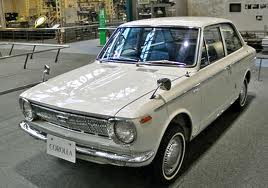
But one of the company’s many brands has managed to bring a smile to the face of executives at the aggressive automaker that is building factories in Thailand, China and Brazil to catch up with other manufacturers and gain market share in developing markets. The Toyota Corolla has now chalked up global sales of 37.5 million units since production began in 1966 and it is now the world’s best selling car ever.

The first Corolla was sold in 1966
The 2012 version of the top selling car of all time

That means that roughly one Corolla has been sold somewhere in the world, every 40 seconds for the past 40 years. The Corolla’s success can be put down to the fact that it has always been inexpensive to buy, run and service and was always reliable.

Such basic principles are a recipe for a successful brand.

AirAsia brand hits turbulence


A week ago, AirAsia X CEO Azran Osman-Rani announced to much fanfare, a new service between Sydney and Kuala Lumpur.

Soon after, the Australian Competition and Consumer Commission, (ACCC) an Australian consumer watchdog announced that it has launched a court action against AirAsia, alleging the company is misleading consumers in its advertisements for flights out of Australia.

This follows negative press after AirAsia X recently announced it was ceasing flights to London, Paris, Mumbai and New Delhi and criticism by Neil Warnock, the former manager of Queens Park Rangers football club, owned by AirAsia chairman Tony Fernandes after he was sacked.

Although the company acted quickly and decisively with offers of refunds or alternative travel at no extra cost for passengers who hold tickets for future flights to Europe and India, in terms of customer loyalty, these latest developments won’t do the brand any favours.

Especially as the airline is also copping plenty of flak for it’s opaque charging and poor engagement skills on social media, as seen by this image taken from a disgruntled customer on Facebook.

The former AirAsia fan says the image was taken down after 10 minutes when he posted it on the company Facebook page and he has since been barred from posting anything on the AirAsia Facebook page!

Hidden or extra fees add almost 100% to cost of Kuala Lumpur to London ticket on AirAsia

According to the ACCC, AirAsia’s website did not include all taxes, duties, fees and other mandatory charges when advertising fares on certain routes from the Gold Coast, Melbourne and Perth. In Australia if a company wishes to advertise part of a price, it must also advertise one total price for the product or service.

Brands are defined by the economic, experiential and emotional value they deliver to customers. Fail on any of these counts and your brand will struggle. The disgruntled Facebook customer and customers like those in this article have undone a lot of the work AirAsia has done to build a people friendly brand.

As Low cost carrier brands grow, charging extra for food and entertainment may be acceptable on short or medium haul routes but many consumers see it as unfair on long haul routes so strategic changes need to be made if they really do want to build brands.

Building a brand in the consumer economy is more than the CEO and Chairman tweeting all day. It requires a strategic plan with processes to deal with reputation issues and a willingness to engage with consumers who raise positive AND negative issues on and off line.

The reality is that AirAsia probably had little choice in cutting unprofitable routes to India and Europe.

But what it should have done was have a strategy in place to announce the changes and a plan to communicate with existing ticket holders to inform them and work with them to solve their personal issues in as seamless manner as possible.

A Facebook page with direct access to a community director and suggestions for alternative routes or airlines and how to go about booking flights would have been a tactical initiative to show the airline cared.

Such an effort may be a relatively time consuming and expensive initiative but in the social economy, one that is imperative and one that will pay retention dividends.

The Chinese are coming


Here’s an interesting thought for all destinations currently writing or reviewing their long term brand plans.

Despite the global economic meltdown, the SARS issue, Terrorist bombings in Bali, Spain, NYC and other places, the UN World Tourism Organisation writes that, “in spite of occasional shocks, international tourist arrivals have shown virtually uninterrupted growth: from 25 million in 1950, to 277 million in 1980, to 435 million in 1990, to 675 million in 2000, and the current 940 million.”

These figures have been helped, on the whole by tourists from emerging markets. Thanks to a booming economy in the 1980s, the Japanese were the first non European/North American country to have an impact of the travel industry. This outbound tourism programme was actually driven by the Japanese government which launched what it called the “Ten Million Programme” to double outbound tourism departures between 1986 and 1991.

Many Koreans also travelled overseas in the 1990s when their economy boomed and we shouldn’t forget the Arabs who have always travelled, especially to Europe and the USA.

But it is the Chinese that are really going to impact the travel and tourism industry like never before. In 2002 ‘only’ 10 million Chinese travelled overseas and those tourists spent US$15 billion.

Between now and 2021, The World Travel and Tourism Council (WTTC) predicts that up to 125 million Chinese will travel overseas and they will contribute US$100bn in overseas spending.

Chinese tourists are already making an impression in Singapore where they spend on average S$1,200 (RM2,880) each, 20% more than the average international traveller. In 1H2011, the Chinese spent S$969mil (RM2.3bil), making them the second-largest spenders behind Indonesians, who spent S$1.33bil (RM3.19bil) in the same period.

At the height of the ‘Ten million programme’, about 17 million Japanese travelled overseas. But it felt like they were everywhere and many newspapers wrote rather negatively about the arrival of the polite, shy and wealthy Japanese.

Imagine what it will feel like with over 100 million mainland Chinese interacting with the local populations in London, New York, Rome, Madrid and other cities not used to the less demure ways of middle kingdom residents!

So as you work on the research for that brand plan, should you be looking to the traditional source markets of the West and investing in 5 star resorts on white sandy beaches or gleaming shopping malls with designer labels and perhaps a casino and theme park?