I read somewhere that out of approximately 25,000 new products launched every year, 22,000 fail to survive more than 18 months. That’s not a great record and one that brand builders should be ashamed of. Now you probably think I’m about to launch into a monologue about using advertising to build a brand. I’m tempted to but it’s Friday so I’ll spare you the rant.
Instead here’s a nice list (well nice, except for number 16) of 16 brands that made it past the first 18 months but eventually despite millions spent on advertising (oops, sorry) they died and went to brand heaven. What’s so unique about this list is that all of them have come back from the dead and, certainly in the case of number 16 are haunting us once again.
Moleskin died, went to heaven, came back 10 years later and now earns £76 million a year
Anyway thanks to the Daily Telegraph for the list. I’m sure the old codgers amongst you will smile at the memory of some of these brands.
Please forgive the crude title but if you read on you will understand why I don’t have a choice.
I remember a few years ago Fusionbrand interviewed a young guy who was about 24 years old. He had only been working for 3 years but had already won more than 25 awards. I can’t remember what they were for but none of them were significant. However he genuinely believed winning those awards meant he was good at what he did and could command a bigger salary.
Nowadays, there are so many award shows for the advertising industry that one of them, in an attempt to stay different, has dropped the word advertising from the title. We’re regularly asked to propose ourselves for awards with suggestions on how to ensure we win. We’ve never done so which is why we’ve never won an award but have always been asked by clients to do additional work.
I don’t know if these award shows are an attempt by a dying industry to stay relevant or perhaps it’s a genuine belief that handing out awards to just about anyone who pitches up for work really will help keep advertising relevant.
Proudly display this award in your reception area
Anyway, there are some people in the advertising business who don’t take themselves too seriously and have noticed the handing out of awards has got out of well, hand. So they’ve created an amusing distraction for the digital era or for those who haven’t won enough awards. The Handy Awards website and app let’s you award yourself an award for anything you want.
All you need to do is download the handy awards app and shake your phone and you’ll win an award. The longer you shake the phone, the better the award. For those with real determination, there’s a Best in Hand award but that takes some real shaking but I know you can do it. And the good news is you can share the award with a friend.
You can even share your impressive award with a friend.
As the site says, “The Handys are the world’s first advertising award show where you can give yourself an award in the comfort of your studio apartment or at your desk within your agency’s open office. All without entering any work or having to sit through someone else’s boring case study video.”
It would appear that, judging by the awards it is only open to male creative wankers but sticking with the crude nature of this post, perhaps there is a female award, err coming?
Advertising campaigns are as common as muck. We’re oblivious to most of them and even when we see one we like, we very rarely buy the product. And it doesn’t matter whether it goes out across social or traditional media, the reality is most advertising is simply noise.
Even if we do buy the product, we’re often let down at some stage of the experience. Because most firms don’t spend enough time and money on looking after us once we’ve bought something, even if the product works well, any positive perceptions created early on are destroyed later when there is an issue and the brand doesn’t respond well. When this happens, many of us become brand activists, for all the wrong reasons.
In the social economy, this can have a devasting effect on the brand. Harvard Business Review went as far as to say, “Traditional marketing — including advertising, public relations and corporate communications — is dead.…in today’s increasingly social media-infused environment, traditional marketing and sales not only doesn’t work so well, it doesn’t make sense.”
The book has been selling well and there is a lot of interest in Asia. Recently the prestigious CMO.com interviewed me and you can read the full interview here.
I think the interview works well and anyone who runs a business and is looking to build a brand should read it and if you like it, buy the book. Seriously I think you will learn a lot.
Thanks to Bobby McGill at Branding in Asia for doing the interview.
Rumour has it that Malaysia Airlines CEO and managing director Christoph Mueller is quitting the airline before the end of 2016.
If this is true it’s a major blow for the carrier that announced its first monthly profit in years in February 2016. Although it won’t come as a surprise to many who spotted tension between Mueller and Khazanah late last year when he announced the new Malaysia Airlines brand would be launched in December 2015.
The CEO was quoted as saying, “The entire brand needs a ‘refresh’ and will be like a start up with a new culture, values and ideas” However, the brand continued in the same livery with little change to the product or values and ideas. Well little positive change anyway.
And then in January 2016, Khazanah Nasional Chairman Tan Sri Azman Mokhtar said “undertaking a rebranding exercise without having a strong foundation would create a vacuum in the carrier.” This comment can’t have gone down well with Mueller.
This comes at a time when the Malaysia brand is struggling to overcome numerous negative issues and is a massive setback for the carriers reputation and that of the country.
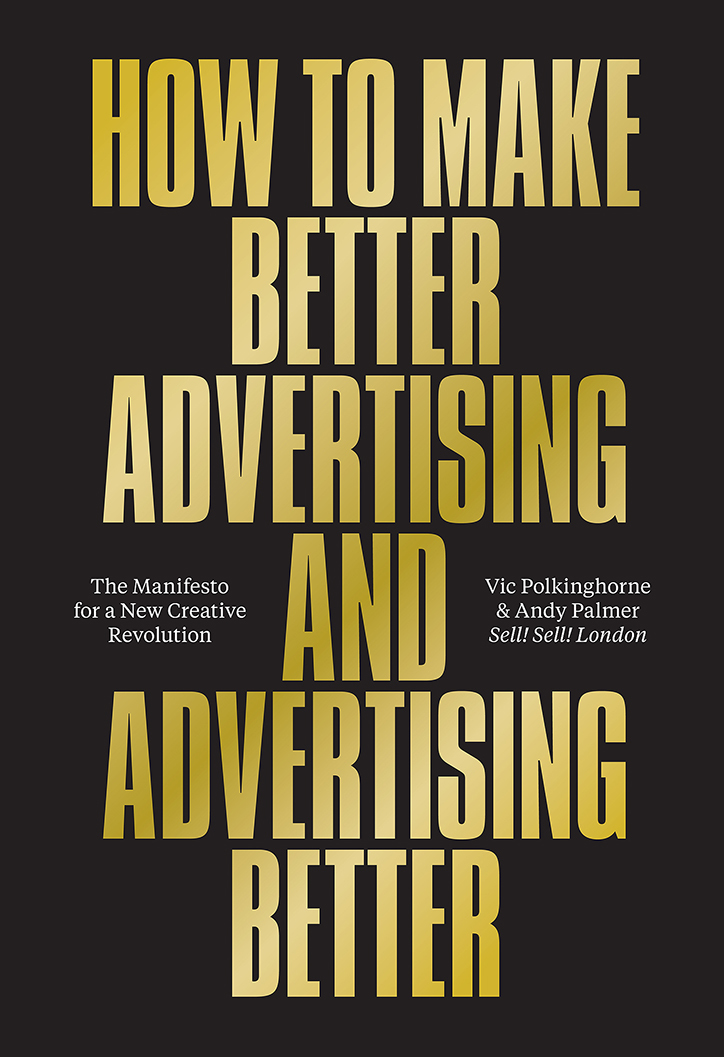
There’s a small creative agency in London called Sell! Sell! The agency is run by Vic Polkinghorne and Andy Palmer and they’ve co-written a potentially interesting new book called ‘How to make better advertising and advertising better‘. This new book shouldn’t be confused with the equally new book ‘Stop Advertising, Start Branding‘ which was written by me.
But I think there will be some similarities between both books because neither of us are happy with the state of advertising today. Here’s a quote from the Sell! Sell! website. “And the poor old punter is left faced with advertising that is at best forgettable, and at worst insulting to the intelligence. Surely there’s a better way?”
Now what we think that better way is may be different. So I’ve ordered a copy and will let you know whether it is and what I think of the book. In the meantime, I have read some interesting reviews online and you can read one of them at the creative review website that is already generating some fascinating comments.
Make it better or bin it
The book has also garnered some interesting testimonials including “This book is full of common sense. Which is rare, so it’s actually full of uncommon sense.” Dave Trott.
And this one from Bob Hoffman “The ad industry is in an unprecedented state of confusion. While the assertions and pomposity grow majestically, the advertising itself diminishes rapidly. Sadly there is no button we can push that will erase all the arrogance and self-delusion. Fortunately we have this book. It might be just the reset button we all need.”
Attached is a press release for Stop Advertising, Start Branding. This is a book about change. Yep, another one. The difference is, this one is about changing back to what you and everyone else used to do. It’s about laying the foundations before building the house. It’s about researching the destination before getting on the plane.
Stop Advertising, Start Branding on sale now
That’s right, it’s about getting the fundamentals in place before coming up with the creative, the quirky, the clever, the funny, the whatever. Far too many brands try to compete in their markets today without doing the right research. Without even communicating to their staff what they are trying to say. At other times they don’t even know if they can deliver on the promises made. That’s mad and why so much advertising doesn’t work.
Stop Advertising, Start Branding is a book that doesn’t have a title with an animal name in it. It won’t win a creative award for the cover even though it looks great. It’s normal, it’s a bit thicker than many branding or marketing books today but that’s because the information you need to build a brand takes up this much space. Sorry.
But if you read it I’m confident it will make you stop advertising and start branding. Which means it’ll save you a lot of money because let’s face it, most advertising doesn’t make much of an impression on anyone.
And you can use the money you save to build a brand your people buy into and want to work for. And once they do that they’ll be able to deliver on the promises you make. And when they do that, your customers will come back to you time and time again and they’ll tell others how great you and your product are. And when that happens you’ll make a lot of money.
OK, it’s not that easy but that’s why the book is 300 pages and that’s why I wrote it. If you want to find out how to build a brand without wasting massive amounts of money on advertising, I suggest you get a copy from your local Kinokuniya, MPH or Times bookstore in Malaysia and Singapore or from Amazon in the UK. And if they don’t have it, make sure you complain and order it or call us at +603 7054 2075 and we’ll sort something out right away.
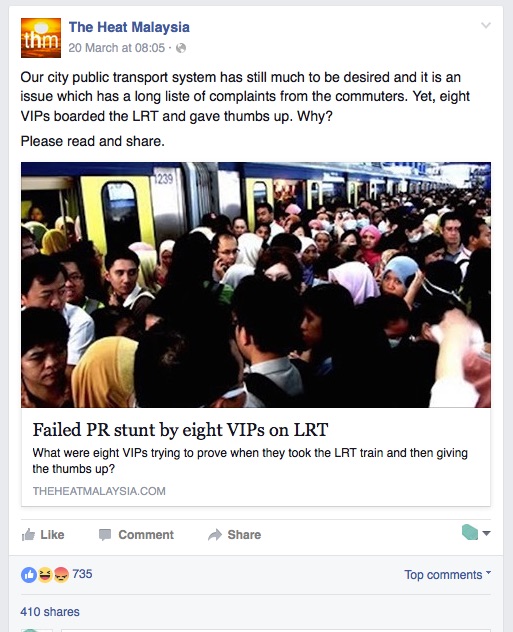
RapidKL the operating arm of Government ownded company Prasarana recently took 8 corporate leaders on the Light Rail Transit (LRT) so that they could experience public transport and more importantly, be seen to be taking public transport in an apparent effort to “encourage the culture within their organization(s) and the public in general, as well as obtain their feedback for further improvements. This is a continuous effort from our end to get key leaders more involved in understanding the need to further enhance public transportation services in the country.”
However, The Heat Malaysia, an increasingly popular source of news for Malaysians called the event a ‘failed PR stunt’ and wrote a long article critizing the event and suggesting Prasarana misled the public by claiming it took place during peak time when in fact it happened between the hours of 11am – 2pm which can hardly be considered peak time.
Prasarana responded quickly with a decent explanation that was duly published at the end of the article. The Heat Malaysia site doesn’t appear to allow comments and it’s not possible to tell how many people shared the article on social media.
But never mind, all well and good so far and for many stories, this is quite often where it ends. Unless of course it is related to an issue that is close to commuter’s hearts. And public transport is definately close to the commuter’s heart. Which is probably why the Heat Malaysia didn’t leave it at that. They know a story with legs and so they also published the article on Facebook. And that’s when things started to fall apart.
Once the story gained traction online, instead of participating, Rapidkl went awol
Within hours, there were more than 50 comments on the post, nearly every one of them negative. By 2.30pm in the afternoon, Rapidkl cobbled together a predictable, corporate response, “Dear The Heat Malaysia, the recent online reports by the media covering 8 key corporate leaders riding the LRT during “peak hours” was inaccurately reported and had caused anxiety among some of our commuters. Please allow us to correct the facts and inform that the hour spoken refers to the afternoon “lunch crowd” and not peak hours as mentioned in the reports. The leaders were given an opportunity to experience taking public transportation as an effort to encourage the culture within their organization and the public in general, as well as obtain their feedback for further improvements. This is a continuous effort from our end to get key leaders more involved in understanding the need to further enhance public transportation services in the country.”
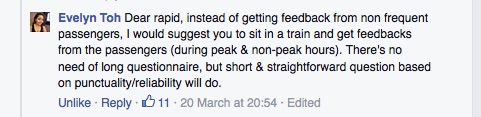
This typically contrived, corporate driven, out of touch and dated response generated even more negativity with Evelyn Toh asking what all of us were thinking would have been the right approach from the start:
Great question Evelyn
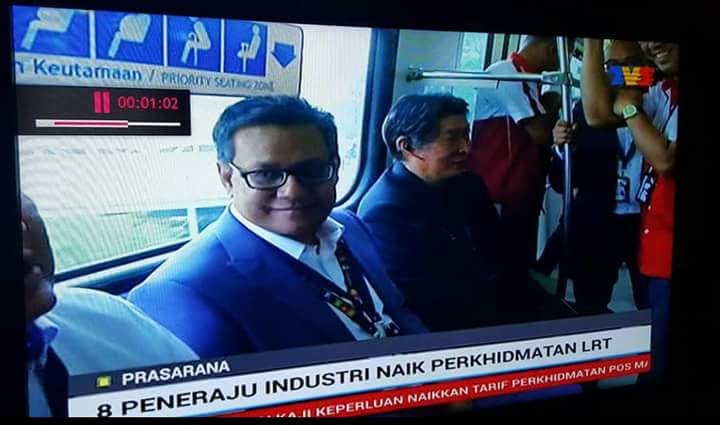
24 hours later there was no let up in the abuse. And when Halim Hassan uploaded this image of the VIPs sitting in seats reserved for the elderly and disabled, what started out as a good idea, became an unmitigated disaster.
Not a good idea to sit in the disabled/special needs seats
However, there was still a chance for Rapidkl to salvage the situation. If it had shown its human side, put it’s hands up and apologised, explained how their intentions were honourable, how they were trying to get more cars off the road, increase use of public transport and make life better for everyone and that in future they would go out and meet with real, genuine commuters and not chauffeur driven VIPs and done a few other things it could have recovered the initiative.
But they did what far too many firms do and ran away from the problem. Despite The Heat Malaysia Facebook post getting more than 500 Likes and 164 comments, Rapidkl refused to participate in the narrative. Hoping it would instead go away. This is a classic example of how not to approach social media. Social media is your friend but the best bit of advice I can give any company is that if you intend to use it as part of your brand strategy then the first thing you have to understand is that you must be social, not do social.
Too many brands think that social media is to be used in the same way as they’ve been using traditional media – as the base for a series of poorly thought out ad hoc tactics pushing a corporate driven message. Social media is not something you do, it is something you are. Which means that the people responsible for your social media communications must know what they are doing. Being young does not qualify you for managing a firms social media communications.
And any social media initiative must be part of a clearly defined brand strategy. This is not rocket science yet so many companies feel they can simply jump into social media with an idea and announce the idea and expect it to spread out across the eco system in a perfectly choreographed, positive manner. This of course rarely happens. But until senior management learns and understands social media, and actively participates in social media, most social media projects will fail because the corporate culture dictates social media competencies and if the CEO is non committal then the culture will be non committal and that’s the wrong place from which to start.
The strategy is so important. All bases must be covered. The ‘what if’ scenarios must be carefully thought through and prepared for. And the team designated to develop the narrative must have the skills required to address any issues and communicate effectively and in tandem with the overall goal.
The irony is that Rapidkl had a good idea but they didn’t understand how to implement the idea and certainly didn’t know how to develop the narrative around the idea on social media. And as soon as it went wrong, they panicked and shut down. Nevermind, all is not lost. The public are a forgiving lot. The next steps though will be crucial. Let’s see what happens.
Place branding is a generic term for all the elements of a nation or country brand, cities, states and regions and even destinations within those areas. In South East Asia alone there are more than 600,000 destinations competing for investment, talent and tourists. In an effort to match their destinations to stakeholder requirements for value, smart places are developing brands that investors, talent and tourists embrace.
Our company Fusionbrand is working on a brand for one state government in Malaysia and in the past have worked with other state governments, tourism boards, enterprise zones and the Malaysia Tourism Board. It’s always a privilege when we win a destination or place branding project because such projects have a major impact on society.
Many nation brands are victims of the politician’s need for quick wins
The Place Brand Observer heard about our work and got in touch with me in February and suggested an interview. The Place Brand Observer is a fantastic resource for anyone responsible for branding nations, cities, states and regions, public diplomacy and reputation management.
The site features insights into the industry, interviews with experts in destination branding from around the world as well as tutorials and case studies of successful branding of countries, regions, cities and destinations. It’s a meeting place for the brains and the brawn of the place branding industry. If you are involved in place branding or simply want to know more about the industry, I strongly recommend you sign up for their excellent news feeds.
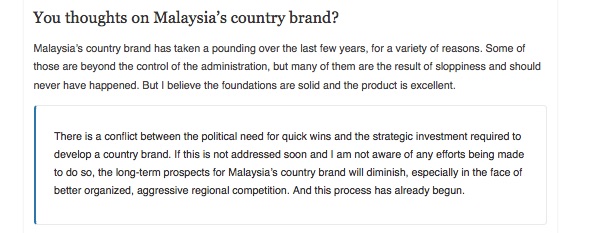
You can read the full interview here . I thought it was a really good interview and we discussed data driven branding, country brands, Malaysia airlines and the link between the legacy carrier and the country. I hope you find the time to comment, good or bad!
Malaysia’s January automotive sales nose dived 12% to 44,591 units although this was expected after the record highs of December 2015. Japanese firms were hardest hit with Toyota sales down 27%, followed by Nissan 22% and Honda down 12%.
It’ll take more than a new logo and a dubious tagline to stop Proton’s slide
Proton continued its slide with sales down 13%. And even though Perodua sold less cars this Janaury than it did in 2015, the relative newcomer to the industry saw its market share increase to 35% giving it more than double Proton’s market share. In an effort to stem the bleeding, Proton has created a new logo and tagline but Perodua is undeniably Malaysia’s number one automotive company.
Mercedes Benz sales went through the roof with a year on year increase of 139%. Mercedez Benz sold 1,027 units in January 2016, up from 430 in January 2015. Mercedes Benz was the only top 15 brand to sell more cars in January 2015 than it did in December 2015.
BMW and Audi probably spend more on traditional advertising than any of the other luxury brands and have been particularly active recently but neither brand was able to match the performance of Mercedes Benz. Audi sales were down over 40% in January over the previous month although they did manage a modest 9% gain over January 2015.
BMW fared better with a gain of 23% over January 2015 but compared to December 2015, sales were down 25%. This fall in sales would probably explain why BMW is now offering a longer warranty although anecdotal evidence suggests the BMW brand is losing its lustre in the local market.
But of most interest to me was the performance of Mazda. Mazda has come from nowhere to take 3% of the market share in Malaysia, up from 1% five years ago. This is an extraordinary feat because Mazda spends very little on advertising. Which is probably just as well because the advertising they do revolves around the words ‘ZOOM ZOOM’ and poorly written copy.
Seriously, what is this ad saying?
For instance ‘A new era of driving experience’ doesn’t make sense. The copy begins, ‘New levels of freedom, new levels of versatility. New levels of pure enjoyment on the road.’ Obviously the person who wrote that doesn’t drive on the roads of KL. Certainly not during the daily commute or on a wet Friday afternoon.
The copy also breaks the cardinal rule of not providing any solutions to problems but instead rambles on about nothing. I mean seriously, how can the CX-3 really be ‘designed and engineered to evoke emotions by closely matching human sensibilities?’ Get real. The copy is cold and doesn’t talk to anyone and ends with Zoom-Zoom is unique. It certainly is. I could go on but I’ll spare you the pain.
This is what I meant when I wrote my book Stop Advertising, Start Branding. It’s not that you should stop advertising, it’s that you should stop poor or weak advertising. Mazda is doing really well at the moment in Malaysia and globally. It has tripled its market share and could be on to something spectacular. But it needs to do more than churn out this sort of advertising because it is wasting money and it may have a negative effect on the brand. It needs to Stop Advertising, Start Branding.
I am yet to visit a Mazda showroom so can’t tell you about the experience. I will endeavour to do so and we’ll do some research and report back to you.
Back in July 2013 I wrote a post about how Proton must fast track its branding activities. You can read the full article here. Two years before that in 2011 I wrote about that the first rule of auto advertising was ‘to keep it real’. You can read that post here. More on this in my next post.
The first post quotes then Proton Edar CEO Hisham Othman as saying that the company, “Would pay greater attention to product quality and customer service.”
Fast forward to March 2016 and Proton Chief Executive Officer Datuk Abdul Harith Abdullah is promising, “new product introduction, network rationalisation, the introduction of new dealers and upgrading of services at our centres.”
Proton is in big trouble. Its market share has dropped from close to 80% to 17% in little more than 20 years. Proton service centres rarely deliver on promises made and many consider the cars to be inferior to the competition and over priced.
In other words, the brand and its reputation is in tatters. Abdul Harith has acknowledged the problem and has vowed to “reform and rebrand.”
What we don’t know at this stage is what Abdul Harith and his team consider to be a rebrand. Certainly some of the noises coming out of the firm are good.
For instance he stated at the weekend, “We have an audit team going out there to make sure that key performance indicators are met.” That’s a good start. The service centres and their ability to look after customers are key to this rescue mission. On this matter he said, “To address the poor quality of our customer services at after-sales operations, key improvement initiatives will include network rationalisation, the introduction of new dealers and upgrading of service at our centres.” Owning up to the faulty hose deception is another good start. As is getting rid of crap dealers, as long as they aren’t replaced with more crap dealers.
Meanwhile, Hong Leong Investment Bank wrote in a report that, “negative consumer perception on Proton’s quality has been a major blow to the national carmaker for many years.” The report adds, “various programs have also been introduced to improve (the) customer experience and provide more value-add services, such as courtesy car service, pick-up and delivery service, quick service money-back guarantee, mobile assist service and one-stop customer care line.” I know what you are thinking – this isn’t the first time Proton has gone through this process.
So can Proton survive? Provided the new Proton cars really are exceptional and meet target market requirements for value. If they are still poor and the team tasked with implementing the rebrand don’t know what constitutes the level of service consumers are looking for and they are able to train the service centre owners and staff to deliver meet those requirements for value at every touch point and every time, it has a fighting chance.
In other words, a rebrand is not the CEO standing up and repeating what his predecessor said 3 years ago. It’s not a change of logo or an advertising campaign. It’s a ‘fit for purpose’ product that is able to deliver on promises made. It’s a comprehensive overhaul of all the processess and systems involved in delivering the value the customer needs.
It’s the collection of data and having the knowledge to interpret and use that data. It’s the ability to deal with issues and crises in an open and transparent manner. It’s the ability to work with potential customers, assuage their fears with solutions that matter to them, and often only them. It’s about going the extra mile, time and time again and often in different ways.
It’s about communications that resonate. Not about a ‘big idea’ created by an advertising agency or the CEO. It’s about talking to customers in a language that they understand and will address their concerns.
It’s an ongoing relationship with the customer that turns them into fans and advocates. If all these are in place then Proton could achieve it’s target of 150,000 vehicle sales this year and start to reverse the decline in its market share.
This is the first in a series of articles where we will track Proton and see how it is doing.





 brandconsultantasia.com