Should destinations brace themselves for a brutal summer?


Grant Thornton has published a report that forecasts 373,000 visitors to the Football World Cup in South Africa in June. That’s a drop of 110,000 from original forecasts.

The big question is, are fans waiting to the last minute to book tickets or is this a sign of the recession? Certainly political tensions in the country may be causing fans to wait and see before making a decision on a significant financial commitment. After all it’s not just the match tickets. Fans also have to take into account the cost of flights, accommodation and internal travel which can be significant distances. Grant Thornton predicts fans will have to fork out US$4,000 each. For a family of four, that’s US$16,000 for a summer holiday in a recession! Hard to justify.

But I believe that the poor ticket sales are a result of the global economic situation. And if I am right, destinations in South East Asia could be heading for a brutal summer.

I think that free spending Europeans will forego an international holiday and instead invest in a large LCD or Plasma TV and stay at home to watch the World Cup. If they do go away, it will be either for a short domestic holiday or somewhere in Europe. I expect Eastern Europe to benefit.

If I am right, what should destinations do to soften the blow?

Well the first thing is to curtail one-size-fits-all mass market TV advertising communicating the usual white sandy beaches, tropical blue skies and azure seas. There is simply no differentiation from other destinations. Consider this comment from Qualitative research carried out by FusionBrand in the United States earlier this month,

“Watching the basketball today and an ad came on for a destination with some really nice water/resort images. It was Malaysia. But is (sic) struck me that the line Truely Asia gave me the feeling that they were trying very hard to say, “us too”. It gave me the feeling of them saying “we’re just like the other (good things) in Asia”. But the images in the ad could have been in the Carribean.”

How confusing is that?

There is no time to build a communications strategy for 2010. If it hasn’t already been done, and at least 2 countries in South East Asia don’t have a plan for 2010, it is too late. But there is still time to develop an integrated tactical approach to activity based not geographic based marketing.

Thirdly, embrace social media, NOW. Start to engage prospects and those who have visited via social media. Redistribute resources, train staff and create teams to build relationships with consumers via Facebook, Twitter, Travelocity, Tripadvisor and others. Forget about the old global buys on CNN and the BBC. Creating awareness via mass marketing wastes valuable resources and anyway, consumers aren’t listening. Reinvest that money in engaging consumers.

Fourth, don’t ignore the traditional web. Make sure your website is as contempory as possible. If you are sitting back thinking, why do we need to change or improve our website again, we updated it two years ago, the Internet is fluid. Destinations need to be seen as dynamic. Singapore is on its third design (and best so far) in two years.

Develop a plan for your digital tactics and don’t forget basic web marketing tools like SEO and SEM.

Call emergency meetings with all stakeholders – representatives of the mayor’s office from all key cities, transportation companies, travel agents, tour operators, shopping malls, hotels and so on. Identify what each has to offer and work with them to develop an integrated holistic plan to leverage their attributes and match those attributes to the requirements of target markets.

2010 is going to be a bumpy ride for cities, states and other destinations. This is an emergency and it calls for emergency measures.

Otherwise the 30% drop in arrivals in South Africa will be duplicated around South East Asia. And without the attraction of a World Cup, they could be magnified, causing many destinations to have a brutal summer.

Your communications are critical.

Another argument for building brands


A year ago, the Wall Street Journal was telling us that wealthy consumers were suffering from ‘luxury shame’. Others were talking about the end of the luxury business. Certainly, the luxury business took a massive hit when the sub prime crisis blew up and the repercussions were still being felt at the end of 2009 when many luxury manufacturers and retailers reported poor sales over the traditionally lucrative Christmas and New Year period.

But even a global financial meltdown doesn’t seem to be able to keep the wealthy out of the stores for long as the luxury industry outperformed the MSCI World Index over 1Q 2010. And unsurprisingly, the wealthy don’t head for the department store to save pennies on same store brands.

So what brands are people, sorry the fabulously wealthy buying? Here’s a quick round up of the most popular brands at the mall or wherever it is the wealthy shop!

Last weekend, the Ferrari 599 GTO was officially unveiled at Modena’s Ducal Palace in Italy. This is the legendary brands fastest road car and does 0 – 100km/h in 3.35 seconds! Although a number of key clients were at the launch, all 599 units of the US$450,000 (RM1,500,000) monster have been sold.

Still with cars, top end ‘more affordable’ brands are also performing well, despite current figures reflecting the anniversary of the peak of the scrapping scheme in Europe. In Germany, car sales plummeted 26.6% last month, year-on-year, but Mercedes declined only 6.1 per cent, while BMW sales rose 9 per cent. During the same period in China Mercedes and BMW both increased their sales in 1Q 2010. Audi meanwhile was up a respectable 77%.

Here in Malaysia where cars are subject to astronomical taxes, BMW Malaysia sold 250 of the 7 Series from January 2009 to March 2010. With the cheapest 7 series costing around RM650,000 (US$200,000) and the top of the range 760Li costing RM1,400,000 (US$435,000), that’s impressive and shows the resilience of luxury automotive brands.

Down south in Singapore, Mercedes-Benz delivered 1,139 passenger cars in 1Q 2010, a 22.7% increase over the same period in 2009. Not to be outdone, BMW sold 960 units during the same period, a robust 29% increase over the same period.

Porsche meanwhile announced last week that orders for the latest version of the Cayenne SUV, due to arrive in European showrooms in May 2010 and priced at €56,000 (US$75,000) price tag, were ‘stronger than expected’.

Over in India, Porsche Design recently opened its first store in New Delhi, joining Prada, Louis Vuitton, Ferragamo and Mont Blanc to name a few luxury brand also taking up residence in the capital of the republic. Louis Vuitton now has 5 stores in the country.

LVMH, the company behind luxury brands such as Dior, Louis Vuitton and Moët Chandon recently reported a 11% increase in 1Q 2010 sales. Watches and jewellery sales rose by 33%, wines and spirits by 18% and fashion and leather goods by 8%. Sales of Dom Perignon and other LVMH owned champagnes shot up by 33% in the same period.

Watches and timepieces, there is a difference you know, are also having a bumper start to 2010 and the mood at Baselworld, the world’s largest watch and jewellery fair, was bullish after positive announcements from Bréguet, Blancpain, Omega and Longines whose sales were up 46%, 48%, 50% and 49% respectively in January and February 2010.

Meanwhile, due partly at least to the fact that it doesn’t have many high end high margin devices, Sony Ericsson has been plagued by declining sales for years and hasn’t made a net profit since 2Q 2008.

However the firm moved quickly to develop high end phones and launched the Xperia X10 and Vivaz last year. The result, the company reported a net profit for 1Q 2010 of €21 million, compared with a €293 million net loss a year earlier. Analysts were expecting a €128 million loss.

With the consultants, Bain & Co predicting luxury industry sales of €158bn in 2010, up 4% after a drop of 8% last year, it seems ‘luxury shame’ was nothing more than an itch!

Negative brand association, real world examples


In October of last year, I wrote a piece on my blog about negative brand association. You can read the short post here

David Ansett of Storm in Australia approached the subject from a different angle and you can read his piece here

Essentially, my attitude is that if the concept of positioning a product in a consumers mind is a serious concept then it is only logical to assume that the same process can have a negative impact on the brand. Over the next few months, I will post examples that I encounter and I hope you guys will enter into a conversation with me on the impact, either positive or negative, of this brand association.

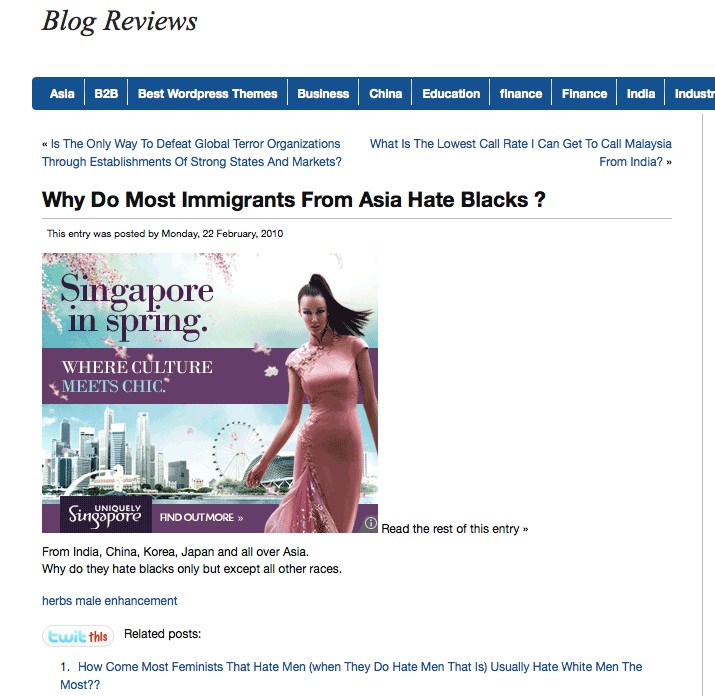
So we’ll kick of this project with a grab of a page I encountered today. I saw the question after answering another question and thought to myself that it would be interesting to see what, if any, the responses to the question might be.

As you can imagine I was shocked to see the ad right under the controversial, not to mention provocative question!

Today’s negative brand association story comes from the BBC site. This time it is a video about a drunk driver in China who is caught on film smashing into road dividers and barricades. You can see the full video here

You’ll note that the story is preceeded by a commercial for Lexus!

Here is a still image from the end of the commercial.

Actually this could also be included in brand disasters. Is it appropriate for a luxury brand such as Lexus to be associated with a drunk driver? Or does it not make a difference?

Any comments?

Will poor execution of a great offer become a public relations nightmare for Hilton hotels?


This is an example of how the old world of ‘special offers’ with hidden strings attached clashes with the new world of social media where transparency, honesty and engagement rule. It also shows, once again that a one-size-fits-all brand strategy conceived by well meaning executives in one country can backfire on the brand in other locations.

Hilton January sale
At the beginning of January 2010, Hilton Worldwide announced “a global multi-brand wide January Sale. Guests who book hotel rooms in January can save 50 percent off weekend getaways throughout the year at participating hotels in Europe, Middle East, Africa and Asia Pacific.”

“To take advantage of the January Sale, guests can pre-purchase hotel rooms between January 1, 2010 and January 31, 2010 and receive the discounted rate for Friday, Saturday and Sunday night stays throughout 2010.”

Hilton Hotels is making a really big deal of this January sale And so it should, after all 50% off a Hilton room is a significant amount of money. Especially in a recession. But I suspect executives at the head office in Virginia didn’t think it through enough.

After all, whilst January and February may be slow months in the USA and other western countries, it is the busiest time of the year in countries like China, Malaysia, Thailand, Vietnam as families get ready for the lunar New Year. In other words, peak time and not really the right time to give away hotel rooms at half price!

But anyway, despite my ‘reservations’, and (plot spoiler) they were the only ones I was going to make, when I read the other benefits

– Lazy breakfast until 11am
– Late checkout until 6pm
– Kids stay and eat for free (Terms & conditions apply)

I knew this would be a great offer for me to take advantage of personally. My family had been suggesting a trip to Singapore but I had managed to put them off the idea because of the costs etc. But with rooms at half price, kids eating for free and the late checkout, even I saw this as an excellent opportunity.

3 hour cocktail hour with free flow
Especially as the Hilton, with its great location and attentive and tolerent staff (very important with my family), is our 2nd favourite hotel in Singapore. Did I mention that the cocktail hour on the executive floor lasts for 3 hours of free flow everything?! Well that helps as well.

So, excitedly I called my wife, to see if we had anything on that weekend. Conincidentally, she was going to be in Singapore earlier that week hosting clients at the Singapore air show and could stay on for the weekend. I thought it odd that Hilton would have such an attractive offer at such a peak period but told her I would drive the kids down to Singapore and meet her at the Hilton for the weekend. She was understandably excited. I also sent a text to my teenage daughter who called back immediately and asked excitedly if we could go shopping!

So the family is pumped, now all I have to do is take advantage of the fantastic Hilton offer. For our preferred weekend of 5th – 8th Feb the offer is not available. Hhhmn, OK, never mind, these things happen, especially with the Singapore air show ending on the Thursday.

So I call my wife and teenage daughter again to check availability for weekend of 12th – 15th Feb. Great, they are both free. Unfortunately the special offer isn’t available that weekend either. Now I’m starting to get irritated because this is taking more time than it should but worse, I’m going to get the cold shoulder at home for 2 weeks. I better check availability for other weekends before calling my family. So I check the weekend of 19th – 22nd Feb. Not available. What about the weekend of 29th Jan – 1st Feb? Nope.

As disappointment sets in and I realise the dream of a very affordable weekend at the Singapore Hilton was just that, a dream, I choose some random dates to see if the offer is available at other times. 5th – 8th March, unavailable. 16th – 19th April, unavailable. One last try, 23rd – 26th July, oops, a 404! This is ridiculous, I can’t spend any more time on this.

Social media
At Hilton facebook page, there is more information on the Hilton sale. But further inspection of the dialogue shows that a vast majority of the comments posted by consumers, both existing customers and new prospects, is related to their frustrations and disappointments because they can’t book on the weekends they want! So I’m not the only one!

It is great to see Hilton using social media, not only to announce such initiatives, but also to engage prospects and customers in real time. But the unfortunate Hilton representative responded to 15 or so complaints, all related to lack of availability and then appears to have given up!

Here are 5 things the Hilton should have done to get the most out of this campaign.

1) Understand that we don’t all march to the beat of the US drum. This is not a political statement, but common sense. Chinese New Year is a very busy time of the year for approximately 1.5 billion people in North and South East Asia. Flights and hotels are full.
2) Check local calendars in the countries you offer special offers. The Singapore Air Show sees hotel rack rates as much as double.
3) If you must black out peak dates, do it in a transparent manner, so that prospects and customers are aware at the outset of restrictions and will not be disappointed. Hiding them in T&C doesn’t count.
4) It is no longer enough to announce a great offer and then assume everone will listen, praise the announcer based on the content of the offer only. As Peter Drucker said, “Communication only works from one member of ‘us’ to another.” If the offer doesn’t stack up, consumers will let others know about it and any good can be undone very quickly.
5) Your existing customers are the key to profitability. Make such offers available to them before new customers.

What started as a great offer from a truly global brand soon became a public relations nightmare and the Hilton credibility has suffered as a result.

What do you think?