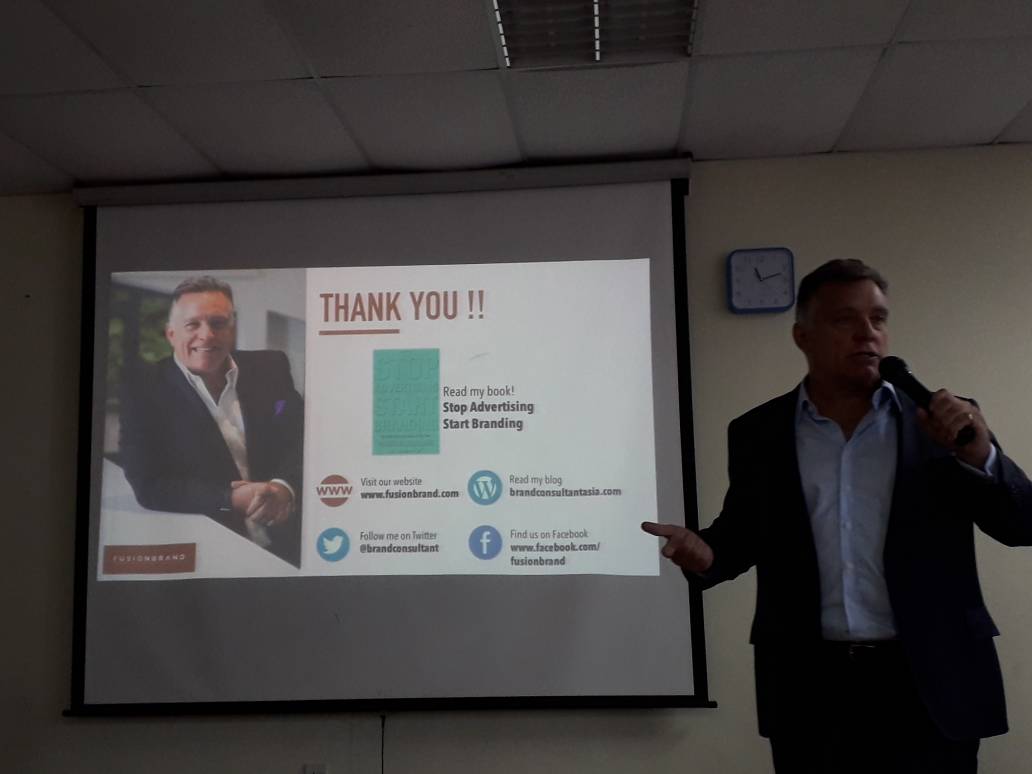
We had a great time today with creative writing, advertising and journalism students at the International Islamic University Malaysia. The discussion revolved around “Branding in the era of industry 4.0” and we talked about what Malaysian brands must do to to thrive in new economy and more relevant perhaps to these guys, how the advertising industry is changing and what they need to do to help those brands stay relevant.
Fusionbrand would like to thank you for having us over & thanks for the lunch too!
Marcus Osborne of Fusionbrand wrapping up before the Q&A session
Overtourism is putting immense pressure on destinations around the world. From Bali to Phuket and from Venice to New Orleans and Ibiza, popular places are creaking under the weight of millions of visitors. 28 million people visited Venice last year, swamping (excuse the pun) the local population of 55,000.
Venice has for years considered limiting the those who enter the city and recently set a cap on the number of cars allowed in and provides ‘tourist only’ routes for accessing the most popular destinations.
15,000 people call the Greek island of Santorini home. Last year they ‘welcomed’ 2 million visitors. The mayor recently announced that only 8,000 can visit each day in an attempt to help retain its uniqueness.
In Bali, the government is trying to take back control of an out of control industry that is threatening to destroy the very island that has made it what it is. One estimate has it that 300 tonnes of waste enters the waters around the island every single day. Little wonder then that attempts to reclaim land for yet another mega project in the island’s Benoa Bay were met with fierce resistance from locals.
But potentially the most dramatic changes are happening in Ibiza, the hedonistic destination for mostly young, British holidaymakers looking for 2 weeks of mayhem. 3 million visitors arrived on the balearic island in 2017 and it seems as if the tiny island’s population of 150,000 has had enough. Earlier this year, Airbnb and other accommodation platforms were banned, open air bars must now close at midnight and club closing times are now 3am instead of 5am.
The tourist board has also taken steps to address the impact of tourism on the island, with its new ‘Love Ibiza’ campaign focusing on sustainable travel. Tourism has made Ibiza what it is today. Whether that is good or bad, only the locals can say. The Facebook page states, “We want to return to the peace and quiet of the traditional Ibiza.”
I was fortunate enough to visit Ibiza in 1980 when it was peaceful and traditional. Relatively anyway. it was a beautiful place with only a hint of the hedonism that was just around the corner.
My concern is that it will take a lot more than a quaint video to change it back to the peace and quiet of the traditional Ibiza. I believe that to reverse overtourism, or at least stall it, without impacting the economy of the destination, there needs to be the buy in of the local population. The Ibiza video suggests some buy in as it talks about sustainability but there doesn’t appear to be a clear direction on how this will be achieved.
Overtourism is a real threat to many destinations. A well thought out destination brand road map would make this a more compelling offering. Otherwise it becomes nothing more than a (well meaning) dream.
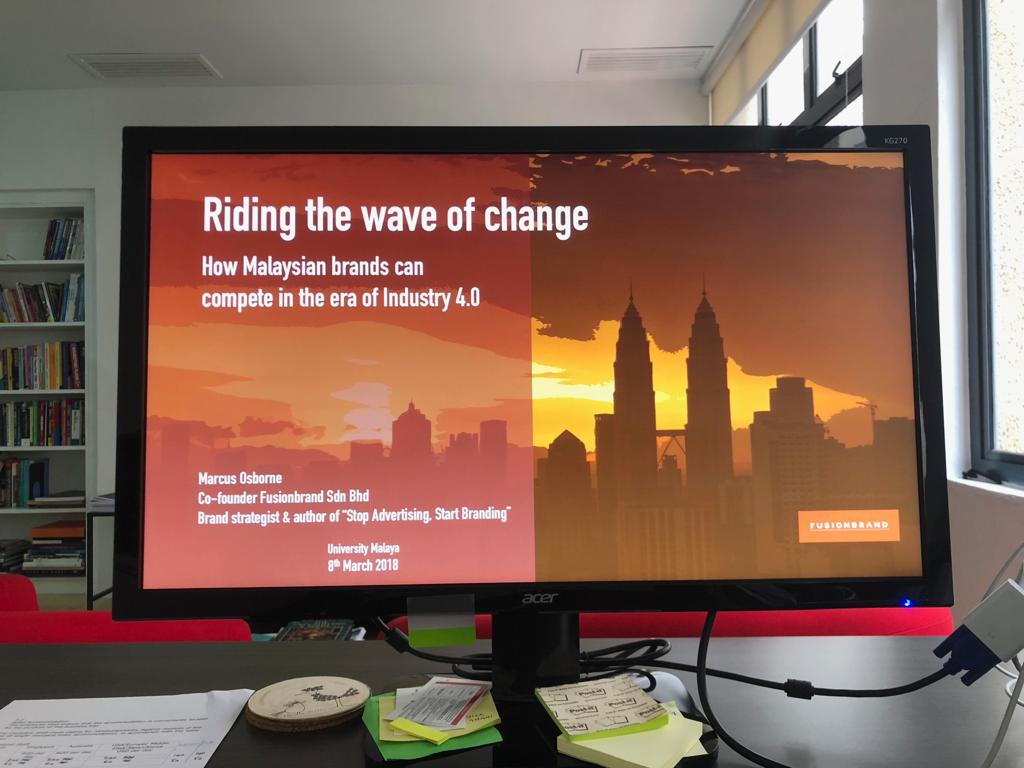
Founded in 1905, the University of Malaya is Malaysia’s oldest university. It has 27,000 students attending 12 faculties, 2 academies and 3 Centres at the sprawling campus on the outskirts of KL. I was invited to be a guest speaker at the Graduate School of Business, Faculty of Business and Accountancy.
The title of my presentation to the UM Graduate School of Business
It was a great opportunity and a privilege to spend a few hours with some very bright people who may one day be running some of the best brands in Malaysia. There was lots of participation and plenty of probing questions! Most of which I answered, I think! OK, maybe not the Samsung one!
Students at the UM GSB kept me on my toes!
Many thanks to Professor Zalfa Laili Hamzah for organising the talk.
There’s a thought provoking piece in the business section of freemalaysiatoday.com that reports more Malaysians buying Chinese made goods ‘out of economic necessity’.
The article says that Malaysians look past the stigma of Chinese products even though there are concerns that they of inferior quality and possibly even dangerous compared to products from other countries.
The article quotes Mr Yeah Kim Leng, professor of Economics at Sunway University Business School who says, “the open market system brought about by globalisation and increased connectivity was intensifying competition for local businesses.”
The President of a local consumers association supports Mr Yeah’s point of view saying that even though many Malaysians are concerned about the quality and legitimacy of China made products, they are prepared to basically risk their lives because Chinese made goods are readily available and cheaper than Malaysian products.
Another economist and Klang MP Charles Santiago is quoted as saying, “Malaysians were buying food from China out of economic necessity despite their misgivings about the quality of the items.” He went on to say, rather worryingly, “There is no excuse for eating toxic food. We must ensure that the food coming into the country fulfils all international health standards.”
I agree with Mr Santiago, there is no excuse for eating toxic food. And in the last twenty years there have been reports out of China of adulterated baby formula. Factories using industrial-grade salt to pickle vegetables then spraying them with banned pesticides before shipment, soy sauce made from human hair, counterfeit alcohol and fruits and vegetables with unacceptably high levels of illegal pesticides.
In our house we stopped buying any foods and most other things from China more than 10 years ago. I don’t care what it costs, I’m not going to jeopardise the lives of my family in an attempt to save money which if they get sick is a false economy anyway. More on the false economy later. But it seems we’re the exception not the rule.
I think there is a deeper issue here. My theory is that there is a culture in Malaysia of ‘if it’s cheap, its good value.’ I think we’ve lost sight of what constitutes value. There are many reasons for this. We’ve been ripped off or know of people who have been ripped off, time and time again by unscrupulous companies from just about every sector and in particular automotive/property/food/transport/healthcare/hospitality and so on.
One patriotic Malaysian friend of mine (and I won’t be popular for quoting this), suggests some Malaysians have been let down so many times and have become so cynical about what companies promise that they now believe it’s better to pay the minimum amount for something and then if it doesn’t deliver on the promises made, well at least the bare minimum was spent.
At the same time, he believes this has created a stubbornness which in turn has made them unable to make sensible decisions when confronted with difficult scenarios.
He suggests that is why many people will spend 30 minutes stuck in traffic to avoid a RM1 toll charge. The fact that the wear and tear on the car engine, the petrol, the lost productivity and stress cost so much more than the RM1 toll charge is irrelevant. The goal is to avoid the RM1 toll charge.
It’s the same with people (and this is not just restricted to Malaysia) who make a special trip to fill up their petrol tank because the next day, petrol is going up by 2 sen a litre. Much of what is saved, is spent on the extra journey, the fuel used in the inevitable long queue and the time spent away from more important things. In almost all such cases, the action delivers a net loss or at best, an immeasurable gain.
And that’s why Malaysians are now buying toxic food. It’s not deliberate, it’s just a natural progression. How many times have you heard a conversation along the lines of:
Q: ‘How was the nasi lemak?’
A: ‘Good, it only cost RM6.’
Hardly the breakfast of champions but never mind, it only cost RM6
The fact that the dish was 80% rice, included 3 peanuts, two ikan bilis, a tiny serving of sambal, the scrawniest chicken wing and 1/8th of an egg is irrelevant. And that’s before we even discuss the source of the oil used in the cooking, the supply chain and the hygiene of the foreigners who cook the food. What’s become important is that it only cost RM6.
What’s all this got to do with the economy and in particular branding? Well for Malaysian businesses to compete against any foreign firms, not just those from China but also those from Europe, the USA and north Asia, they need to move on from the mentality of competing purely on price.
To move on from a belief that they can only compete if they are the cheapest. To see their business not as a series of transactions, but as building relationships with their customers. Because this approach is unsustainable. There will always be someone out there, who can produce what you produce cheaper. And in this case that someone is China.
The economist Mr Yeah suggests that Malaysian firms should ‘think big’ and he’s right, Malaysian firms or rather the businessmen that run them, need to think big but only after they move away from the belief that what’s cheap is good or what’s big is cheap. And the good news is that it’s not a huge step.
International luxury houses such as Gucci, LVMH, Prada, Georgi Armani and Channel have for years dominated sales of luxury goods in Malaysia. Closer to home, Malaysia has proven it can build brands from scratch. Think of Royal Selangor Pewter, PappaRich, Sime Darby, YTL, Proton and Linghams sauces, probably the first Malaysian brand to go international and now available in 100 countries.
But these are the exceptions, not the rule. And it’s the middle ground that needs to change. To move away from the false economy of cheap is best. The false economy in Malaysia has become so chronically negative that it is having a detrimental effect on decision making across the spectrum. Even though it is now threatening lives.
I find it extraordinary that I am writing a blog post about people willing to risk their lives to save a few pennies. But everywhere I go, my team and I have discussions about brand tactics that are driven not by questions such as “What do we have to do to make our business the number one choice in our sector” but instead by questions like “How much does it cost?”
Recently I had a discussion with the head of marketing at the Malaysian campus of a British school with a unique 150 year heritage. The head of marketing wants a video for the school and he asked us to submit a proposal. He didn’t have a brief (which as head of marketing he should prepare) but wanted us to submit a proposal for ‘a school video’. When we asked the budget, he refused to share it.
So there was no brief and no budget. I explained that there were already a lot of videos of the school online (‘none of which are very good’ according to the most senior member of staff) and how is this one going to be any different? He replied that that was our job.
That we should ‘think out of the box’, to ‘propose something unique’, to ‘do something special’. When we explained that ‘thinking out of the box’ took more time and therefore cost extra and therefore we needed to know the budget to see if was possible, he refused to share it.
I explained that even without the ‘thinking out of the box’ requirement, the budget was crucial because it would determine the type of production. Did he want a script? Did he require a film crew to visit the school? Are we to interview staff/pupils etc? Would he like drone shots? How long does he want the video to be? SD or HD? And so on.
We realised that if we were to go this route, we could be submitting ideas for months before we accidentally created something he liked. We also realised that by not sharing the budget, there was a good chance that even if we created something he liked, he might not be able to afford it (or alternatively, we could propose something that didn’t utilise the full budget, to the detriment of the school) and that his decision would probably be based on price and so we reluctantly walked away from the business.
This mentality of ‘cheapest’ has a negative impact on his brand. Not because he didn’t get to work with us although thats one reason, but also because it makes the video a priority instead of making what the video can do a priority. It’s the business equivalent of buying potentially tainted food from China and ignoring that fact because the main thing is it was cheap.
This culture of cheapest is best has caused him to move from doing what’s best to market the school to getting a video done. It actually becomes a box ticking exercise instead of a useful tactic. And we’re seeing this time and time again.
Once a large percentage of Malaysians get past the ‘cheapest is best’ mentality, then only then can businesses have the confidence to ‘Think big’. It will require a cultural change in both how they think and how they run their businesses. Once they do that then we’ll see more successful Malaysian businesses become brands.
Yes it looks like an irresponsible adult allowed a petulant child with a grudge against the creative fraternity loose on a very old software programme and yes, it should never have made it past the idea stage. It’s the creative equivalent of a train crash featuring trains carrying toxic chemicals or nuclear weapons. But does it matter? In the short term, perhaps. Long term, maybe. But it never have happened.
I’m talking of course about the Tourism Malaysia VMY2020 logo (see pic) launched at the end of January 2018 by Datuk Seri Nazri Aziz, the Malaysia Minister of Tourism and derided by much of Malaysia, graphic designers worldwide and respected media organisations such as the Daily Telegraph, the BBC and the South China Morning Post.
How to make sure you don’t end up with one of these
Despite the negative reaction of, well everyone, I’m going to stick my neck out and say that the reality is the new logo (if it survives and I don’t think it will) won’t have an effect on visitors contemplating whether or not they should visit Malaysia in 2020 (and the years before and after 2020).
In fact after being featured on social media and a host of international news channels and publications, it may have provided Malaysia with yet more free publicity.
Admittedly not the kind of publicity Malaysia really wants but it’ll take more than negative publicity about a crap logo to attract or stop foreigners from visiting the country.
Nearly every business/school/institution and many individuals have a logo. We see logos on business cards, buildings, billboards, buses, lamposts, food packets, print ads, TV ads and just about everywhere else you can stick one.
And they sell computers, clothes, cars, cosmetics, finances, food, schools, fashion and fags, alcohol, appliances, airlines and holidays, and just about anything else in between.
There are good logos and bad logos, some change on a regular basis, think Google, others stay pretty much the same for years, think Apple or Nike. We’re told logos must be unique yet instantly recognisable.
They must have colour because certain colours convey certain meanings yet they must be instantly recognisable and have the same impact in black and white.
We’re told that each element of the logo has meaning. A logo designed with sharp, straight lines communicate a strong, trustworthy brand.
Curved lines on the other hand communicate a caring and supportive product or service. The rationale for combining curved and straight lines is an ambitious company.
And we’re told that everyone should have a logo because they represent the brand and make you stand out from the crowd. But crowds behave differently today and are influenced in different ways.
The illustrative style that we recognise as logos today is nearly 150 years old and harks back to a time when Western civilisations moved out of the fields and into the factories. Most of those factories are now here in Asia where we’re living our lives a little differently today than we were back then.
The main role of the logo, traditionally anyway, has been to create awareness about a business or in this instance, a destination (and not the country) and help to build a positive image about the business/destination.
Logos evoloved to become a symbolic reflection of what the busines/destination wanted to communicate to audiences. And when logos changed, it was meant to be part of an overall strategic shift in direction for the brand and would be one of many elements of that new brand strategy that had to be communicated in a joined up, integrated manner.
But over the last 20 years, businesses have got lazy or perhaps greedy. Too many businesses have changed logos in isolation, without incorporating the change into a new strategy.
They’ve updated the brand identity and called it a rebrand without making any improvements to the organisation. And then they’ve watched, surprised when nothing changes.
The London 2012 logo dodged a bullet
Sometimes when a logo changed slightly and the reaction was negative, the brand got away with it. Remember the London Olympics logo? Other times, such as the GAP logo change in 2010, the consumer response was deafening and GAP had to backtrack quickly. But overall, because these changes were ad hoc or tactical, they made little difference to the business delivery.
Another classic example is oil behemouth BP. Back in 2000 the firm decided they wanted a new logo that communicated ‘green growth’. Despite spending over US$200 million it was considered a massive failure because the opinion of most people was that there was nothing green about the business of oil. No matter what the company tried to make us believe.
Our new logo tells you we’re not in a dirty business so you must listen
And then in 2010, the largest offshore oil spill the history of the oil business put paid to the concept of the green growth oil company communicated via its logo. For many, that’s when logos lost their relevance.
With the proliferation of countries competing for the same visitors, too many destinations play safe and compete with the same look and feel, making it difficult for potential visitors to differentiate them.
Add to this mix the powerful impact of social media on the travel industry and visitors now use the Internet for research purposes and get most of the information that influences their decision making from content generated by people like them and not logos.
The rise of the ‘me too’ destination logo dilutes the importance of the logo in the visitor’s decision making process
The focus has shifted away from the identity of the destination to the experiences of other like minded people in that country. Against this backdrop, it’s hardly surprising then that the importance of a logo will not be what it was.
According to the World Travel & Tourism Council (WTTC), global tourism generated $7.6 trillion for the global GDP. More than 105 million international visitors arrived in South East Asia in 2015 and that figure is growing at an average of 8% every year.
Many of those visitors will visit Malaysia not because of the logo but because Kuala Lumpur International Airport is an increasingly important hub for low cost carriers servicing destinations such as Vietnam, Cambodia, Thailand, Myanmar and more. And any trip to SE Asia will include visits to other countries in the region.
So in terms of the impact the logo will have on visitors to Malaysia, it will be negligible. However, it will help shape perceptions of Malaysia as a country and much of the debate across social media was how embarrassing the logo is for Malaysia.
So in terms of the reputation of Malaysia, there will be a perception impact and that will probably add to the negativity about the country. If most of the content consumers read about Malaysia is negative, then perceptions will become negative. And those perceptions can only be influenced and changed with a brand strategy that includes all stakeholders and not with tactical activities such as a new logo, advertising or events.
For Malaysia, what’s done is done. What can other countries, states, regions, cities or towns do to ensure their efforts aren’t ridiculed in the same way?
Here are 6 lessons that can be learned from this fiasco. They should be applied to any destination branding initiative.
1) Set up a nation branding task force.
Every country or state/city/place should have one. Malaysia used to have one and in 2008 the task force commissioned Fusionbrand to develop the Malaysia nation brand but the plans were canned when a new administration took over and a new department was set up under the new Prime Minister’s Office. This department embarked on a badly researched project about 5 years later that revolved around a tagline and a logo and not a strategy and as a result, lasted little more than a month.
2) Nation branding is strategic not tactical.
Nothing related to the nation brand can be done in isolation. To avoid similar failures, anything related to the nation/state/region/city brand must go through the nation branding task force. And that includes important ministries such as the Tourism ministry. Even state tourism boards and other stakeholders must share with the nation branding task force.
3) Test identity concepts before launch.
No man is an island. But sadly in Malaysia, if a senior person proposes something it is rarely challenged internally, even by marketing professionals hired supposedly for their knowledge. Anything creative should always be tested internally and with multiple consumer segments and the task force. I know it’s time consuming and expensive but which is worse, a delay in the launch or becoming the laughing stock of the world?
4) Have a plan for your identity launch.
Don’t expect to wing it. And be prepared for serious back lash from consumers because most of us hate change. Not many new logos were well received initially. But many of them are now very familiar, think Pepsi, Citi, Accenture, Qantas. After a certain amount of fumbling, the Minister stated, “I have launched it. Nazri Aziz never backtracks. This is what will be used for the world, only one logo, no other logo.” Would a clearly defined, sensible rationale have been a better way to announce the new logo? Absolutely.
5) Social media is your friend not your enemy.
I get the impression, perhaps wrongly that Tourism Malaysia was completely unprepared for the reaction to the logo. Especially on social media. Social Media CAN effect change so learn to work with it. But remember it is not a soapbox. Simple consumer research at the logo development stage on Facebook and Twitter would have saved Tourism Malaysia and the country, a lot of embarrassment.
6) Logos / taglines etc should not be confused with branding.
Malaysia has had a tough time over the last few years with the country struggling to stay relevant in an increasingly competitive environment. It’s hard to find current arrivals figures but the general consensus of opinion is that visitors from wealthy countries or high spending tourists are not visiting as they used to. A lot of this is because there is confusion over what constitutes branding and the Malaysia tourism brand has little differentiation. Brand identities / taglines / positioning statements / advertising campaigns and other marketing tactics are not branding. They may create awareness but that rarely convert to arrivals.
As I’ve stated already, I don’t think this farce will have much of a positive or negative impact on arrivals. But it’s impact on Malaysia’s brand? That worries me but that’s a discussion for another day.
Fusionbrand is Malaysia’s premier strategic brand consultancy. For more information on how we can help you get your branding right the first time, please call +60379542075.
And it’s winding up a few people in the UK. But despite the controvery, it’s not getting the viewing numbers. In a week it’s only had 132,000 views while the M&S ad has generated more than 4 million over the same period and the John Lewis ad has been viewed 1 million times in 2 days.
Tesco has said that everyone is welcome at this time of year which is fair enough. Ignoring the religious argument (and for that matter the vegan one), it has some nice touches that most of us have experienced at some stage of our Christmas’s past. The oblivious teenage son at the beginning resonated with me!
The gay couple, the stressed mother, the backseat chef, the delirious kids, the muslim family, the, wait what did you say? Back to the religious element, a Muslim family celebrating Christmas? Yep, and those of other faiths get into the spirit (but I’m sure not the spirits) as well. And from what I can tell, it doesn’t dilute their faiths.
So will we see this ad on TV in Malaysia? It would be interesting but somehow, an ad featuring Muslims in the UK appearing to enjoy Christmas, I doubt it.
Back in my day we knew Christmas was coming because the thick woollen shorts we wore through the winter term, yes shorts despite going to school in the wettest, darkest, coldest (well it felt like it in those shorts) part of England, began to rub the skin off your thighs because your legs were so cold.
Christmas meant it would be warm in 3 months and you’d soon feel your toes again. Nowadays they say you know Christmas is coming when the John Lewis TV ad is released. And this year, just like previous years it was eagerly awaited and came out today. You can watch it in all its glory here.
Reactions on YouTube have been mixed. One comment was, “So basically… his parents gave him a badly wrapped present that killed his only friend.” While another said, “Such a disappointment! It has no sweet sentiment that makes you feel all warm and excited about xmas. I’ll go as far as to say it’s shite. Look what you’ve made me say about xmas!”
John Lewis 2017 Christmas ad. Not as good as the animals on the trampoline
The 120 second TV commercial will premiere on Channel 4 and Sky tonight, 10th November. It cost about £1 million to shoot which is the same as the M&S ad and John Lewis will also spend another £6 million to cover media.
I haven’t seen any other Christmas ads except this one and the M&S ad. My money is on the M&S ad being more popular.
A fund will be created (not sure where the money will come from but I have a hunch it’ll be the tax payer) to support marketing campaigns by airlines and travel industry players in 2018.
Anyone know why they had to go to London to sign the MOU? And for that matter, how will an airport promote tourism? And how this project will link with other initiatives?
The big news yesterday was the low key announcement (contradiction deliberate) of Tourism Malaysia’s tie up with Luis Suarez, the Uruguay centre forward, once of Ajax and Liverpool who reluctantly sold him to FC Barcelona three years ago for about €81 million.
After scoring 88 goals in 3 La Liga seasons, he signed a new contract with FC Barcelona earlier this year but is struggling with a knee injury and has only managed 3 goals in 8 appearances. So hardly setting the footballing world on fire. Unsurprisingly there is now talk of him leaving the club but with an aging body and an existing knee injury, he may become the first high profile player to retire at Barcelona.
So it was a surprise to hear Tourism Malaysia announce a partnership with the player. Tourism Malaysia said in a press release, “The partnership is expected to drive interest for Malaysia as a tourist destination, leveraging on the football player’s popularity around the world which foresaw an increase in millennials visiting the country.”
Tourism and Culture Minister Mohamed Nazri Aziz said, “Suarez had proven to be not only among the world’s top-ranking footballers but also a respected community leader.”
Is Luis Suarez a good fit for Tourism Malaysia?
He carried on, “As a hero to millennials, Suarez is an inspiration to many and we hope that this title and acknowledgement will shine the limelight on Malaysia as a tropical holiday destination that appeals to the millennial spirit for travel and adventure,” he added.
I didn’t know Suarez was a respected community leader and a hero to millenials.
What I do know is that he has a reputation for cheating, racially abusing, biting and punching players both on and off the field. After he was accused and punished for racially abusing Patrick Evra in a Premier League game, the FA released a report that said, “Suárez damaged the image of English football around the world”.
However, Mediapro, the company that represents LaLiga claim Suarez is extremely popular in Asia and Asia MD Lars Heidenreich said, “We are very confident this branding and activation exercise with Suarez will help attract more travellers to consider Malaysia as their next holiday destination and experience all that Malaysia has to offer as being ‘Truly Asia’,” he added.
Suarez considers it “to be an honour and privilege to be able to work with Malaysia and was looking forward to embarking on this journey to introduce the exotic country to the world. Especially its rich culture and heritage to all my fans and make them fans of Malaysia.”
Lots of mixed messages there.
Is such a controversial figure, in the twilight of his career, really a good fit for Malaysia? What is the strategy? How will this deal ‘shine a spotlight on Malaysia’? How will Suarez be used? What is his role? Bearing in mind Qatar sponsors FC Barcelona, how will Malaysia gain exposure?
Does more people considering Malaysia as a destination need such a character? Won’t Malaysia be on the radar of anyone considering SE Asia? In the social media era, will an aging footballer getting limited game time move travellers from consideration to confirmation? Or is that likely to be influenced by the experiences of people like them that they find on social media?
Who exactly is Tourism Malaysia targetting with this exercise? Is it Asian markets? If so, which ones? Is it Millennials? If so, are Millennials from Vietnam the same as Millennials from Japan? which ones?
It’s an interesting deal but it creates more questions than answers. Assuming Suarez gets over the knee injuring, starts playing and more importantly, scoring goals we’ll no doubt see more of him in Malaysia.
Have you ever wondered how powerful the Internet really is? Have you ever wondered if video can really help increase sales? Have you ever wondered how to sell something for more than it’s worth? Would you like to turn US$499 into US$150,000 with a little bit of creativity? Then watch this video.





 brandconsultantasia.com