Stop advertising and start branding


Are you happy with your branding activities? Or do you find the money you spend does little to build your brand?

Unfortunately, most branding initiatives revolve around a creative campaign developed by an advertising agency. Depending on budget, the creative campaign will be implemented with a one-size-fits-all message communicated to all and sundry and across multiple mass media platforms for as long as budget allows.

The model essentially revolves around hope – hope that lots of people will see the campaign, hope that amongst those people will be the target markets, hope that the message will resonate with those target markets, hope that those target markets will remember and hope that if they remember they will act.

In a noisy world, is a traditional approach to building a brand going to make you stand out?

So basically, the ‘strategy’ is one of hope. Chances are if it doesn’t work, the agency will, if you haven’t already fired them, propose more of the same.

For most brands this approach is an exercise in futility. Wouldn’t it be better to first get an understanding of where your brand is – both internally and externally?

In the social economy, where consumers not companies define brands, don’t you want to know what your stakeholders want from your brand, what you are doing right (and wrong), the channels they are most likely to interface with, their influencers and more?

Internal and external brand and communications audits can both help determine how effective your branding activities have been and, more importantly, what they need to accomplish in the future.

In the social economy, a brand audit is the first step to building a brand

Brand audits have multiple advantages. They provide a benchmark to evaluate the current brand position. Carried out every 2 years they can evaluate progress toward branding goals. They also unify an organization. Too often, everyone has a different definition of branding. A brand audit will identify this and provide recommendations for improvement.

Indeed, a brand audit can provide a consistent, universally accepted brand DNA and from that a definition that ensures that everyone in the organisation is marching to the beat of the same branding drum. Finally, a brand audit can help eliminate the all-too-common disconnect between what companies believe their brand to be and what customers perceive it to be.

An internal brand audit takes the brand temperature from corporate executives and other personnel. One-on-one confidential interviews probe to determine each individual’s perceptions of the brand, branding goals, evaluation of past branding activities, knowledge of key corporate or brand messages and other key points.

An Internal brand audit is a key component of any brand strategy, when did you last carry out an Internal brand audit?

What are the current branding and customer processes, and how can they be improved? One great question to ask is: “Imagine it is five years from now, and the company is celebrating historic financial and market success. How did the company arrive at this point? What are some of the activities that brought us to such success?”

A brand audit can cover a wide cross section of departments but must have the customer and the customer’s needs at its core. What do we know about customers? Are we collecting THE RIGHT data? Is relevant customer data being added to corporate databases? Is customer information shared with other areas of the company? What initiatives are on the horizon that will affect certain customers and how will this be addressed?

A minimum of 25 minutes is required for each interview, but they can take up to an hour. Questions can be prepared beforehand, but the most valuable insights often result from free-ranging discussions on relevant topics.

A key component of a brand audit is a communications audit, which is especially useful for larger firms with multiple divisions or departments that get involved in branding activities.

A communications audit looks at all the visual material that represents a brand – the brand identity, sales documentation, press releases, ads, brochures, Web sites, social media channels, merchandise, vehicles, logos, etc.

Too many so called brand strategies are really just pointless journeys to unknown destinations

Analysis then determines the amount of consistency and integration in appearance/design, messages and their relevance to target markets (in a noisy world where consumers are time poor, content is so, so important) and adherence to corporate standards. Ideally, a brand manual is in place to provide a benchmark.

The role of social media in both internal and external corporate communications is increasingly important and a social media audit must be included in the communications audit. Communications across social media require different skill sets to traditional marketing and this is scaring some companies away but it must be addressed.

A social media audit lays the foundations for the social media strategy that has an crucial role to play in the brand strategy developed later.

Internal brand and communications audits often reveal a stunning amount of discrepancies that result in mixed messages to both prospective personnel and customers, incompatible branding efforts or even disagreement about branding goals.

An external brand audit looks at how various stakeholders (or, more accurately, constituencies) view the brand. Such constituencies include customers, prospects, media, distributors/retailers, regulatory bodies and suppliers.

Sometimes, an external brand audit is combined with a loss analysis to determine why a contract or other business went to a competitor. These constituencies are asked their perceptions and experiences with the brand and crucially, asked “What do we have to do to win back your business?”

For some companies, it should also be combined with a customer acquisition audit to see if relationships are being developed effectively.

Sample questions can include: “Why did you buy the first time?” “Why will you buy again?” “How useful and relevant are corporate communications?” “How responsive is our support?” “How do our competitors compare to us?” One revealing question we’ve used in the past is: “If you were running our company, what would you do to better meet your requirements?”

The number involved in brand audits can vary greatly according to time, cost or other constraints. Even as few as 5 – 10 qualitative interviews may produce actionable insights.

The success of a brand audit will be determined by the people involved. They must understand branding imperatives, be familiar with the relevant products and company and have superb questioning, listening and analytical skills.

Results of brand audits (the good and the bad) must not only be shared as widely as possible but also incorporated into internal and external branding efforts, including employee communications, advertising and PR.
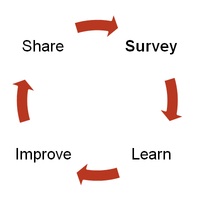
Share research data, not just the good stuff!

It is especially important to use the results to drive changes in sales, service, support and other customer-facing activities.

Finally, remember to use brand audits as guidelines for improvement, not as sticks for punishment.

5 facts about developing a brand strategy in the social economy


1) Research is more important than ever.
Research has always been important but it was cumbersome and time consuming. Not any more. Today, the right research can be developed and implemented and results analysed quickly and efficiently.

Brand building - don't run before you can walk
Brand building – don’t run before you can walk

It’s easy to find those people who are likely to like your product. It’s even easier to talk to them. But too many companies don’t bother, preferring to chase the holy grail of more new customers through corporate driven messages.

And don’t forget your existing customers because they are your best source of information. Talk to them, find out what they are looking for, what they value and match attributes to their requirements for value.

2) Mass market branding with a focus on the 4 Ps is no longer effective.
Brands today are built on delivering economic, experiential and emotional value. Not on creating some cool position and communicating it across as many channels as possible for as long as possible.

Deliver that value with stories that resonate with target markets and existing customers. Build relationships with customers by allowing access to the brand, personalizing all elements of all interactions, through relevance, experiences and emotions.

Ignore the social element of the social economy by trying to speak to everyone with one corporate driven message and you will fail.

3) Focus on developing more profitable relationships, not a more profitable product. Brands evolve when companies start buying for customers instead of selling to them. This is especially true in times of economic hardship.

4) Branding is an organisational issue not a departmental responsibility.
And the organisation is the responsibility of the CEO. The CEO needs to be involved in the development of the corporate brand.

Your brand is too important to be left to a marketing department that still believes in the corporate driven message over the engagement of the consumer.

And once you’ve built a brand, don’t rest on your laurels, continue to innovate or you will be left behind.

5) Retention is key to brand building.
Companies no longer sell products, customers buy them. And once customers have bought a product, companies must do everything possible to hang onto those customers. After all, you’ve investment a lot of money to gain a customer, why let them go?

Especially as the more time a customer spends with you, the more money they will spend with you.

Can poor customer engagement across social media destroy a brand?


I came across a remarkable story about how a brand failed to deliver on its promise and the result of that failure. You can read the full story here

In a nutshell, it’s the story of a gamers attempt to buy an add-on for video game console controllers. The tool, known as the Avenger and invented by N-Control was announced in November 2011, word soon spread across social media and demand went through the roof.

After ordering 2 of the controllers, the gamer was told it would ship in early December 2011 however by the middle of the month he had heard nothing so emailed the president of marketing to enquire as to the shipping date and was told it would ship a day later than announced.

Unfortunately it didn’t. Then it was announced that anyone ordering the controller after December 26th would get a US$10 discount however, those who had ordered before December 26th and had still not received their controllers were not entitled to the discount.

By this stage the gamer was getting a bit annoyed and emailed the firm asking if he cancelled his original order, could he then qualify for the US$10 discount (don’t forget he’s ordered 2 of them).

The firm came back with this statement, “Feel free to cancel we need the units we’re back ordered 11,000 units so your 2 will be gone fast. Maybe I’ll put them on eBay for 150.00 myself. Have a good day Dan.”

By this stage the gamer was seething so he wrote again to the President of marketing but this time copied the email to organisers of major gaming conventions in the US. Amazingly the President of marketing responded by calling the gamer childish, laughing at his complaints, and dropping the names of numerous gaming conventions that they intended to attend, one of which was organised by the very company the email was CCd to.

The organiser took the side of the gamer and banned the company from taking a booth at their gaming convention. Then the story was posted online and went viral and this is when it really hit the fan. Because of the power of Facebook, Twitter, Reddit and others the story even crashed the site it originated from! You can see more information on how it went viral here

Soon after N-Control fired the President of marketing and made a US$10,000 donation to charity.

What lessons can be learned from such an event?

Promises made must be kept. If you don’t prepare to feel the wrath of the consumer.

Make sure the people who represent your brand live the brand.

N-Control is on the defensive and maybe for some time. It didn’t need to be in this situation. Know how to use the Internet.

Be careful when you offer discounts. Consumers who have paid pre discount rates expect value. If you don’t deliver, offer the discount to those who kick started your sales.

I believe that an event such as this may not bring down a brand but it could be extremely expensive and the fall out for N-Control will last for years. If they come up with a sub standard product they will really struggle.

And such an event can certainly cost people their jobs and quite possibly, as more and more employers trawl the Internet for information on potential hires, their careers.

Consumers have changed, has your marketing strategy?


Doe this sound familiar?

You need to spend time creating a position that is driven by the corporation.

Once created, the position must be communicate across traditional media (with a nod toward social media, but a nod only) to as many people as possible and hope that some of it sticks.

If it doesn’t, create a new position and repeat ad nauseum. Hopefully you will get it right. If you don’t, well you can always discount. This model was developed by Jack Trout in the 1970s. I wrote a blog post about it here

Sadly, despite US$1.5 trillion spent annually on marketing, 70% of today’s manufactured goods will be obsolete in six years (Industry Week magazine). There are estimated to be more than 30,000 new product introductions in the US alone every year, and that’s just in the packaged goods market. According to AC Nielsen, up to 90% of products fail to become brands. This means that as many as 27,000 of those new products will fail.

Today’s consumer has changed the way he lives his life and moreover, markets are so fluid, spending time developing a position and watching your competitors is the fastest route to business oblivion.

The key to success is the sales force and their ability to build your business through collaborations and by matching products/services to individual customer requirements for value and then maintaining those relationships and your brand communities team who develop brand evangelists and influence influencers.

And with social media and modern technology, that is not difficult. A lot less difficult than creating a position and pinning all your hopes on, well hope.

Customer retention is not the same as customer loyalty


I read an interesting post on The Free Malaysia Today website about customer loyalty and you can read the full article here

It’s a useful article that any Malaysian business owner should pay attention to. But as often happens, it blurs the lines between customer loyalty and customer retention. They are not the same thing.

A retention program is not the same as a loyalty program because a retention program is normally price driven and those customers acquired as a result of a retention program can often be lost to competitors.

A loyalty program on the other hand will help increase share of wallet by encouraging more purchases, often of more premium products and, more pertinently in the social economy encourage customers to become brand advocates and communicate positively about the brand and experiences with the brand.

A case in point for me personally is MAS. I am a member of the MAS frequent flyer program but it does not buy my loyalty. MAS retains me as a customer but I am always looking for a better deal with other carriers.

If another carrier were to invest in building a relationship with me I would switch in a heart beat. I also tend to talk negatively about MAS and even when it delivers a positive experience I tend to take it for granted.

Whilst I’m on the topic of MAS I should mention that one way MAS could improve its business is by investing in its loyalty program and in particular software that can mine the database more effectively. As it is, all the loyalty program does is try to blanket sell all offerings to all members.

Loyalty is no longer about personal relationships and how often you take someone to karaoke or for teh tarik. Customers also expect you to know their industry, the challenges they face, who are their competitors and crucially, who are their customers, potential customers and who are the influencers of those customers.

If you understand and integrate a loyalty program into your brand strategy you will be on the way to building a strong brand. But if you mistake a loyalty program for a retention program, you may do more harm than good.

5 branding tips for Malaysia Airlines to save its troubled brand


Earlier this month, troubled Malaysian carrier, Malaysia Airlines (MAS) reported a staggering RM2.52 Billion (US$850 million) loss for 2011. Despite the tough economic climate, a number of competitor airlines – British Airways, Singapore Airlines and Cathay Pacific all reported a profitable year.

Soon after, Group CEO of MAS Ahmad Jauhari announced that he will implement ‘strong and immediate measures to stem the flow of losses with staff redeployment, improved productivity and efficiency, further cost controls and more route reviews’ whilst at the same time, he also promised ‘an aggressive sales and marketing strategy’.

Marketing budget doubled
Then MAS announced that it has doubled its marketing budget for 2012. The marketing budget is reported to be as much as 2% of revenue which on 2011 revenue of RM13.90 billion (US$4.63 billion) equates to about RM278 million or nearly US$100 million.

So if the marketing budget is doubled, it means that MAS has more than RM550 million or US$190 million to rebuild it’s battered brand. That’s a tidy sum.

Details of what marketing initiatives the company has in mind are sketchy. Although the company has announced it will provide ‘better and more branded customer experience and embark on a major advertising and promotions campaign in 2H/2012’.

This morning I read that the airline has appointed Ogilvy and Mather Advertising as its master creative agency. I also read this comment on the appointment from Al Ishal Ishak the senior vice president for marketing and promotions, “2012 will be a breakthrough year for Malaysia Airlines on our path to recovery. We recognised, however, that we could not achieve financial success without clearly defining our brand positioning.”

He went on to say, “Ogilvy understood this and throughout the pitch process were best able to translate our message into a powerful campaign idea. An idea that is big enough to help us transform our business and truly engage our customers like never before.”

Before I go on, I have a confession to make, I am a loyal Malaysia Airlines passenger and fan of more than 20 years. During that time I have been on the receiving end of more positive than negative experiences with the airline. So I want the airline to succeed.

But if this is the last chance for this iconic brand, Al Ishak and his team have to get it right. Any advertising campaigns will need to reflect the culture of travel and consumers today and not try to use the traditional high gloss beautifully presented images and TVCs so favoured by the airline industry to ‘clearly define our brand positioning’.

How will MAS spend the marketing budget?
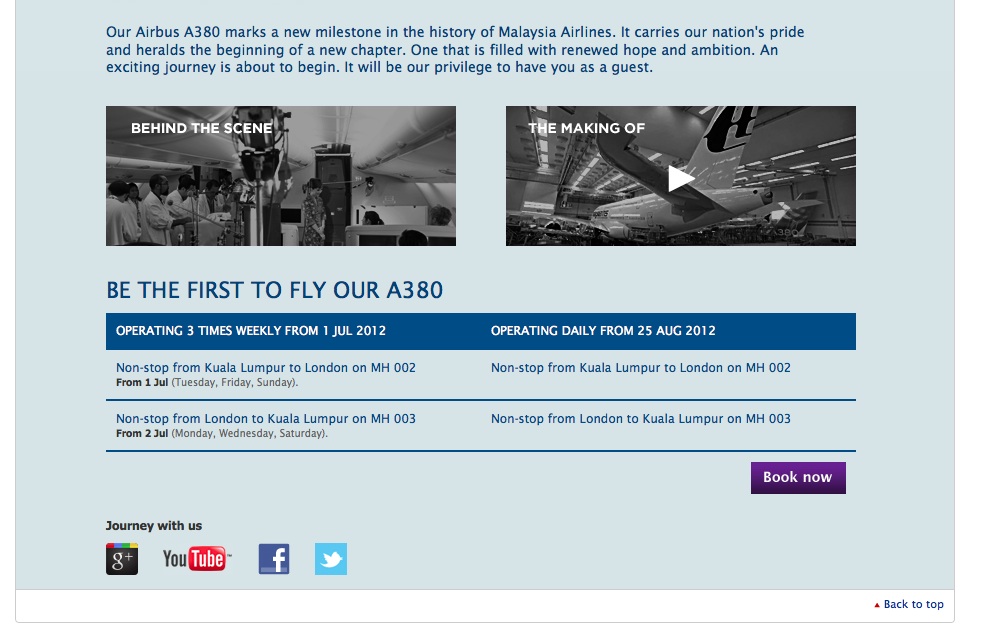
I appreciate it is early days but I have noticed a digital campaign selling the new A380. The style would suggest MAS is going the traditional route using glossy images and slick advertising with high production values to attempt to position the company in the minds of its consumers.

The ad features an image of the A380 in the very attractive new MAS livery and a tagline about the journey which I assume is related to the A380 and one about the aircraft being the pride of the nation. Let’s hope Ogilvy improves on that. Anyway, clicking on the ad, you go to the existing MAS site where you are greeted with the same, larger image of the A380 and the same taglines.

Below the fold there are two black and white images with click through options. The one on the left entitled, Behind the scene (sic) links to still images of the making of the new commercials which look very traditional and my first reaction was what a pity they haven’t changed the cabin crew uniforms. The image on the right links to a video entitled ‘The pride of our nation”, a predictable and uninspiring video of an MAS A380 being painted!

Throughout, the copy is uninspiring.

Below the images are social media options. I had a quick look at the twitter feed and it looks very collaborative with plenty of discussions although efforts to build the brand in the social context can be improved.

But I have a sneaking suspicion that the bulk of that US$190 million is going to be spent on advertising. And as Singapore Airlines learnt with it’s A380s, you can no longer rely on developing a position and using advertising to communicate that position in the hope that it will work and consumers will buy.

Positioning
The problem is that positioning is a throwback to the mass economy that no longer exists. What advertising agencies tried to do was create a position that reflected the strengths and weaknesses of the offering. Ideally, this position was based on being first in a particular category.

If someone was already first in a category, then companies attempted to redefine themselves in a new category to be first. In the airline business, this tended to be related to passenger comfort or service. The effectiveness of positioning depended on the ability of advertising to drive branding perceptions in the mind of consumers.

To do this, airlines often made promises they were unable to keep (admittedly, often due to third party issues out of their control), failed to meet traveller expectations, often because dynamic competitors moved quickly and so raised the bar, which in turn led to brand disillusionment.

Positioning was ideal for the mass economy. It was also ideal for advertising agencies and marketing departments because it gave them enormous power without the responsibility of accountability. Al Ries and Jack Trout invented the concept of positioning. The preface to one of their books states, “Positioning has nothing to do with the product,…. (it) is what you do in the mind of the prospect.” So, essentially this means that the consumer can be made to believe, through extensive advertising and PR and via the right conduits to consumers, and other vehicles, what an offering means to them.

Well I’m sorry, this might have been true in our parents day, when consumers were more predictable, more trusting and had less choice but in today’s mean spirited world, a world in which only 4% of Americans and 14% of Malaysians believe what they read in adverts it is going to be very, very difficult. And of course the problem with using positioning to build a brand is, if it doesn’t work, the money is wasted, time is lost and you have to repeat the process again, with a new position!

So how can MAS save its troubled brand?
1) Research. Your existing customers are your best source of information. But they are not all the same. I would be interested to know which, if any customers MAS talked to when they were configuring the aircraft. MAS is talking about flat beds and big TV screens in first and business. Well that is so last year and who doesn’t offer them so why should I change? What about Internet access? I hope the A380 offers it throughout the aircraft.

2) Mass market branding and the old model of developing a position and communicating that position across for mass media repetatively for as long as possible is no longer effective. Brands today are built on relationships, access, personalisation and relevance. Before MAS marketed to segments of 18 – 34 year olds, businessmen and so on. Today, MAS must deliver economic, experiential and emotional value to to everybody and on their terms.

3) MAS must focus on developing more profitable relationships, not a more profitable product. Brands evolve when companies start buying for customers instead of selling to them.

4) Branding is an organisational not a departmental responsibility. And the organisation is the responsibility of the CEO. MAS is charging about a 100% premium for an economy class ticket on its A380 in July over the price of an economy class ticket on a 747 for the same route. Throw in all the other airport fees etc and it’s going to have to be a pretty good product to charge such a premium.

5) Retention is key to brand building. Companies no longer sell a product, customers buy a product. And those customers have plenty of choice, especially in the airline business. Sadly too many companies spend lots of money on acquiring a customer but very little on retaining them. MAS is one such company. Once a consumer buys the product, companies should do everything possible to hang onto those customers, build relationships with them, learn about them and leverage them.

Bonus tip. This is the social era. As I said MAS is working hard on social media but there is room for improvement and integration. It would be interesting to know how they leverage their social media efforts to get more business.

ASTRO makes a small but significant branding blunder


Rugby is an increasingly popular sport just about everywhere. According to a recent Mastercard report, the overall global growth in the sport is estimated at 15% per year.

The main rugby event is the rugby world cup which is held every four years. The first rugby world cup was held in 1987 and attracted a global TV audience of 300 million. Twenty years later, the 2007 Rugby world cup attracted a global audience of 4.2 BILLION TV viewers, and the Rugby world cup is now the most watched sport after the Football world cup and the Olympics.

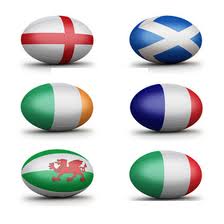
The six nations rugby tournament is the second most important international rugby tournament after the rugby world cup. It is held annually between England, Ireland, Scotland, Italy, France and Wales and was watched by over 69 million TV viewers in Europe in 2011.

The six nations, only a few games live on TV in Malaysia

According to Wikipedia, in Malaysia there are sixteen rugby unions, associations and councils affiliated to the Malaysian Rugby Union and more than 300 clubs and 600 schools and universities nationwide that teach the game.

There are 41,050 registered rugby players in Malaysia (I don’t know who they are registered with), and the country is currently ranked 57th in the world.

There are also countless other rugby players and fans who are not registered but have an interest in the game, such as expatriates from rugby playing countries.

When the commonwealth games were held in Malaysia in 1998, it was estimated that over 50,000 people watched the Rugby Sevens part of the tournament live and 20,000 were at the ground to watch the final, won by New Zealand.

It wouldn’t be too far fetched to say there are probably 250,000 to 500,000 people connected to or involved in some way with rugby in Malaysia.

So it has caused somewhat of a storm within the rugby fraternity in Malaysia to discover that ASTRO, the only satellite TV provider in the country has decided to show only a small percentage of this top class global event live on TV.

One corporate subscriber that spends almost RM100,000 per annum subscribing to Astro was stunned to learn of Astro’s poorly thought out decision not to show the games live and said, “I am shock (sic) to learn of this decision. I don’t get it, why would you not show this popular competition live? We know Astro can do it so why don’t they?”

Another domestic subscriber summed the situation up thus, “I’m sick and tired of the crap they show on Astro and then when something I really want to watch isn’t on live, it really makes me angry and I wish I could change provider.”

An audience of 500,000 is relatively small (although it does equate to about 25% of total Astro subscribers) but this is a lucrative segment with influence and with related content, advertisers would have a captive audience. Such an event should be on the radar of destinations, financial institutions, hotels, automotive companies, schools and universities, real estate agents and more.

One potential local advertiser would be Mastercard which supports rugby on a global scale. Credit cards are sold in many ways in Malaysia, including a sort of hijacking of prospects at petrol stations.

Personally, I would be more likely to be influenced by a Mastercard advertisement linked to rugby than I am by the current tactics.

Astro spends a lot of money acquiring customers but spends little on retaining customers. It may be that because Astro is a monopoly, it doesn’t think it has to listen to its subscribers and it may have a point.

But with a new provider due to launch in 2Q2012, the growing penetration of IPTV providers such as Telekom Malaysia and the growing trend for downloading programmes from the Internet, now may not be the best time to alienate a small but wealthy segment.

What do you guys think?

Effective use of Twitter to build your brand


This article first appeared in the 29th November print edition of The Malaysian Reserve

Earlier this week at the launch of the 1Malaysia Social Media Convention, the Prime Minister of Malaysia Datuk Seri Najib Abdul Razak announced that the Barisan Nasional (BN) was developing an army of BN friendly cyber practitioners to engage consumers online.

The PM said at the launch, “As a party that wants to be relevant, we have to change according to the change in time”. The Malaysian Prime Minister should be applauded for his grasp of the importance of Social Media because there are over 12 million Internet users in Malaysia and Social Media is responsible for one third of the web traffic in the country.

The Prime Minister understands that social media has transformed people’s behaviour, their expectations and how they like to express themselves. Unfortunately, although the Prime Minister is aware of the importance of Social Media, most corporations appear oblivious to the impact of Social Media on consumers and the way they learn about and share information on products.

This may be because up until recently companies have been able to manage their communications but this is changing and today, consumers no longer respect or trust slow, opaque, bureaucratic, dictatorial corporations and the structured PR and advertising they like to push out across traditional broadcast media. In fact a recent study noted that a staggering 86% of Malaysians don’t believe what advertisers tell them in traditional ads!

Consumers are fed up with the automated voicemail that greets them when they call with a product or service issue. Especially as many corporations use the inevitable waiting time to try and sell something else to a customer who is often seething at the company and is not in the right frame of mind to be sold to.

Today, consumers expect, no demand to be able to talk to the right person at the right time.

Today, successful organizations are the result of being human, responsive and transparent. And consumers will communicate with these companies across open and transparent social media communities such as Twitter, Facebook and others.

So over the next few months we’ll talk about some of the most likely social media tools you can use to communicate information about your brand and how those tools can be used for businesses such as yours.

This month we look at Twitter, what it is and how you can use it to build your brand.

Worldwide, there are now 100 million active Twitter users and daily Tweets are over 250 million. Most top actors, athletes, politicians, businessmen and artists are active on Twitter.

Every news, current affairs and sports programme proudly displays its Twitter account name. Global events anywhere in the world break first and spread faster on Twitter. While CNN is showing 2 day old sports’ scores on its ticker tape, Twitter is providing those who are interested with ball by ball updates live from the next days play.

Barack Obama has 11.2 million followers, Datuk Seri Najib Razak has 295,000, AirAsia has 245,000, Amazon has 149,000, Firefly has 47,000 and the numbers are growing fast. In Asia, Indonesia has the most subscribers to Twitter whilst there are about 1 million in Malaysia.

It is important to understand that Twitter is not another Facebook. Facebook is best described as a few to a few social network created with a goal of sharing personal information and life related stuff with friends. Only once two people ‘friend’ each other can information begin to flow. Twitter on the other hand, is a one to many social network that allows me to say follow Firefly to keep abreast of their offerings yet they don’t have to follow me back to make the relationship work.

Twitter allows prospects and customers to instantly connect with you. Brands are no longer defined by the campaigns created by marketing and PR departments within companies. In the social economy of today, brands are defined by consumers or more specifically the experiences those consumers have with brands.

Get it right and you’ll build a brand. Get it wrong, and consumers will ensure your brand fails.

One of the reasons for Twitter’s success is because consumers got fed up with the automated responses they were faced with every time they contact a company.

Twitter is a popular platform to disseminate news about your company. If you have set up your Twitter account properly, Twitter is a dynamic and inexpensive platform for you to post information relating to your brand. A well planned Twitter strategy can help keep prospects and existing customers abreast of new developments and engaged. Beware however that it is not a broadcast medium and you must know when to stop. Constantly sending out the same message will have a negative impact on the brand. It’s also important to respond to comments from consumers related to your announcements.

Twitter is an excellent platform for sourcing actionable data. Twitter lets you find out priceless information about your customers – their opinions of your brand, what they like and/or dislike about your brand, what they think of your competitors, recommendations for improvement and much more. Twitter gives you an opportunity to improving your business, often without the need for costly investments.

Twitter helps you to humanize your brand. Twitter allows you to reach, communicate and engage with consumers and match your product attributes to their requirements for value whilst other companies are publishing generic ads in newspapers or attempting to convince consumers with PR.

Twitter lets you send the right message to the right people immediately. By using groups, lists, communities and other Twitter features effectively, Twitter lets you distribute news, make announcements, inform or create awareness of special offers to the right people in real time. No more waiting a month for the magazine to come out or 24 hours for the newspaper (assuming they have the space).

Being active and effective on Twitter communicates a company at ease with technology. Being a part of the Twitter community shows that you are moving with the times, that you embrace technology and are an open and transparent organization.

Twitter case study
A frequent business traveler between Malaysia and the UK was a loyal user of Budget Rent a car. But after a 13 hour flight, the business traveller was forced to wait two hours for a pre booked car. He stayed with Budget until on another occassion he received a bill for £86 because he forgot to pay the £10 congestion charge. So he decided to look for another car hire company for his next trip to the UK.

Using a price comparison site he came across Sixt, a company he had never heard of. The company offered an attractive pick up and drop off within a 5 mile radius of the nearest showroom. But when the businessman was booking the car hire on line he couldn’t find out any information on the pick up service.

So he turned to Twitter and asked for help. Within 5 hours the MD and CEO of Sixt had both contacted him with a request for his email address so that the @Sixt customer service team could get in touch.

Arrangements were made with customer service for the pick up and as a nice touch the car hire company upgraded him to a premium car. The experience was seamless, quick and pleasant. The businessman then shared, across multiple social media platforms details of his experiences and I am now sharing his experience with readers of this Blog and across Twitter, Facebook, Stumbleupon and more.

What was the cost of the positive buzz and acquiring this new, influential customer from a competitor? In terms of time perhaps an hour at most. Financially, next to nothing.

Should you use celebrities to promote your brand?


There are lots of differing views on the use of celebrities to sell brands but if you have the money, it makes sense to explore this option.

But tread carefully because celebrities after all are human and humans get injured or worse, make mistakes – think Tiger Woods, who was unceremoniously dumped by Tag Heur, Gatorade, Gillette, ATandT and Accenture, soon after the details of his infidelities emerged in late 2009.

Firms the world over spend hundred of millions of dollars getting endorsements from celebrities. And studies would suggest the returns are worth the investment – and the risk. Which is probably why Rolex has announced that Tiger Woods will now endorse its watches.

Indeed, a report last year by Anita Elberse for CNN found that sales of brands in consumer product categories jumped an average of 4% in the six months after an endorsement deal was announced.

Interestingly the report also noted that stock prices went up about 0.25% on the announcement and would generally react favourably each time the athlete won an event in his field.

As an aside, although Tiger Woods lost those endorsements, he is still the most endorsed athlete in the history of sport. And justifiably so if a report from Kevin YC Chung is anything to go by. According to the report, from 2000 – 2010, just the golf ball division of Nike earned an additional profit of US$60 million after acquiring 4.5 million customers after Tiger Woods began endorsing Nike products.

Of course Celebrity endorsements are not cheap. In 2000, Nike paid Woods US$100 million for a 5 year endorsement deal. Tennis player Anna Kournikova has multiple deals with Omega, Berlie Lingerie, Prince racquets and Canon. Kournikova also signed a US$50 million six year deal with Adidas. Fortuitously for Adidas they wrote a line into the contract that insisted on Kournikova winning something. This she rarely did but she still earned US$3 million from the deal.

Probably the biggest endorsement deal ever done was between Adidas and David Beckham. The lifetime deal cost Adidas US$161 million back in 2003. But at least it stops Nike from getting their hands on the globally popular football star.

Sometimes however all it takes is a little bit of good fortune related to a celebrity to generate massive sales. Victoria Beckham let it slip in an interview recently that despite the healthy state of her and husband David’s bank account, David was more than happy buying his socks from Marks & Spencer.

Since she made the statement, Marks & Spencer claim they have seen a more than 30% increase in the sale of men’s socks! And the cost of this celebrity endorsement? US$0.

5 Essential Rules for Social Media and your small business brand


The original version of this article first appeared in the August 26th 2011 print edition of The Malaysian Reserve.

It is not a question of if you will stick your corporate toes in the social media waters, but when. Whether you like it or not, social media is taking the world of business by storm.

In a recent survey by Nielsen, a research company 73% of connected consumers in Indonesia, Malaysia, the Philippines, Singapore, Thailand and Vietnam agreed they had been influenced by advertisements on social media.

Firms that continue to believe that social media is a fad or fun or not for business are only doing one thing, giving their competitors an advantage.

Research from Hubspot and MSN shows that companies with a social media brand strategy are seeing a significant increase in awareness, traffic to websites, search engine rankings, and social-media-generated qualified leads, perhaps the most important element of all. Moreover, statistics increasingly show that more and more people like to do business with businesses that have a strong social media presence.

But social media is much more than setting up a Twitter account or starting a Facebook page. Social media activities must be elements of your brand strategy in the same way as advertising, direct mail, email, PR are. The problem with these traditional activities is that they are reactive, you put it out there and wait for something to happen. If nothing happens you spend more money on another idea. If that doesn’t work you try something else.

A social media strategy, if done properly is proactive and can actually offer you all the things your traditional campaign can’t offer you – accountability, retention, a measureable return on investment, effectiveness tracking and more. Data from a 2010 report by Nielsen, a research company showed that social media had better results than traditional marketing activities.

So how should a small business enter the world of social media? The following five rules are relevant to any firm that seeks to develop a contemporary platform to raise awareness and be heard over the noise, acquire customers, increase sales and better serve customers which will in turn ensure customers are retained and not released to the competition.

1. Social media is not a technology issue it is relational and requires cultural changes within organizations.

The social media space is not the place for people with a traditional marketing mindset. Social media is exactly that, SOCIAL and requires you to use social skills to build rapport with consumers so that they may eventually become prospects, customers and possible evangelists. Trying to use a traditional marketing approach in social media and using a hard sell and trying to push a product or service in social media will damage your reputation.

2. Identify who in your organization will be responsible for your social media strategy.
You will need to have a social media strategy and it will have to be integrated with your brand strategy. If you don’t already have someone, you must be looking to hire a social media manager who reports directly to the CEO and not to a marketing or sales director. And because social media is incredibly dynamic and changes are happening 24/7, you are going to have to be prepared to give this person a lot of autonomy to interact with consumers and make decisions, some of which will be financial, that directly impact the relationship with prospects and customers.

In the old days of mass advertising across mass media you had control of the messages related to your brand. Social media is fluid, consumer driven and places the control of your brand in the hands of consumers. Accept that you have to relinquish control.

3. Social media is not a technical initiative, it is a relational initiative
Relationships don’t stop for an hour at lunchtime, at 5pm or over the weekend and nor does social media. Success in social media takes time as firms seek to build the credibility needed for consumers to trust them. Make sure posts are made daily and questions or requests attended to immediately even if raised over the weekend.

Although your social media strategy is not a technical initiative, social media personel need to have at least an understanding of related technology such as Google Analytics, Content Management Systems (like WordPress), and third party social media software like Tweetdeck and HootSuite – so as to assign metrics by which to assess and respond quickly.

4. Define your core audience and messages for those audiences.
Traditional marketing attempts to be all things to all people. This model won’t work on social media. If you intend to educate, identify who you want to educate and do so but don’t try to sell to them. If you have targeted them effectively, they will take the initiative and seek out more information about your organization and how you can provide value to them.

5. Social media is not a volume business
Someone once said that volume is vanity, value is sanity. What this means is that firms should look to increase profitability not sales. Used properly, social media can help you reduce your cost of acquisition and increase profitability. Don’t set out trying to have lots of followers who never buy your product or service. A single follower or friend who is engaged and interacts with you is worth more than a thousand followers or friends who only drop by once a year.

Social media is participatory and is an efficient tool for your organization to learn, exchange and build professional networks so take time to build individual relationships. Once you have a follower or friend or contact, you have their permission to interact with them in a consultative manner. It is not about broadcasting messages but holding conversations.

When a consumer gives an organization permission to speak to them, it is because they like what the organization is saying and want to hear more of it. An organization must engage, gain trust and then solve the problem. But be warned, this means that the organization’s messaging must be relevant just about 100% of the time.

This may take time and you may find it difficult to open up, especially if you and your marketing department, educated on a diet of broadcasting corporate driven messages to as many people as possible, are not used to sharing information, especially with prospects.

However, get it right and you will find that you build relationships and followers quickly, and inexpensively and this will lead to increased sales and more loyal customers who will not only spend more with you, they will share their experiences with your brand with their friends.