Are brands responsible for where their ads are placed?


A couple of years ago I wrote a blog post about negative brand association. You can read the story here.

I hate to say ‘I told you so’ but I’ve always said that in the social economy, the concept of using communications to try and position a product or service in the mind of a consumer is fraught with danger because it can backfire in many ways.

When I last discussed this issue, I mentioned a video on the BBC website that featured a drunk driver in China who was caught on film smashing into road dividers and barricades.

That video story was preceded by a commercial for Lexus! Here is a still image from the end of the commercial.

Negative brand association - Lexus and drunk drivers
Negative brand association – Lexus and drunk drivers

Interestingly, the story is still online but now the video is preceded by a commercial for the Philippines with an amusing if a little tactless play on the concept of parking! Which would suggest the ad placement is left to the media owner.

India spent millions and millions of dollars positioning the country as an incredible destination only for all their hard work to be undone in a matter of months this year as report after report came out about the rape and murder of women, tourists and children.

More recently, Facebook has been criticised not only for featuring customer ads on controversial sites, but also for reacting slowly to complaints from customers.

Facebook - not just their fault

Dove, owned by Unilever the global Multinational Corporation that spends over US$1.5 billion per year on advertising, with an increasingly large percentage spent online was said to be furious when its ads on Facebook were featured on controversial group pages such as ‘Drop kicking sluts in the teeth’ and ‘Raping’.

Vodafone, another advertiser with a global marketing budget in excess of US$1.3 billion was particularly miffed when its ads appeared on the offensive Facebook page ‘This is why Indian girls are raped’.

It's the responsibility of brands to know where their ads are placed
It’s the responsibility of brands to know where their ads are placed

Another advertiser affected in a similar way announced that it would review it’s advertising if Facebook could not ensure this didn’t happen again.

Facebook’s revenue from advertising in the last quarter was an impressive US$1.33 billion, up 41% on the previous quarter.

If Facebook wants to continue to see such massive increases in advertising revenue, it needs to sort out its processes and systems.

But it’s also the responsibility of CEOs, brand owners and managers who need to understand that in the social economy, using traditional methods to try and position brands is a lazy approach and unless they start to take control of their brands, the platforms they use and the way they communicate, they may find that their brands will suffer in the long term.

They will probably blame their advertising or media agency and they have a point but the real responsibility lies with them, the brand owner.

Which brands fooled you on April 1st?


The concept of the April Fools Day joke has had something of a renaissance with the advent of the Internet. Many brands take it very seriously as they try to out do each other with varying levels of success. Google is always up there and this year Twitter also scored well in the original stakes. But the traditional media companies also performed well this year.

Here is my top 5 of this year’s gags.

5) Youtube is shutting down

4) Google now has a search by smell feature (still in beta stage)

Google adds the new 'scentsation' in search
Google adds the new ‘scentsation’ in search

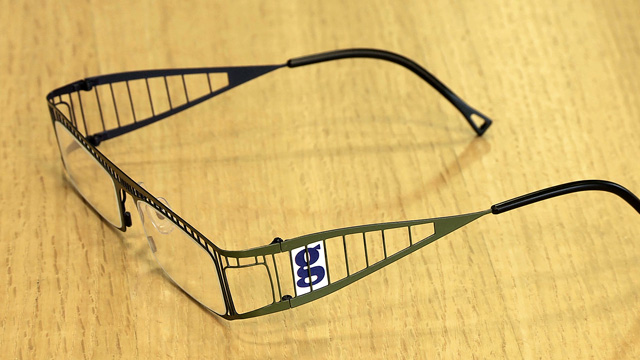
3) The Guardian newspaper in the UK launched a product a pair of Web-connected ‘augmented reality’ spectacles that will beam content directly into the wearer’s visual field, enabling users to see the world through the Guardian’s eyes at all times.

Now we can all groan

2) Apple to release a unisex scent that smells like Steve Jobs. This report came from Macworld in the UK (I’m not sure if it refers to when he was alive or now)

Now you can smell like him

1) Richard Branson announces Virgin has developed new technology that will see the production of glass bottomed planes

The 'drawings' for the glass bottomed plane
The ‘drawings’ for the glass bottomed plane

5 facts about developing a brand strategy in the social economy


1) Research is more important than ever.
Research has always been important but it was cumbersome and time consuming. Not any more. Today, the right research can be developed and implemented and results analysed quickly and efficiently.

Brand building - don't run before you can walk
Brand building – don’t run before you can walk

It’s easy to find those people who are likely to like your product. It’s even easier to talk to them. But too many companies don’t bother, preferring to chase the holy grail of more new customers through corporate driven messages.

And don’t forget your existing customers because they are your best source of information. Talk to them, find out what they are looking for, what they value and match attributes to their requirements for value.

2) Mass market branding with a focus on the 4 Ps is no longer effective.
Brands today are built on delivering economic, experiential and emotional value. Not on creating some cool position and communicating it across as many channels as possible for as long as possible.

Deliver that value with stories that resonate with target markets and existing customers. Build relationships with customers by allowing access to the brand, personalizing all elements of all interactions, through relevance, experiences and emotions.

Ignore the social element of the social economy by trying to speak to everyone with one corporate driven message and you will fail.

3) Focus on developing more profitable relationships, not a more profitable product. Brands evolve when companies start buying for customers instead of selling to them. This is especially true in times of economic hardship.

4) Branding is an organisational issue not a departmental responsibility.
And the organisation is the responsibility of the CEO. The CEO needs to be involved in the development of the corporate brand.

Your brand is too important to be left to a marketing department that still believes in the corporate driven message over the engagement of the consumer.

And once you’ve built a brand, don’t rest on your laurels, continue to innovate or you will be left behind.

5) Retention is key to brand building.
Companies no longer sell products, customers buy them. And once customers have bought a product, companies must do everything possible to hang onto those customers. After all, you’ve investment a lot of money to gain a customer, why let them go?

Especially as the more time a customer spends with you, the more money they will spend with you.

Cross platform marketing to build a brand


It is accepted now that consumers are paying less attention to traditional media.

Although the TV or the radio may be on, it doesn’t mean they are viewed or heard. And with the proliferation of ads and trailers, more consumers are reaching for other screens during a break in programming.

But marketers still insist on using traditional media to reach as many consumers as possible in the hope that their message will stick. Even those companies that are spending on digital are using the same methods as they used in the old mass economy.

This despite the fact that last year Harvard Business Review said, “Traditional marketing is dead… in today’s increasingly social media-infused environment, traditional marketing and sales not only doesn’t work so well, it doesn’t make sense.”

However, all is not doom and gloom for traditional media channels. Or at least the TV.

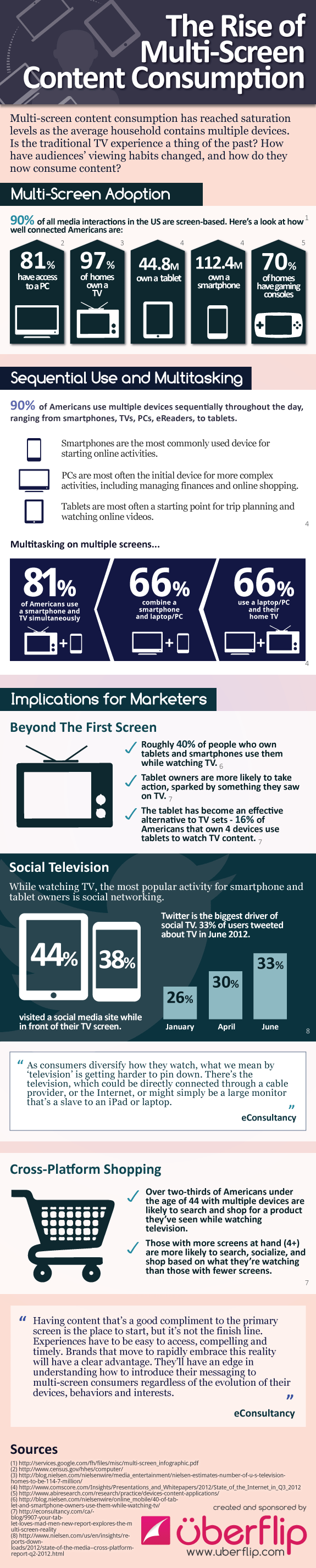
This infographic from Uberflip shows that although consumers are reaching for other devices whilst watching TV, many of them (66%) are using those devices to source information on a product and often purchase after seeing that product on TV.

Cross platform marketing requires a new mindset

So there may be a future for the TV as a communications tool after all.

However, what marketers must do is rely less on corporate driven messages and instead, identify how to introduce their products on one screen and then integrate that product and messaging across other screens taking into account changed behaviours, attitudes and cultures.

When is the best time to use Twitter?


Whether we like it or not – and despite the fact that there are 500 million Twitter users of whom 200 million are active users, far too many companies refuse to take Twitter seriously. Preferring instead to continue to use traditional channels – Twitter is an increasingly important tool for brand building.

It allows firms to distribute real time content to people that are interested in that content. It provides access to celebrities and other people of (significant) influence.

It also allows brands to lay the foundations for and build stronger business relationships, address negative issues in a transparent manner and thereby improve customer service and help retain customers that could have been lost.

But one of the drawbacks of Twitter is not knowing when and when not to use it. Not any more. Thanks to this excellent infographic from linchpinseo you can time your tweets to perfection!

Perfect tweet times
Perfect tweet times

Can poor customer engagement across social media destroy a brand?


I came across a remarkable story about how a brand failed to deliver on its promise and the result of that failure. You can read the full story here

In a nutshell, it’s the story of a gamers attempt to buy an add-on for video game console controllers. The tool, known as the Avenger and invented by N-Control was announced in November 2011, word soon spread across social media and demand went through the roof.

After ordering 2 of the controllers, the gamer was told it would ship in early December 2011 however by the middle of the month he had heard nothing so emailed the president of marketing to enquire as to the shipping date and was told it would ship a day later than announced.

Unfortunately it didn’t. Then it was announced that anyone ordering the controller after December 26th would get a US$10 discount however, those who had ordered before December 26th and had still not received their controllers were not entitled to the discount.

By this stage the gamer was getting a bit annoyed and emailed the firm asking if he cancelled his original order, could he then qualify for the US$10 discount (don’t forget he’s ordered 2 of them).

The firm came back with this statement, “Feel free to cancel we need the units we’re back ordered 11,000 units so your 2 will be gone fast. Maybe I’ll put them on eBay for 150.00 myself. Have a good day Dan.”

By this stage the gamer was seething so he wrote again to the President of marketing but this time copied the email to organisers of major gaming conventions in the US. Amazingly the President of marketing responded by calling the gamer childish, laughing at his complaints, and dropping the names of numerous gaming conventions that they intended to attend, one of which was organised by the very company the email was CCd to.

The organiser took the side of the gamer and banned the company from taking a booth at their gaming convention. Then the story was posted online and went viral and this is when it really hit the fan. Because of the power of Facebook, Twitter, Reddit and others the story even crashed the site it originated from! You can see more information on how it went viral here

Soon after N-Control fired the President of marketing and made a US$10,000 donation to charity.

What lessons can be learned from such an event?

Promises made must be kept. If you don’t prepare to feel the wrath of the consumer.

Make sure the people who represent your brand live the brand.

N-Control is on the defensive and maybe for some time. It didn’t need to be in this situation. Know how to use the Internet.

Be careful when you offer discounts. Consumers who have paid pre discount rates expect value. If you don’t deliver, offer the discount to those who kick started your sales.

I believe that an event such as this may not bring down a brand but it could be extremely expensive and the fall out for N-Control will last for years. If they come up with a sub standard product they will really struggle.

And such an event can certainly cost people their jobs and quite possibly, as more and more employers trawl the Internet for information on potential hires, their careers.

Consumers have changed, has your marketing strategy?


Doe this sound familiar?

You need to spend time creating a position that is driven by the corporation.

Once created, the position must be communicate across traditional media (with a nod toward social media, but a nod only) to as many people as possible and hope that some of it sticks.

If it doesn’t, create a new position and repeat ad nauseum. Hopefully you will get it right. If you don’t, well you can always discount. This model was developed by Jack Trout in the 1970s. I wrote a blog post about it here

Sadly, despite US$1.5 trillion spent annually on marketing, 70% of today’s manufactured goods will be obsolete in six years (Industry Week magazine). There are estimated to be more than 30,000 new product introductions in the US alone every year, and that’s just in the packaged goods market. According to AC Nielsen, up to 90% of products fail to become brands. This means that as many as 27,000 of those new products will fail.

Today’s consumer has changed the way he lives his life and moreover, markets are so fluid, spending time developing a position and watching your competitors is the fastest route to business oblivion.

The key to success is the sales force and their ability to build your business through collaborations and by matching products/services to individual customer requirements for value and then maintaining those relationships and your brand communities team who develop brand evangelists and influence influencers.

And with social media and modern technology, that is not difficult. A lot less difficult than creating a position and pinning all your hopes on, well hope.

Advertising doesn’t work, just ask Microsoft


This is a great ad for Windows 8 from Microsoft Portugal (stick around for the ending) but it’s a corporate driven message and in the social economy, consumers no longer believe or trust corporate driven messages.

On seeing this ad, the first thing most consumers will do is search the net for more information. I did and I came across an interview in the Verge with Gabe Newell, Chief Executive of gaming company Valve who called Windows 8 ‘A great sadness’. He said Windows 8 is ‘inoperable’ and ‘it just hurts everybody in the PC business’.

He went on to add, ‘Rather than everybody being all excited to go buy a new PC and buying new software to run on it, we’ve had a 20% plus decline in PC sales.’

Consumers have been equally disappointed. One commented on extreme tech, “I’ve had win 8 on a desktop since last February and everything you do takes as many as 3 extra steps compared to win7, everything from shutting down to closing a program or web page is unduly complicated. This is by far the worst windows ever and I have been using windows since 1981.”

In December, MIT professor Philip Greenspun said the new operating system was a “Christmas gift for someone you hate.” Although Greenspun liked some of the apps, he hammered just about every aspect of Microsoft’s new software, noting that ‘Microsoft had since October 2008 to study Android and since June 2007 to study the iPhone and its OS, but still couldn’t build a usable tablet experience.’

Late last year Microsoft announced that it had sold 40 million Windows 8 licenses in the first month of sales which began at the end of October 2012. It’s unclear whether those licenses were sold to customers or retailers or how many were upgrades and new purchases.

Microsoft spent $1.6 billion in fiscal 2012 (its year ends in June) on advertising, $1.9 billion in 2011, and $1.6 billion in 2010. Prior to that the firm spent $1.2 billion in fiscal year 2006, $1.3 billion in fiscal 2007 and $1.2 billion in fiscal year 2008.

Despite spending these phenomenal amounts on advertising, according to IDC, Goldman Sachs Research Microsoft’s share of the consumer market has nosedived from 95% to 20% in the last 8 years.

microsoft-google-apple-other-consumer-compute-market-share-640x353

My bet is that Microsoft will find it hard to sustain those early Windows 8 sales if trade and consumer reviews continue to lambast Windows 8.

And no matter how much the firm spends on advertising and no matter how creative or well executed is the advertising, if the product doesn’t work properly, Microsoft’s share of the PC operating market will continue to plummet.