Another example of why you need to invest in Social Media today


When we develop a social media strategy for a company we often have a hard time getting them to understand that there is a definite need for a well structured strategy with carefully thought out ideas and schedules. And once we’ve done that, we then have an even harder time explaining that because of it’s very dynamic nature, social media also requires the ability to have a nimble and loose approach to engagment. It’s almost a contradiction in terms.

But the ability to engage consumers and address certain issues ‘on the fly’ and in a human way is often more important and more effective than trying to push out corporate driven ideas and messages. Often, consumers will look at the way a company reacts to a unexpected situation and develop their perception of the brand based on that interaction.

A story broke today (Wednesday) about a young customer at Pret a Manger, the legendary UK sandwich bar that has grown from one outlet in London in 1984 to 374 outlets in 2015 and turnover of £500 million. Now Pret a Manger will have a social media team either in house or outsourced. That team will have a strategy but also SOPs for unique situations.

The customer purchased a ‘Chef’s special avocado and crayfish wrap’ from his local branch that he said, from the first bite was, “possibly the worst tasting item I have ever eaten. It tastes like my daughter’s sandpit.”

He went on Twitter and told the company how unhappy he was with his lunch and they responded immediately with an offer (after taking the discussion out of the public domain and into direct messages) of a free lunch as compensation.

The right people in the right place can do wonders for your brand

Impressed, he congratulated them on their service and shot off a text that was apparently a reference to a Jay Z and Kanye West song about Paris.

Pret got it immediately and responded with a pun of a Jay Z lyric from his Problems song. The customer then came back again, this time with a play on Silento lyrics which Pret responded to using a play of the Weeknd’s ‘I can’t feel my face’ song.

And so it went on for about two hours, with references to Taylor Swift, Notorious BIG, Dizzee Rascal and finally Adele.

The story was taken up by the national press in the UK with both tabloids and serious papers running stories that reached millions of British consumers in a very short time and hundreds of them commented on the issue or shared it across Facebook, Twitter and other platforms, thereby increasing the positive narrative about the brand. And all from a negative experience.

In addition to the ability of social media to cover many traditional roles, this is a great example of why it is important to have the right people with the right authority who understand the organisation’s values responsible for the brand.

Other lessons to be learned from this little exchange include

1) A humanized approach works on social media. Don’t try to be a corporation, it’s the wrong place
2) Know when to go with the flow. In other words, don’t do social, be social
3) Your customers generally have good intentions. Be nice and they’ll be nice to you
4) A sense of humour goes a long way on social media. Just like in real life, which social media is
5) There really is something called a free lunch. Well this time anyway
6) A structured social media strategy is important but knowing your contemporary music is a must. Presuming you have 2 hours to kill and your boss isn’t around
7) Social media has a reach traditional media can only dream about. So why are you still putting all your money into traditional media?
8) Who needs advertising? Seriously, who does?
9) The right social media approach gets instant results. Are you using the right model?
10) In the right hands, social media is an effective sales/marketing/advertising/customer service/retention/awareness tool. Is your social media in the right hands?

What’s the downside of this experience? There really isn’t one. The exposure was phenomenal and cost Pret nothing more than another sandwich and two hours of a social media team members time. A bit of creativity from the social media team generated more effective brand exposure than any billboard, TV or print ad could ever do. And for a fraction of the cost.

What I’m interested to see is how Pret a Manger leverages the experience going forward. If I hear anything I’ll let you know.

Which is your favourite 2015 Christmas ad?


According to a recent Nielsen report, 9 out of 10 Malaysians believe the country is currently in a state of recession and are tightening their belts as a consequence.

This has led the Malaysia Retailers Association to lower their retail growth forecast to 4% with quarterly growth rates at their lowest since the Asian financial crisis of 1998.

Some sectors, such as supermarkets and department stores have seen quarterly slumps of 18% and with the end of the year sales and Christmas period unlikely to lift revenue, are bracing themselves for a terrible 2015.

No such issues for the UK retail industry as the Barclays Christmas survey 2015 reports 79% of UK retailers expect an increase in sales over 2014.

A far cry from 2013 when Company Watch predicted over 5,000 UK retailers would fail to make it to the ‘killing season’ the post festive months from the end of December to mid February.

With over 25% of retail sales generated in the next 6 weeks, the big retailers will be fighting tooth and nail over more than £40 billion in sales with Christmas advertising campaigns signalling the start of the contest.

Here’s a look at the first Christmas 2015 advertisements to be launched.

John Lewis – The Man on the moon
What happens – A little girl on earth looks through a telescope and spots an old man on the moon. As the seasons change, she watches him sitting on a park bench staring wistfully at earth. Christmas arrives and presents are opened while the old man sits alone. Out of nowhere arrives a gift of a telescope.
Tagline – Show someone they are loved this Christmas.
Anything else – A reminder that many people will be alone at Christmas. Aurora sings ‘Half the World Away’ originally by Oasis. A Twitter feed to keep the story going and an app.
Youtube views – 13,014,000 in the first week and 69,000 Likes.
Facebook – Only the John Lewis page.

Sainsbury’s – Mog’s Christmas Calamity
What happens – It’s Christmas Eve and the Thomas family are all dreaming except Mog the cat who is having a nightmare. In the nightmare he wreaks havoc and practically destroys the house and any chance of a joyous Christmas.
Tagline – Christmas is for sharing.
Anything else – Based on a character made famous by children’s author Judith Kerr. An illustrated book is available and profits go to Save the Children.
Youtube views – 3,526,000 in the first day and 19,200 Likes.
Facebook – Nothing yet.

Harvey Nichols – Avoid Giftface
What happens – It’s Christmas Day and a large, middle class family are giving presents. Lizzy darling has a look of concern on her face but manages to remain gracious as she’s given a series of predictably bad gifts.
Tagline – Avoid Giftface.
Anything else – A bit more cynical, goes against the grain of the other ‘feel good’ Christmas commercials. Nothing on Facebook, Twitter or anywhere else as far as I can tell.
Youtube views – 672 in the first 3 days and 2 Likes.
Facebook – Nope.

Marks & Spencer – The Art of Christmas
What happens – Everything happens! Christmas isn’t just about Christmas Day, it’s about the build up, the parties, the anticipation, the surprises and excitement and finally the big day, the meal and the nap. This series of ads aims to take the viewer on a blockbuster ride through all of those emotions.
Tagline – The Art of Christmas.
Anything else – There isn’t anything else! Links to Facebook, Twitter, Instagram, Pinterest and just about every other social media channel.
Youtube views – 1,828,000 in the first week and 695 Likes.
Facebook – Only the official M&S page.

Facebook Malaysia ad is not real but is that bad?


There’s an ‘ad’ for Aston Martin cars doing the rounds on Facebook in Malaysia. A lot of men, and probably a few girls are salivating at the image of a scantily dressed, leggy woman leaning against a counter in a kitchen.

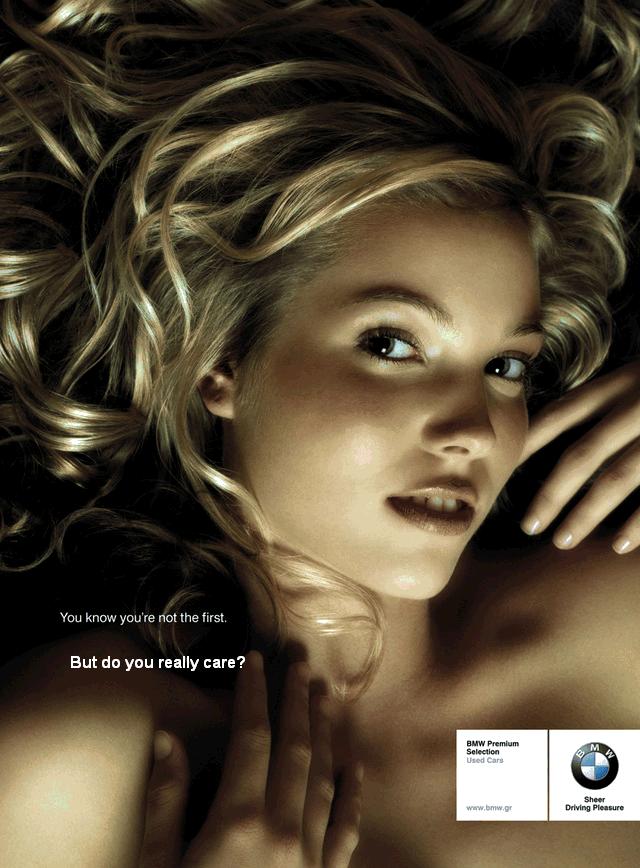
The caption with the ad says “Aston Martin’s newest advertisement for pre-owned cars” and the actual tagline is “You know your not the first but do you care?” Followed by the Aston Martin logo and name.

Not a real Aston Martin ad

It’s a great looking ad and appears genuine. However, just after the Aston Martin name are the words ‘PRE OWED.” Now this could be an extension of the gimmick or it could be slack proof reading but that’s not the case.

The truth is it’s a spoof. This image originally went viral back in early 2013 and was featured on an unofficial Aston Martin blog. What surprised me was the response of Aston Martin’s lawyers who wrote to the owner and asked him to take down the image.

In the social economy, this sort of earned media – word of mouth and viral mentions, shares, reposts and content created as a sort of homage to the brand is gold dust for savvy brands. These brands realise they can no longer control the message so encourage users to develop their own content and share it across the ecosystem. This is how a brand’s narrative develops. And to be honest, I think the discussion this ad created sits nicely with the Aston Martin Brand.

Predictably, the comments in response to the lawyer’s letter were not very complimentary and I’m happy to say that Aston Martin wrote to the blog owner apologizing for the snotty legal letter.

A real BMW ad
A real BMW ad

For the record, the same concept and tagline was used before, back in 2009 by BMW as a campaign to market their premium selection used cars in Greece and before that by a Belgium company called Nearly New Cars.

Luxury brands look to digital to attract generation AAA


Luxury brands, especially those with significant exposure to China have had a tough 2015. Swatch group annouced a 20% drop in 1H2015 profit whilst Prada saw a 25% drop in its 1st half profits, citing a slump in demand from China and Hong Kong. Jaguar Land Rover sales in China have fallen 20% in 2015 and Maserati closed its Beijing financial street showroom.

Growth in Asia was essentially driven by opening more stores, filling them with a lot of stock and mass advertising. On the whole, luxury brands ignored or at best paid lip service to digital.

This was a huge mistake as Asia’s e-commerce market is now worth US$525bn in online sales and is growing at 25% per annum. This article in CMO magazine that I contributed to, explores what went wrong and what luxury brands need to do to engage Asian consumers online.

http://www.cmo.com/articles/2015/9/14/apac-luxury-brands-navigate-new-normal.html

Seriously, is #todayishere the new Malaysia Airlines tagline?


According to marketing magazine, the new Malaysia Airlines brand was launched with what they call ‘a new branding campaign’. Now personally I don’t think you can have a branding campaign. In my opinion that’s an oxymoron but let’s not go there for now.

Marketing magazine reported that a new hashtag #todayishere is the new tagline. A hashtag is the new tagline? Is that from MAB or is that an assumption? And besides, what does ‘todayishere’ mean? Does it mean we can simply forget about the past? And what about tomorrow? How does todayishere reassure me that it is safe for me to fly or put my kids on Malaysia Airlines?

And how is todayishere going to improve the experience of interacting with Malaysia Airlines? Does anyone know? How is anyone going to build a brand narrative around todayishere? Perhaps the agency Prophet from Hong Kong can share with us the next stage of their rebrand strategy because I want to know if there is anything else to come?

Are the crew going to be trained to represent this ‘new brand?’ What improvements have been made to the key touchpoints of the brand? How will a first time user be engaged at the booking engine? Has the broken booking engine been fixed? If not, why bother with a new hashtag/tagline/rebrand launch? Why not wait till that key component of the experience is at least working properly?

Although I don’t consider ‘todayishere’ to be a tagline, it is borderline criminal to believe you can rebrand any organisation with a tagline. Just ask the Malaysian government. Almost 2 years ago to the day, they tried to launch the Malaysia nation brand with a tagline.

But you can’t retrofit a brand around a tagline. Branding is about delivering value, at every touchpoint and at everytime and on the customers terms. It’s actually very easy, provided you start from the right place, the organisation because the organisation is the brand. Not a tagline, not a hashtag, not an ad campaign, not a campaign, not a new logo. Please, someone pass the message to the Malaysia Airlines board.

Are you wasting good money on bad advertising?


I wrote a blog post recently about print ads and how I was convinced that print advertising was in decline. You can read the post here. I also shared the post on the Advertising Copywriting group on Linkedin and it generated a lot of comment, most of it ridiculing my stand. You can see the thread here.

A lot of people, especially those from the advertising industry were not very happy with what I wrote. And some of them quoted, rather predictably the mighty advertisers Coca Cola and McDonalds. Yet despite spending US$1 billion on advertising in 2014, McDonalds profits were down 15%! And are now lower than they were 5 years ago. Samsung spent US$14 billion on marketing in 2014 and suffered 3 straight quarters of losses for the first time ever.

And I asked how much have Nokia and Blackberry spent on advertising over the last 10 years to get them to the brink of extinction?

Others looked at the quality of ads, with one copywriter stating, “Quite frankly, the quality of most print ads is abominable. They are either badly written or designed, or so “avante garde” that the company’s name and logo are hidden.”

And this is a huge problem in South East Asia where, on the whole what constitutes a good ad – a strong headline or call to action, unique image, and well written copy is often lost in the charge for fast turnaround of materials, low budgets and the habit of marketing professionals not challenging bosses, business owners or even their spouses!

The results can often be catastrophic as immediately forgetable ads that fail to connect with target markets, don’t deliver the right information, are too confusing or worse, look like other ads appear across newspapers and magazines.

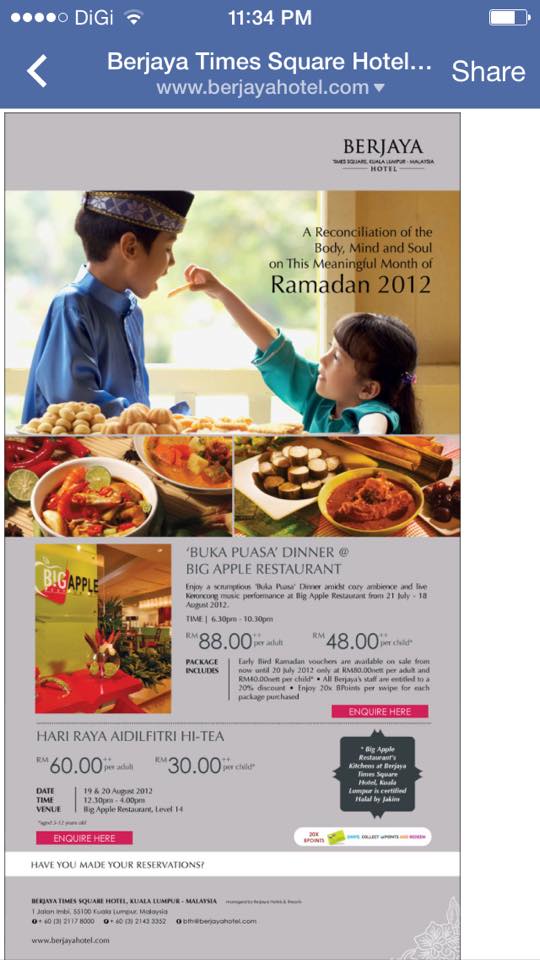
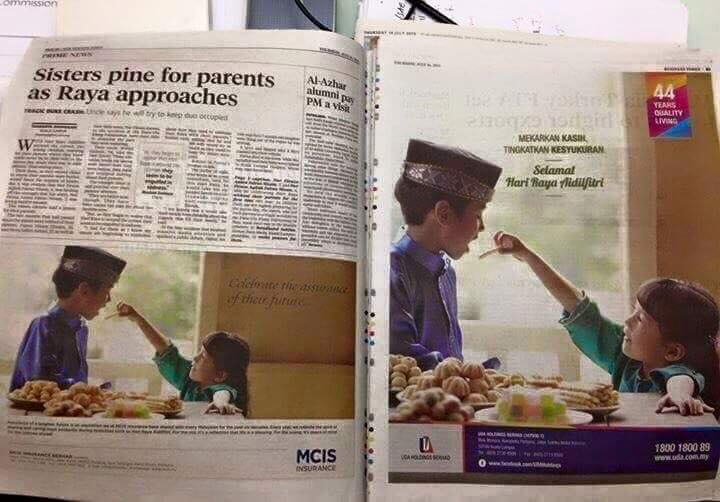
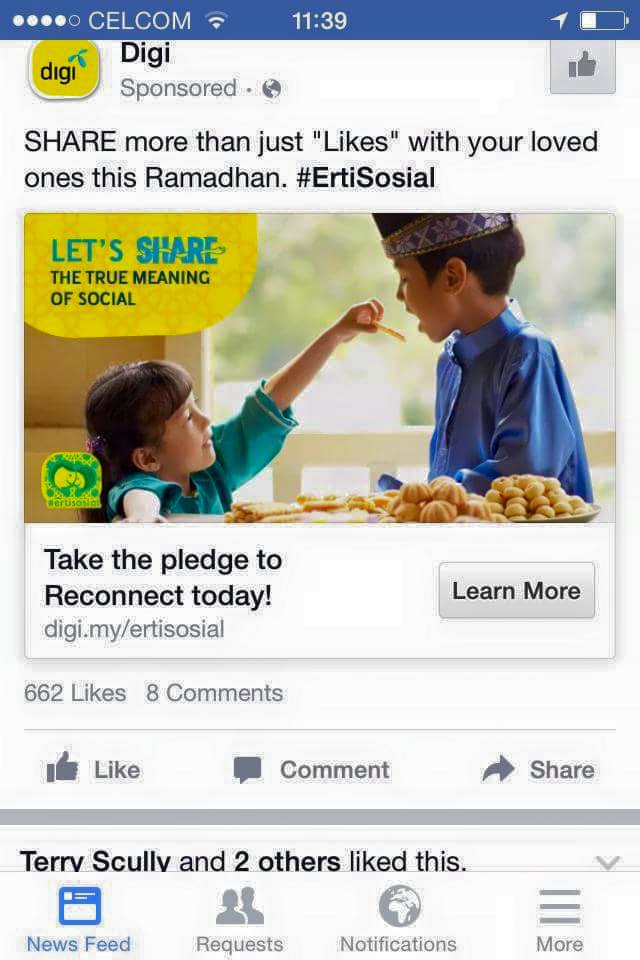
The following ads illustrate the approach to advertising in Malaysia over five years of five different companies from telecommunications, hospitality and insurance.

11698640_10155821247650416_1348248290595925206_n

11218072_10155821155380416_7420016036015256668_n

Share or reconnect?
Share or reconnect?

11705135_10155821247830416_2670629538737281677_n

Much of the copy is weak, the messages, if there are any are obscure or try to do too much and the calls to action, if they can be called that, don’t make sense and there are more than one!

But most tragic of all, they have all used the same image to try and connect with their audience.

These ads will accomplish little and are a waste of money. They have very little value for the company and will most likely be ignored by consumers. I suspect they were done in house and no doubt the image is a free download from an image bank.

I cannot imagine any professional marketing director allowing these ads to go out so one can only assume they were approved by bosses who don’t know the importance of a good ad.

Firms wonder why advertising doesn’t work and question why they should have to pay for advertising agencies. Well this sort of advertising is not the solution. Until firms appreciate the importance of a good ad, they would be better off throwing money down a drain.

This Ramadhan Coca Cola wants you to leave your prejudices at home


Memac Ogilvy Dubai and FP7/DXB Dubai, two top tier advertising agencies in the Middle East have come up with a novel idea to sell expensive sugary water.

They’ve taken a group of strangers, sat them around a dinner table in a dark room and got them to describe themselves to each other and then asked them to guess what they look like and the type of character they are.

The video has been viewed more than 8 million times on Youtube and has got over 11,000 Likes in a week.

When the lights come on and the characters are revealed, the results are predictable. And then each participant is invited to reach under the table and take out a box.

As the camera zooms into the box it is opened and we see a (drum roll) box of limited edition Coke cans without the brand name but instead the caption “Labels are for cans, not for people” printed on the can.

Throughout Ramadhan, Coca Cola bottles and cans with this caption and not the brand name will be distributed at events across the Middle East.

It’s neat and is part of Coca Cola’s global ‘Let’s take an extra second’ campaign that encourages people to stop and get to know each other. Coke has seen a rise in sales, certainly in the US but I have a sneaking suspicion that the long term outlook for sugary water isn’t bullish. Nice touch though, what do you think?

100 brilliant ads but are they relevant?


The print industry is changing rapidly. Publications are increasingly niche or evolving around new industries such as airbnb. The hospitality company with the largest inventory of beds but doesn’t own a single hotel launched Pineapple last year. It doesn’t aim to market the brand but instead inspire people to travel and of course hopefully use the company.

not selling airbnb but travel

Another new ‘investment and Lifestyle journal’ from Singapore called Cache was created not by a publishing house as a way to generate revenue but by a conglomerate with multiple interests in the luxury and related sectors.

Cache Singapore aims to grow the parent company's database of contacts.
Cache Singapore aims to grow the parent company’s database of contacts.

Although advertising revenue will help to fund the project, the main aim is to generate contacts for much more lucrative deals. These and other new publications have a different take on the publishing industry.

They are not so much worried about readership, rate cards and revenue, but more interested in reinforcing their brand values, enhancing their reputation, generating organic leads, building strategic relationships and adapting the online media platform model of being content sharers not creators.

So when I came across this interesting post called “100 brilliant print adverts” on the influential creativebloq site, I was intrigued because I thought it would be fascinating to see if the ads had a place in the new world order of publishing. Sadly, for me anyway they didn’t. Well certainly not the first 13 or so ads because after the VW ad I got bored.

Sure there was some creative genius in there as well as some comedy gold but there was also a lot of nonsense that just made me think I’d seen it all before. Traditionally, a good print ad must do six things

1) Be memorable and easy to recall

2) Connect with its audience

3) deliver useful information quickly

4) Make absorbtion of information simple

5) Don’t confuse the viewer or force them to have to do any hard work

6) Have an simple call to action

Is this a good ad?
Is this a good ad?

And historically a good print ad should include these elements

1) A strong headline

2) A unique or provocative image

3) No more than 3 paragraphs of well written copy

4) A logo and/or contact information

Is this a brilliant ad?

Advertising companies are ignoring these rules in an attempt to get our attention. But it is very hard to be creative after 150 years of advertising. And even if the creativity, the sexuality, the humour or the horror of an ad gets our attention, it doesn’t mean we’re going to interact with the brand.

Furthermore, consumers don’t engage with new brands the way they used to and besides, we are now carpet bombed by so many messages every minute of every day that most of us simply block out the noise.

Add the proliferation and fragmentation of media, the sheer number of ads, the ridiculous claims made in ads and the changing nature of how we absorb information and news means we don’t really need ads anymore.

Moreover, the concept of the ad that has to be conceptualised, created, approved, produced and distributed means it can take 6 – 12 months before a campaign sees the light of day and in that time, an idea can become obsolete.

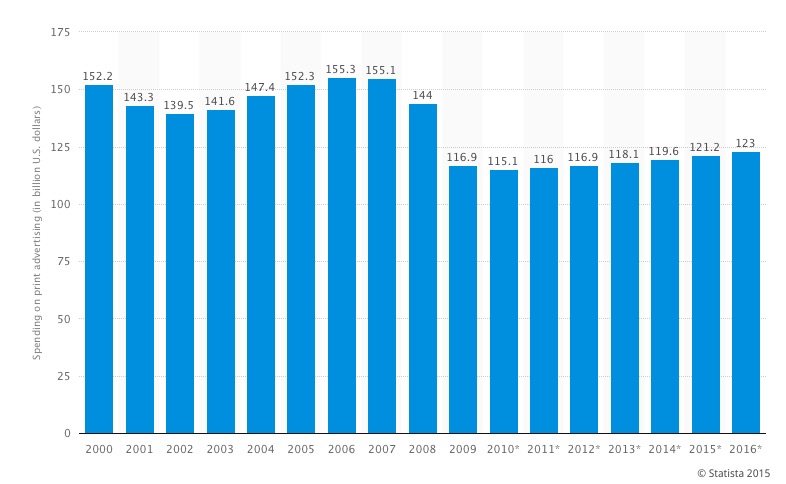
However, according to the graph from statista below, worldwide spend on print advertising has dropped from a high in 2000 of US$152.2 billion to US$119.6 billion in 2014. The same report suggests spend on print advertising will grow to US$123 billion in 2016. ad spend Admittedly that growth is maginally positive but I can’t help but think that turning up the noise isn’t going to change the fact that we’re not really paying attention to advertising anymore. I can’t help but think that in the new publishing world, we’re not interested in ads, we’re interested in what others like us have to say.

And in this environment, firms would be better off saving the money they spend on advertising and use the money saved to generate content about their business, build relationships with their customers and encourage those customers to share that content. The debate rages about whether print advertising is dying or already dead.

Personally I don’t think it’s dead but it is wounded and unless it reinvents itself, it may soon be irrelevant.

5 reasons why advertising doesn’t work


I recently wrote an article on the state of advertising which you can read here. The post went viral and I have been criticised a lot, especially on Linkedin and you can read the comments here.

I still don’t think advertising is effective. Here are 5 more reasons why advertising doesn’t work

1) I’m not looking to replace advertising. Advertising needs to get its s*** together because it is losing credibility. Moreover, much of it is ignored by consumers who spend their lives multi screening and simply tune out when they see ads.

2) Far too many companies advertise for the wrong reasons, often simply because of their ego. They get a kick out of seeing their brand on a billboard or their friends telling them they saw their brand on a billboard.

Or they advertise because everyone else is advertising but for most of them their advertising never makes an impact. I’m not talking about Unilever, Nestle and the other 8 companies that own 80% of the world’s brands because they have the kind of deep pockets most firms can only dream of. I’m talking about the rest of the companies that make up most economies.

3) My personal belief is that because so many advertising campaigns are too short and don’t run for long enough, the vast majority of advertising is a complete waste of money and that money would be better spent on brand building rather than advertising.

4) Technology has changed the way we live our lives yet we’re still doing things (in terms of advertising) the way we always did. Airlines continue to sell themselves with pretty girls and big smiles and white teeth and with a pretty child holding a teddy bear (OK no child with teddy bear in this example but you get the point).

Exotic destinations use white sandy beaches, purple seas and clear blue skies, banks use ridiculously handsome couples and children and cars use all of the above. It’s boring, unbelievable and doesn’t match the experiences of others who have been there.

And we can read about their experiences online or from our friends. And those experiences, not advertising influence our decisions.

5) Firms would be better off focussing on core branding competencies – a) strategic (inspire & aspire) – trust, credibility & communities, leadership & segmentation. b) Communications – building the narrative collaboratively and social engagement through multiple platforms. c) Execution – on brand organisation able to deliver on promises, data collection and use, monitoring &messaging and d) connection, engagement and collaboration with relevant communities and influencers.

How we do that depends on the organisation, the industry, the customers and budgets and other constraints. Advertising is bandied around as a silver bullet. Want to increase awareness? Advertise. Want to change perceptions? Advertise. Want to increase sales? Advertise. Want to increase share of wallet? Advertise. Got a crisis? Advertise. But there is no silver bullet.

Building a brand takes a strategic approach to multiple actions and requires commitment and buyin from everyone. Advertising is a tactic and for most brands – there are some exceptions, such as a new movie launch, or an exhibition or property launch – it simply doesn’t work and money spent on advertising would be better spent on building a brand.