There is a lot going on in the world of website design and development and it can be hard to keep up. As a result, some CEOs believe the only way to stand out is to give creative people free rein over the design of their website.
Now I’ve written about Lexus before and I mention them in my book (which incidentally you can buy from the Fusionbrand website) because they are spending a lot on marketing but don’t seem to appreciate the importance of the experience in the consideration process. Plus, every time I see a new billboard or print ad it seems to be telling me something different. There isn’t any consistency in their communications.
And then I saw a digital ad this morning and clicked on the link and came to this Lexus Asia website. In my opinion (and don’t forget all comments on this site are my opinion) this website is a serious contender for the worst website of 2016.
At least TRY to make your content real and believable
People today are time poor and impatient. They don’t want to sit around and wait for your complicated video to load (unless they are given an option to look at the video). And once they’ve watched the video they don’t want to have to burn up a lot of grey matter listening to a lot of nonsense and figuring out how to navigate around the site.
The Lexus Asia site looks good but is terribly complicated. It also looks different to the Malaysia site and uses a completely different approach to the Lexus Malaysia site which also has it’s own tagline.
Now following my terrible experiences with BMW, I’m actually in the market for a new SUV and I went to the site to arrange a test drive for the weekend but left angry and frustrated and without a test drive.
So if you designed the Lexus Asia website, here are 5 free tips that you might want to cut out and put on your wall.
1. Your website must be consistent and responsive. This means it must look the same on any screen and adapt to a users screen size to ensure a seamless experience. Your site isn’t the same on a smart phone, losing the consistency that is key to successful brand building.
2. Your website must be easy to navigate and have a clear, easy to follow layout. Get anywhere in three clicks or less is the general rule of thumb.
3. Flash is very last year and search engines don’t like them and some older browsers even block flash.
4. Your site should be free of clutter.
5. Make sure your video scripts make sense – “Luxury is stiff. It’s very lobster.” Seriously?
The Lexus site was overwhelming. Beautiful and creative perhaps, but it’s only there to get visitors in for a test drive, not to win an award. Oh wait, maybe that’s it!
Malaysia has joined Australia, Ireland, France and the UK by anouncing the introduction of plain packaging for tobacco products, however unlike the other countries who have announced a deadline of May 2016 for the new law to come into effect, Malaysia has not given an implementation date, saying only it will happen in stages.
Price increases and plain packaging have seen a big reduction in smoking in Australia, especially amongst teenagers so it is a logical step for Malaysia. Malaysia and other countries like Singapore have tried more traditional campaigns including shock and awe advertising but these have failed to have any long term impact on the number of smokers in the country.
Smoking statistics in Malaysia
In Malaysia, 25% of smokers are reported to start smoking before they are 10 years old. It’s not known how much smoking costs Malaysia but in Canada, a country with a lower average number of smokers but a similar sized population, smoking costs the Canadian government around RM10.5 billion in direct health care and another RM38 billion in lost productivity. Meanwhile revenue from taxes on cigarettes totaled around RM9 billion. Canada is a good benchmark for Malaysia because approximately 5.7 million Canadians smoke, about the same as Malaysia.
According to the Star Newspaper, Malaysia’s treasury generates RM3.28 billion from duty on cigarettes yet could be losing 3 times that in health care costs and 10 times that in lost productivity.
Since 1991, Malaysia has spent over RM100 million on advertising to try and reduce the number of smokers in the country and in 2003 introduced the ‘tak nak’ campaign which you can read about here which seemed to do little more than raise awareness of the dangers of smoking but did little to reduce the numbers of smokers in the country, 20,000 of whom die from related diseases every year.
According to the Guardian newspaper, global tobacco sales are more than RM2.2 trillion and generate more than RM140 billion in profits for the top six tobacco firms. That equates to a profit of RM4,000 PER SECOND of every day!
The implications for the tobacco brands are huge and they are likely to fight such steps. It’s a complicated issue but with 25% of Malaysian smokers – that’s over 1 million Malaysians – starting under the age of 10, plain packaging is a good start but it is a tactical initiative and it won’t solve the problem on its own so needs to be part of a strategic branding initiative from a strategic brand consultancy such as Fusionbrand.
This post from the poke on how to start a creative agency is actually very funny yet at the same time a sad reflection of the confusion around building brands.
Unfortunately, too many firms are under the impression you hire a creative agency to build a brand using creative driven tactics and in particular advertising, that are pushed out across media that few consumers pay any attention to. And even if the advertising is on digital platforms, it rarely understands how consumers live their lives, the environment they are advertising in and the needs of those consumers.
Too many CEOs are seduced by the creative industry
The ‘suits’ as they are called of the agency seem to have an almost hypnotic power over clients. And when they tell potential clients that the way to build a brand is with creative driven advertising that costs a lot of money they nod and write the cheque.
Then, when you ask the suits (if they haven’t moved on to another company) why the advertising didn’t work, they often blame the client and tell him that he shouldn’t have approved the initial campaign or the campaign was right but he didn’t spend enough money the first time around.
And the only way to solve the problem is do it all again and despite failing the first time, they are the team for the job. Sadly, most clients will agree and waste yet more money on a creative campaign that rarely helps build the brand.
Some advertising is very good but that doesn’t mean it works. The reality is that most advertising doesn’t work, especially with millennials who have seen their parents let down by so many products that failed to deliver on promises made through creative driven advertising. Instead they trust the opinions of their friends or others like them who share their space and their interests and have no ulterior motive but to help a friend or like minded soul.
Authentic Brand consultants understand this better than any creative agency. They know that to lay the foundations for your brand you must develop a customer centric organisation that looks at delivering economic, experiential and emotional value to customers at every touch point and every time.
Sometimes this involves advertising but more often than not, it requires nothing more than improvements to the delivery system. It’s not as cool as advertising but it is much more effective. And more often than not, it’s a lot cheaper and improvements are immediate.
For more information on the difference between a brand consultant and an advertising agency, please read this.
I’ve been looking forward to the new Malaysia Airlines (MAB) brand from both a professional and a personal perspective. Professionally, I’m eager to see what direction a global company with a huge reputation proposes for the carrier. Personally, I’m a big fan of Malaysia Airlines and have been for over 20 years. I also believe a national carrier is a critical component of any nation brand and building a nation brand is harder without a national carrier.
Right now, despite a new CEO and one presumes new management, the brand seems to be directionless. I think 3 launch dates for the new brand have come and gone and each time the date passes, there is a deafening silence from management.
Meanwhile corporate driven messages tell us the new brand focus will be on ‘making the customer experience change.’ In mid 2015 we were told that in December 2015 the airline “will begin installing new cabin seating and improving inflight entertainment, customer service and on time performance. New technology, lounge concepts and catering would be introduced and the uniforms may change.”
This is not the new cabin seating I was expecting
But I can’t find anyone who has witnessed the ‘new cabin seating and improved inflight entertainment.’ I hear complaints about the poor state of aircraft and have witnessed it myself. Delays are inevitable when launching a new brand but in a social world, these delays must be explained. There is nothing wrong with being normal.
Poorly thought out announcements are made regarding long haul flights that result in global condemnation and humiliating U turns but management remains silent. Days later, as if nothing happened, a press release is sent out about the new beginning at MAB and how the CEO will ‘boost product offerings and rebuild confidence in the carrier.’
What does ‘boost offerings’ mean? Does it mean make it cheaper? The lines between Low Cost Carrier (LCC) and Legacy Carrier have become blurred. The low cost carrier (LCC) model is familiar to just about everyone who travels. Basically you purchase the use of a seat on a (very cramped) plane and then pay through the nose for anything else such as luggage, food, drinks and even the location of the seat.
The alternative is Legacy carriers but I’m not really sure what they are. The term came out of the USA but today, seems to apply to any national airline not making money. With a legacy carrier or national airline, you pay one fee that covers everything including what should be a postive, even memorable experience.
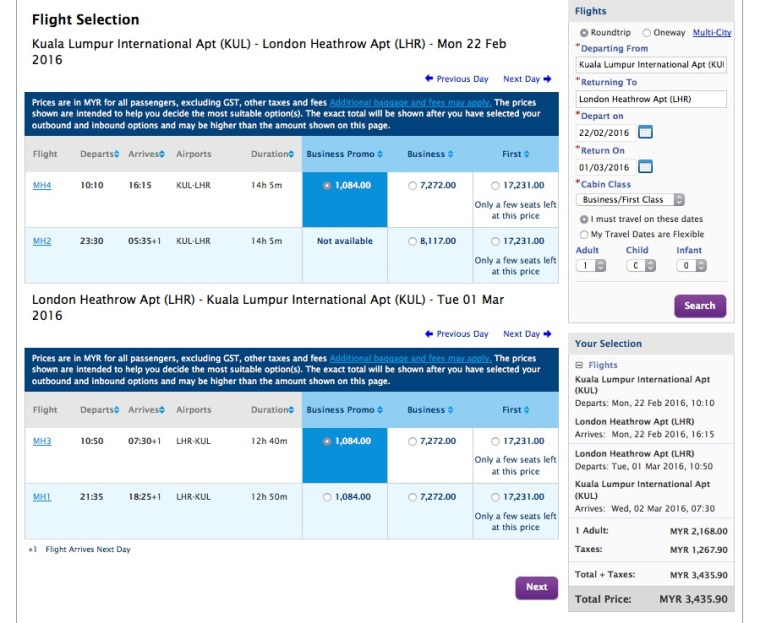
Nowadays, a lot of so called legacy carriers mimic the low cost carrier model. Many of them do it quite well, others not so well. Malaysia Airlines seems to bounce between the two. It recently offered business class seats to London at the ridiculously low return fare of RM3,400. However, just like LCCs the rate excluded GST (6%), taxes and fees and added a caveat that additional baggage and fees may apply. I didn’t check but I suspect this would have bought the figure to the same level as competitors.
MAB needs to focus on delivering on the promises it is making not slashing prices
This is a dangerous game because if Malaysia Airlines cannot compete on price with the Middle East carriers, it won’t be able to compete with LCCs like Air Asia. According to the Economist newspaper reporting on a KPMG study, “a legacy airline operating an Airbus A320 between London and Rome spends US$12,000 more on each round-trip than a low-cost airline.” Whilst the amounts may be different, the additional perceptage is no doubt the same in SE Asia.
Malaysia Airlines should focus more on improving its product than trying to discount its way through low seasons. Instead of trying to match the LCCs with their basic services and expensive add ons, Malaysia Airlines should seek to improve its relationships with its customers and offer a premium service rather than discounts, especially to its passengers at the front of the aircraft.
And it needs to start communicating with the public. Successful brands today are built on accessibility, transparency, collaboration, retention, personalisation and integrity. And consumers not companies determine the success of brands. Corporate driven press releases are not as effective as positive comments shared across social media. Malaysia Airlines needs to get its head around this.
And it must do it now because Air Asia, once the poster boy of LCCs is struggling to stay relevant and is looking to innovate. If it looks to Europe or Australia for inspiration, it will see the likes of Easy Jet and Virgin Australia morphing into legacy carriers. According to the Economist, this may leave legacy airlines “in a perilous state, regardless of their location and size.”
And before anyone says Malaysia Airlines is a private entity and doesn’t need to explain anything to anyone. Just remember that this is the 21st century not the 20th century. Consumers are smarter and acquire knowledge not from brands but from those who use them. And besides, Malaysians have invested billions in the carrier and they have a right to know what is happening and why deadlines are not being met.
If Malaysia Airlines is serious about its brand, someone needs to take charge of the communications and take charge now because I for one, don’t want to see this once great airline continue to make these elementary mistakes. Otherwise the only thing serious about the rebrand will be its inneffectiveness.
When we develop a social media strategy for a company we often have a hard time getting them to understand that there is a definite need for a well structured strategy with carefully thought out ideas and schedules. And once we’ve done that, we then have an even harder time explaining that because of it’s very dynamic nature, social media also requires the ability to have a nimble and loose approach to engagment. It’s almost a contradiction in terms.
But the ability to engage consumers and address certain issues ‘on the fly’ and in a human way is often more important and more effective than trying to push out corporate driven ideas and messages. Often, consumers will look at the way a company reacts to a unexpected situation and develop their perception of the brand based on that interaction.
A story broke today (Wednesday) about a young customer at Pret a Manger, the legendary UK sandwich bar that has grown from one outlet in London in 1984 to 374 outlets in 2015 and turnover of £500 million. Now Pret a Manger will have a social media team either in house or outsourced. That team will have a strategy but also SOPs for unique situations.
The customer purchased a ‘Chef’s special avocado and crayfish wrap’ from his local branch that he said, from the first bite was, “possibly the worst tasting item I have ever eaten. It tastes like my daughter’s sandpit.”
He went on Twitter and told the company how unhappy he was with his lunch and they responded immediately with an offer (after taking the discussion out of the public domain and into direct messages) of a free lunch as compensation.
The right people in the right place can do wonders for your brand
Impressed, he congratulated them on their service and shot off a text that was apparently a reference to a Jay Z and Kanye West song about Paris.
Pret got it immediately and responded with a pun of a Jay Z lyric from his Problems song. The customer then came back again, this time with a play on Silento lyrics which Pret responded to using a play of the Weeknd’s ‘I can’t feel my face’ song.
And so it went on for about two hours, with references to Taylor Swift, Notorious BIG, Dizzee Rascal and finally Adele.
The story was taken up by the national press in the UK with both tabloids and serious papers running stories that reached millions of British consumers in a very short time and hundreds of them commented on the issue or shared it across Facebook, Twitter and other platforms, thereby increasing the positive narrative about the brand. And all from a negative experience.
In addition to the ability of social media to cover many traditional roles, this is a great example of why it is important to have the right people with the right authority who understand the organisation’s values responsible for the brand.
Other lessons to be learned from this little exchange include
1) A humanized approach works on social media. Don’t try to be a corporation, it’s the wrong place
2) Know when to go with the flow. In other words, don’t do social, be social
3) Your customers generally have good intentions. Be nice and they’ll be nice to you
4) A sense of humour goes a long way on social media. Just like in real life, which social media is
5) There really is something called a free lunch. Well this time anyway
6) A structured social media strategy is important but knowing your contemporary music is a must. Presuming you have 2 hours to kill and your boss isn’t around
7) Social media has a reach traditional media can only dream about. So why are you still putting all your money into traditional media?
8) Who needs advertising? Seriously, who does?
9) The right social media approach gets instant results. Are you using the right model?
10) In the right hands, social media is an effective sales/marketing/advertising/customer service/retention/awareness tool. Is your social media in the right hands?
What’s the downside of this experience? There really isn’t one. The exposure was phenomenal and cost Pret nothing more than another sandwich and two hours of a social media team members time. A bit of creativity from the social media team generated more effective brand exposure than any billboard, TV or print ad could ever do. And for a fraction of the cost.
What I’m interested to see is how Pret a Manger leverages the experience going forward. If I hear anything I’ll let you know.
A new airline has been launched in Malaysia and to succeed it will need to be on top of its game. Called Rayani Air it’s based out of Langkawi and it started operations on 20th December 2015. According to the new managing director Jaafar Zamhari, Rayani Air is not a budget carrier but it flies into the budget terminal at Kuala Lumpur International Airport (KLIA) and the homepage of the Rayani Air website says it is a low cost carrier.
LCC or full service carrier?
Most intriguing of all, the carrier is being touted as a Syariah compliant airline, the first in Asia although others are classed as Syariah friendly none has used it as a key differentiator. Now I’m no expert on syariah compliance but I was under the impression that Syariah compliance is related to the financial services industry and funds that must be structured in accordance with Syariah law.
But that doesn’t mean the concept of a syariah compliant airline should be laughed at. The UK has a Muslim population of over 5% and London is pushing Dubai and Kuala Lumpur hard in an attempt to become the Islamic banking capital of the world. The country already has more syariah-compliant banks than any other country outside of the Muslim world and syariah-compliant finance funded the construction of the Shard and the London Gateway as well as much of the Olympic Village.
But creating and building a Syariah compliant airline brand is going to be a different challenge. To start with, what are the Syariah rules that Syariah compliant carriers must comply with? Who is responsible for developing those rules (the airline calls them ‘relevant authorities’ but doesn’t name them) and are they accepted universally? And will they make flyers switch brands? Who will enforce the Syariah guidelines? How will they enforce them? And what happens if they are breached? Is the carrier grounded? Or just the specific aircraft?
Remember Halal authentication differs around the world. Actually Halal certification differs in every country – in France there are 30 certification authorities. If the same happens with syariah compliant carriers, you could conceivably leave one country on a syariah compliant airline and arrive at your destination on a non syariah compliant airline. Litigation anyone?
CEO says full fledged airline, website says LCC. First rule of branding, know what you are.
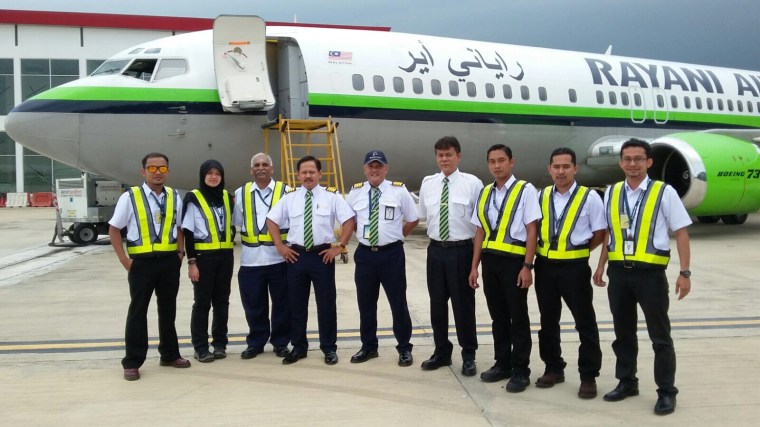
Rayani Air claims it has 2 Boeing 737s that are 22 years old and ex Malaysia Airlines stock so you know they’ve been worked hard. 355 employees including 8 pilots and 50 crew. However interestingly, not all the flight crew are Muslim which surely makes Syariah compliance tough? Rayani intends to increase the size of its fleet in 2016 and start charter flights for Umrah and the Haj.
So it’s starting with an old fleet and limited routes and it intends to grow with routes that are traditionally flown once in a lifetime (Haj) and maybe a few times (Umrah). But the opportunities for growth for these religious flights are difficult because Saudi Arabia limits the number of arrivals from each country. Currently, Malaysia is only allowed 22,320 pilgrims to Mecca and travelling with the pilgrims fund is strongly recommended to avoid horrors such as trip cancellations and paying as much as 3.5 times more.
The reality is that with restrictions on the number of pigrims allowed to fly to Saudi, it will be tough for Rayani to break into the pilgrimage markets where relationships have been forged over many years.
Rayani currently has an English language only website which may make it difficult to attract passengers from the rural destinations it is intending to fly to. The site has very limited information and a reasonably easy to use booking engine. Social media icons at the bottom of the page link back to the top of the page, not the social media pages where most potential customers will look for real life experiences before trying the carrier.
As yet, there isn’t a Google company page but there is a wikipedia page that says the airline is a full service carrier and the tagline is ‘Let’s Fly’. The company was started by two non Muslims from Malaysia and then there is the name. Rayani Air. Is it a subsidiary of Ryan Air? Or is it suggesting it could be?
I get the impression that Rayani Air intends to grow organically and that it will address communications on the fly. It might want to review that approach. It’ll need to work hard to get passengers and even harder to keep the passengers it gets in the early days. One way of doing this is to have an exceptional frequent flyer programme but I don’t see a reference to one on the website. What it doesn’t want to do is presume cheap tickets will fill planes. It’s not enough.
Getting this new aviation brand off the ground and using Syariah compliance as a differentiator is going to be a challenge but it can be done. They need a robust brand strategy that understands its customers and knows what resonates with them. Messages must quickly be determined and clearly communicated in a synchronised manner. Experiences must be sensational, better than anything else on offer at the moment and the ongoing relationship development will need to be exemplary.
The early signs suggest Rayani Air needs to up its branding game.
In my previous post I promised to report on the experience of flying Malaysia Airlines this December to see if there were any improvements in the experience following the earlier announcement that the new brand would be launched this month. These were my 40th and 41st flights on Malaysia Airlines this year so I had a decent benchmark.
The good news is that whilst 2 flights are not proof of overall improvements it can be seen as a sign of progress. I’m pleased to report the experience was a lot better than it has been for a while. The aircraft wasn’t new but it wasn’t as tatty as the one’s I’ve flown recently. The cabin crew were very professional and conveyed a confidence I haven’t seen for a while in Malaysia Airlines crew.
My return flight was delayed and I was informed of the delay via a text at least three hours before my departure time which meant I was able to continue working before leaving for the airport.
About two hours before departure, I received a call from a customer service representative who apologised for the delay. I asked him the reason for the delay and he put it down to the weather which, if you’ve been in Malaysia over the last month you will know has been rough.
I asked if I could be switched to an alternative flight and he was able to check for me and I presume, if there had been a flight available he would have transferred me to that flight. All signs of a potentially seamless brand experience.
One minor criticism, whilst waiting for my departure from KLIA I spotted an aircraft on the tarmac sporting livery from the 1980s that is celebrating an event from 2012. I really think it’s time to change the livery because it communicates laziness and a lack of urgency amongst other negatives.
This livery is celebrating an event in 2012. It’s time to apply the current livery.
The tie up between Malaysia Airlines (MAB) and Emirates is an interesting one. On the one hand, there must be money to be made from these routes otherwise Emirates wouldn’t touch them and the cost to Emirates will be minimal because they are flying all these sectors anyway.
MAB will still be able to show it offers flights on the CDG – KL route but in reality it will be an Emirates flight that goes via DXB. As a result, MAB will lose a substantial source of foreign currency and the carriers brand as well as the Malaysia brand will be diluted.
At least Malaysia Airlines passengers can use this on flights to Europe
It’ll also make it harder to sell Malaysia as a location for FDI to European companies because there are limited direct flights (to busy CEOs a 2 hour stopover in DXB each way is an expensive irritant) to the country.
On the other, it makes sense because Malaysia Airlines is now associated with the current poster boy of the aviation business (Sorry SIA) which should benefit the carrier. Although I wonder how this will work once Emirates gets a look at the weak offering MAB is, especially up the front of the bird.
It looks increasingly like Mueller wants to make Malaysia Airlines a small, regional quasi low cost carrier. That’s a tough ask in a market where loyalty is hard to come by. Whichever way you look at it, the brand is being diluted and that’s a costly shame for the carrier and the country.
I suspect there are KPIs involved that focus only on the bottom line and not on building a global brand that flies the flag for Malaysia and helps sell the country as a business and tourist destination. That’s a pity.
Flying into Kuching this morning on Malaysia Airlines the haze was so bad the pilot aborted the landing and went around again. The same thing happened last week. The haze isn’t MAS MAB fault but it has a significant impact on its brand.
Last week, the pilot came on the PA and explained the problem, reassuring everyone with his confidence and authority. This time the flight deck was silent. So we the passengers are sitting there wondering why the landing was aborted.
Without any information and aware of the carriers recent issues, we start asking ourselves, “Is there a problem with the aircraft?” or “Perhaps the airport is closed?” In that case, “Do we have enough fuel to go elsewhere?” “Are the pilot and co-pilot ill or even conscious?” An intimidating situation such as this one can have a negative effect on the brand. Yet at the same time, it can be part of the rebranding process.
It’s the little things that make or break a brand. Especially one that is already broken. A simple 30 second explanation was all that was needed to calm everyone down and earn a little bit of respect. Communication is a key part of branding. Successful brands have an emotional connection with consumers.
MAB has a credibility problem and that credibility problem needs to be fixed. One of the problems is the lack of an emotional connection. How can consumers connect with a brand that doesn’t communicate? If there is no connection the rebrand will fail. It certainly won’t be fixed with pressing the flesh, a new name, new livery, new advertising and a new logo.
It’ll be fixed by creating an emotional connection with customers and delivering economic, experiential and emotional value to those consumers.
According to marketing magazine, the new Malaysia Airlines brand was launched with what they call ‘a new branding campaign’. Now personally I don’t think you can have a branding campaign. In my opinion that’s an oxymoron but let’s not go there for now.
Marketing magazine reported that a new hashtag #todayishere is the new tagline. A hashtag is the new tagline? Is that from MAB or is that an assumption? And besides, what does ‘todayishere’ mean? Does it mean we can simply forget about the past? And what about tomorrow? How does todayishere reassure me that it is safe for me to fly or put my kids on Malaysia Airlines?
And how is todayishere going to improve the experience of interacting with Malaysia Airlines? Does anyone know? How is anyone going to build a brand narrative around todayishere? Perhaps the agency Prophet from Hong Kong can share with us the next stage of their rebrand strategy because I want to know if there is anything else to come?
Are the crew going to be trained to represent this ‘new brand?’ What improvements have been made to the key touchpoints of the brand? How will a first time user be engaged at the booking engine? Has the broken booking engine been fixed? If not, why bother with a new hashtag/tagline/rebrand launch? Why not wait till that key component of the experience is at least working properly?
Although I don’t consider ‘todayishere’ to be a tagline, it is borderline criminal to believe you can rebrand any organisation with a tagline. Just ask the Malaysian government. Almost 2 years ago to the day, they tried to launch the Malaysia nation brand with a tagline.
But you can’t retrofit a brand around a tagline. Branding is about delivering value, at every touchpoint and at everytime and on the customers terms. It’s actually very easy, provided you start from the right place, the organisation because the organisation is the brand. Not a tagline, not a hashtag, not an ad campaign, not a campaign, not a new logo. Please, someone pass the message to the Malaysia Airlines board.





 brandconsultantasia.com