AirAsia brand hits turbulence


A week ago, AirAsia X CEO Azran Osman-Rani announced to much fanfare, a new service between Sydney and Kuala Lumpur.

Soon after, the Australian Competition and Consumer Commission, (ACCC) an Australian consumer watchdog announced that it has launched a court action against AirAsia, alleging the company is misleading consumers in its advertisements for flights out of Australia.

This follows negative press after AirAsia X recently announced it was ceasing flights to London, Paris, Mumbai and New Delhi and criticism by Neil Warnock, the former manager of Queens Park Rangers football club, owned by AirAsia chairman Tony Fernandes after he was sacked.

Although the company acted quickly and decisively with offers of refunds or alternative travel at no extra cost for passengers who hold tickets for future flights to Europe and India, in terms of customer loyalty, these latest developments won’t do the brand any favours.

Especially as the airline is also copping plenty of flak for it’s opaque charging and poor engagement skills on social media, as seen by this image taken from a disgruntled customer on Facebook.

The former AirAsia fan says the image was taken down after 10 minutes when he posted it on the company Facebook page and he has since been barred from posting anything on the AirAsia Facebook page!

Hidden or extra fees add almost 100% to cost of Kuala Lumpur to London ticket on AirAsia

According to the ACCC, AirAsia’s website did not include all taxes, duties, fees and other mandatory charges when advertising fares on certain routes from the Gold Coast, Melbourne and Perth. In Australia if a company wishes to advertise part of a price, it must also advertise one total price for the product or service.

Brands are defined by the economic, experiential and emotional value they deliver to customers. Fail on any of these counts and your brand will struggle. The disgruntled Facebook customer and customers like those in this article have undone a lot of the work AirAsia has done to build a people friendly brand.

As Low cost carrier brands grow, charging extra for food and entertainment may be acceptable on short or medium haul routes but many consumers see it as unfair on long haul routes so strategic changes need to be made if they really do want to build brands.

Building a brand in the consumer economy is more than the CEO and Chairman tweeting all day. It requires a strategic plan with processes to deal with reputation issues and a willingness to engage with consumers who raise positive AND negative issues on and off line.

The reality is that AirAsia probably had little choice in cutting unprofitable routes to India and Europe.

But what it should have done was have a strategy in place to announce the changes and a plan to communicate with existing ticket holders to inform them and work with them to solve their personal issues in as seamless manner as possible.

A Facebook page with direct access to a community director and suggestions for alternative routes or airlines and how to go about booking flights would have been a tactical initiative to show the airline cared.

Such an effort may be a relatively time consuming and expensive initiative but in the social economy, one that is imperative and one that will pay retention dividends.

The Chinese are coming


Here’s an interesting thought for all destinations currently writing or reviewing their long term brand plans.

Despite the global economic meltdown, the SARS issue, Terrorist bombings in Bali, Spain, NYC and other places, the UN World Tourism Organisation writes that, “in spite of occasional shocks, international tourist arrivals have shown virtually uninterrupted growth: from 25 million in 1950, to 277 million in 1980, to 435 million in 1990, to 675 million in 2000, and the current 940 million.”

These figures have been helped, on the whole by tourists from emerging markets. Thanks to a booming economy in the 1980s, the Japanese were the first non European/North American country to have an impact of the travel industry. This outbound tourism programme was actually driven by the Japanese government which launched what it called the “Ten Million Programme” to double outbound tourism departures between 1986 and 1991.

Many Koreans also travelled overseas in the 1990s when their economy boomed and we shouldn’t forget the Arabs who have always travelled, especially to Europe and the USA.

But it is the Chinese that are really going to impact the travel and tourism industry like never before. In 2002 ‘only’ 10 million Chinese travelled overseas and those tourists spent US$15 billion.

Between now and 2021, The World Travel and Tourism Council (WTTC) predicts that up to 125 million Chinese will travel overseas and they will contribute US$100bn in overseas spending.

Chinese tourists are already making an impression in Singapore where they spend on average S$1,200 (RM2,880) each, 20% more than the average international traveller. In 1H2011, the Chinese spent S$969mil (RM2.3bil), making them the second-largest spenders behind Indonesians, who spent S$1.33bil (RM3.19bil) in the same period.

At the height of the ‘Ten million programme’, about 17 million Japanese travelled overseas. But it felt like they were everywhere and many newspapers wrote rather negatively about the arrival of the polite, shy and wealthy Japanese.

Imagine what it will feel like with over 100 million mainland Chinese interacting with the local populations in London, New York, Rome, Madrid and other cities not used to the less demure ways of middle kingdom residents!

So as you work on the research for that brand plan, should you be looking to the traditional source markets of the West and investing in 5 star resorts on white sandy beaches or gleaming shopping malls with designer labels and perhaps a casino and theme park?

Despite falling sales, Volvo still trying to use advertising to build its brand


Sadly, too many firms believe, or are led to believe that the way to build a brand is through advertising or, more specifically a series of advertising campaigns that are ever more creative, cutting edge, out of the box, off the wall or any other cool catch phrase your agency cares to throw at you.

If the budget is large enough, and it seems too many companies have too much money to play with and no accountability as to how it is spent, then the best thing the agency can do is buy lots of expensive TV air time, ‘wraparounds’ for publications, preferably daily newspapers because lots of people read them so the eyeballs will be high, above the fold pop ups on websites and lots of other expensive high profile spots.

Of course no advertising campaign would be complete without a couple of high profile billboards in high traffic areas to create awareness of the product with as many people as possible, irrespective of who they are and whether they are interested in or can afford the product.

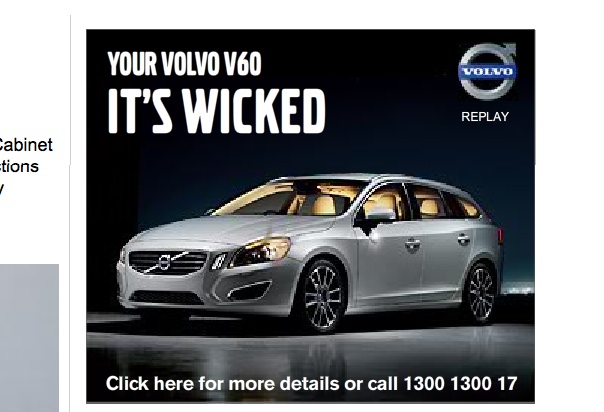
Volvo is the latest automotive brand to launch yet another new car with a creative campaign across at least print and digital media. This latest campaign expects us to believe that a Volvo is hiding a beast inside.

Are we really going to believe there is a beast inside a Volvo?
This is no longer safe, now it is wicked. Or maybe it is safe and wicked!

The above the fold digital campaign is being used to launch the new V60, T4 and T5 range and features intrusive hover or pop out ads on The Malaysian Insider and possibly other news sites. Interestingly, once the Volvo ad on The Malaysian Insider closes, there is an expandable ad for BMW beneath it!

Back in early 2010, Volvo ran a new creative campaign for the new Volvo V50 with the tagline, “There’s more to life with Volvo.” Later that same month Volvo ran another campaign featuring a man and a woman wearing parkas sitting in a pile of snow and staring at a snow covered landscape (don’t forget we’re in Malaysia which sits pretty much on the equator!) with the headline, “Volvo owners get more out of life.”

Even more confusingly, at the time there was a Volvo billboard outside my office with the tagline, “Winner of fuel efficiency award.”

In 2011, Volvo launched a new version of the S60. This time they encouraged us to “get naughty with it.” The ad claimed there are ‘naughty cars everywhere’ and that ‘naughty cars go everywhere’. The box ad features the price of the car and two links to either get naughty with the car or test drive it.

You can read more about this campaign in my post of last year which is here.

The fact of the matter is that these campaigns are not working. In 1999 Volvo sold 642 cars in Malaysia. In 2009 Volvo sold 550 cars. In the same year, Peugeot sold 1,258, VW 885, Mazda 1,444, BMW 3,564 and just to put things into perspective, Toyota sold 81,784 in the same period.

In 2010 Volvo sales increased to 839 but this was below the target of 1,100 set by the CEO. And in the same period, VW sold almost 4 times as many cars (2,810) as the year before. Mazda increased sales from 1,444 in 2009 to an impressive 4,325 in 2010. Even Peugeot increased sales from 1,258 in 2009 to 2,562 in 2010. Mazda and Peugeot do very little advertising in Malaysia.

So these creative new campaigns are obviously not working. So what should Volvo do?

1) Develop a plan to identify and target the right consumers
2) Create content that will resonate with your consumers. Better still, get consumers to generate the content.
3) Separare the acquisition strategy from the retention strategy
4) Integrate all activities across all platforms don’t just launch ad hoc tactical campaigns and hope they work. They aren’t.
5) Invest more in sales and post sales communications
6) Volvos are safe, they can’t be safe and wicked. We like the fact they are safe but we appreciate you want to attract new segments but please, keep it real or you will lose existing segments and not attract new ones.

Implementation of any creative campaign should take into account the fact that consumers are no longer impressed with well executed, high quality, brand driven commercials. Because they don’t believe what they read anymore. In Malaysia 86% of participants in a survey said they no longer believe what they read in advertisements.

A brand can no longer rely simply on ads to sell products. An integrated brand strategy is crucial to successful branding. With a recession coming, Volvo needs to get it right and get it right soon.

By the way, whilst Volvo is trying to tell us the Volvo is actually a beast and that a Volvo is wicked, Volkswagen is pushing it’s park assist in Europe. Have a look at this enjoyable <a href="

Volkswagen – Tiguan – Park Assist II (ENG) from AlmapBBDO Internet on Vimeo.

” target=”_blank”>video made for iPad.